
...located in the beautiful High Desert of Eastern Oregon
FOR SALE - Bottles & Bottle Books
& other collectibles
Click HERE to go straight to the "BOTTLES FOR SALE" pages links
| LINKS TO MY PAGES |
This and the associated linked web pages are my current listings of antique or "historic" bottles, bottle books, and other collectibles for sale.

I try to be as comprehensive as possible in describing bottle condition but am not perfect (thus the money back guarantee). Many of the "flaws" or condition issues that I point out are often overlooked by others. I also try to take representative pictures of all the bottles listed, though some bottles can defy accurate pictorial representation. Click on the highlighted link(s) in each listing description to see the picture(s) of the specific item for sale.
If you would like additional digital pictures or information, please e-mail me (link below).
If you have any concerns about the quality or reliability of my transactions, check my extensive (and perfect) eBay® buyer & (sometimes) seller feedback: eBay Feedback for jfcutter.
To help properly describe the bottles on this list or for the people who found this page and have some basic questions about antique bottles, I have another web page that is a glossary of some major antique bottle descriptive terms. It is found at the following link - Bottle Description & Condition Glossary. It includes more links to pictures to help portray some of the bottle characteristic described.
My email is -
|
Important Information For Buyers Shipping/insurance is in addition to the listed price on all bottles, books & collectibles and will be calculated at as close as I can estimate to the actual cost via the USPS website depending on the weight of the item and your zip code. No additional packaging or handling fees; I use recycled boxes and packing materials from past purchases. I will ship via USPS Ground Advantage (books via Media Mail) unless a buyer wants the item(s) sent via the now more expensive Priority Mail at additional cost.
I will ship to the U. S. and (maybe) Canada but not to other overseas addresses any longer due to the difficulty in determining shipping costs ahead of time - even to Canada at times. Insurance cost will (usually) be noted in my shipping quote back to you upon inquiry though I suppose it is optional. Insurance on items up to $100 is included in the shipping cost by the USPS if sent via Ground Advantage or Priority Mail. Above that value would be additional. I try to pack well but one never knows how packages will be treated in transit so I usually prefer having the insurance added at bottle priced and sold above that already included as noted. I offer a 7 day, no questions asked, 100% (sales price; buyer pays return shipping) money back guarantee on everything I sell! It's the only way to do "e-business."
Payment by personal check is much preferred. If not a
previous buyer personal checks may entail a 5 business day electronic clearing
time. Money orders (MO's) are accepted though they can no longer be electronically
cashed. Instead, MO's must be deposited at my credit union (Klamath
Falls ~30 miles away) and I only go to town once or twice a week which may
entail a
shipping delay. My mailing address for sending payment will be provided via email once the total price - with shipping/insurance - is determined. Please confirm item availability prior to sending any type payment and include your zip code in your message so that the shipping can be calculated. |
 For
an idea of the shipping costs, click on the following USPS link to calculate the
cost from my zip code of 97624 -
For
an idea of the shipping costs, click on the following USPS link to calculate the
cost from my zip code of 97624 -
I also have a books-for-sale (non-bottle books) list if you click on the following link: BOOKS FOR SALE. Though limited in scope, this list has a variety of books, with an emphasis on Western Americana books.


ANTIQUE BOTTLES FOR SALE
▪The bottle categories are listed in the menu below.▪Click on each category link to move to that section.
▪The first category - "Western American Bottles" - is on this webpage below.
▪The other categories are on separately linked pages.
▪Use the browser back arrow to return to this menu from any of the category pages.
Click on the thumbnail picture, highlighted title links, or other links within each listing to see pictures of the bottles described.
My email is -
Western American Bottles
Liquor/Spirits

 WOLTERS
BROS / & CO / 115 AND 117 /FRONT ST / S. F.
- According to the late John Thomas's most recent though posthumous "Whiskey
Bottles of the Old West" (2002) Henry Wolters first began the wholesale
liquor business in San Francisco in 1872 with a partner (Charles Fecheimer) at
the corner of Third & Market Streets. They moved to 221 California St in
1874. In 1878 the partner sold his interest in the business to Henry's
brother August in 1878 - the business name changing to Wolters Brothers.
They moved again to the address embossed on this bottle - 115 and 117 Front
Street - in 1885. The company lasted until 1896 then apparently went out
of business according to Thomas with another wholesale liquor company listed as
occupying that address in 1897. Maybe the brothers were bought out?
(Note: There is an almost identical plate mold - aka "slug plate" to collectors
- cylinder that has the 221 California address on it instead of that on this
bottle. It is quite a bit rarer and listed as #176 in Thomas's book.
This offered example is the last cylinder listed at #177.)
WOLTERS
BROS / & CO / 115 AND 117 /FRONT ST / S. F.
- According to the late John Thomas's most recent though posthumous "Whiskey
Bottles of the Old West" (2002) Henry Wolters first began the wholesale
liquor business in San Francisco in 1872 with a partner (Charles Fecheimer) at
the corner of Third & Market Streets. They moved to 221 California St in
1874. In 1878 the partner sold his interest in the business to Henry's
brother August in 1878 - the business name changing to Wolters Brothers.
They moved again to the address embossed on this bottle - 115 and 117 Front
Street - in 1885. The company lasted until 1896 then apparently went out
of business according to Thomas with another wholesale liquor company listed as
occupying that address in 1897. Maybe the brothers were bought out?
(Note: There is an almost identical plate mold - aka "slug plate" to collectors
- cylinder that has the 221 California address on it instead of that on this
bottle. It is quite a bit rarer and listed as #176 in Thomas's book.
This offered example is the last cylinder listed at #177.)
Like most - but not all - of the plethora of mouth-blown Western liquor cylinders made from the late 1860s to National Prohibition this bottle is just embossed on one side, the reverse being plain. Click reverse view to see such which is where the long gone label would have been; what brands of whiskey they sold I have no idea. The embossing on this example is typical - comparatively sharp and bold given the thin engraving the plate received. Click close-up of the embossing to see such. The base is moderately domed in the center and of the #1 type that Thomas described as that found on the majority of older Western whiskies made between 1870 and 1890. Click view of the base to see the early type base this example has. (It also has some interesting crudity.) The lip has a moderate "drip" to the base of the applied then tooled "brandy style" finish. The tallest one (top to bottom) is shown in the image to the right; click to enlarge. There is also a horizontally wider but less tall drip on the opposite side (not pictured) just below the base ring. The glob top, applied finish examples are the ones most desired by collectors of Western liquor bottles though these were also made with tooled finishes probably until the company bit the dust in the mid 1890s. I don't know the ratio of glob/applied finishes (like this one) to tooled finishes but these globs are by far the most desired and probably much less common that the tooled lips.
The specifics details of this bottle are that it is a standard "fifth" in size (1/5th of a gallon), is just under 12" tall and the glass is a nice, bright medium amber in color. Thomas notes that most of these cylinders have air venting at the shoulder though this one does not (and I've looked hard). So this is likely an early example from the mold prior to air venting (?) probably dating from about 1885 to maybe 1887. The bottle has moderate crudity in the form of a nice smattering of teardrop bubbles here and there and ample stretch marks to the neck. There isn't any whittling to the glass but the crude neck has a couple very small unmelted "stones" which have no radiations whatsoever. There are no cracks, chips, nicks, scratches, staining or other post production issues - it is essentially perfectly as it left the glass makers which was almost certainly the San Francisco & Pacific Glass Works. This bottle was used for illustrating two differently embossed cylinder liquor bottles which were almost certainly made in the same mold - using different plates - the other being the Thos. Taylor & Co. P. Vollmer's Old Bourbon plate mold bottles. (Both are shown at the following link on my other Historic Glass Bottle ID & Information website at the following link - https://secure-sha.org/bottle/body.htm#Plates%20&%20Plate%20Molds ) These cylinders don't show up much any more and though not exceptionally rare they are a great addition to anyone's Western collection. One of the few I've seen on eBay was recently and it sold for $943 and it was certainly no better than this example. $850

 SIMMOND'S
/ NABOB / TRADE (Sultan with hookah and attendant) MARK / PURE / KY BOURBON /
WHISKEY - All this embossed on this well known but quite scarce,
full faced, Western "picture" whiskey cylinder fifth. This example is
listed in the late John Thomas's most recent book (2002) as #142A and is the
earliest of this short series of cylinders
dating from the late 1870s to early 1880s. Apparently this whiskey was
advertised in 1882 as being "Strongly recommended by the medical
faculty (what "faculty" isn't noted!) for all cases of nervousness,
dyspepsia, chills, etc..." Like many high alcohol products of that
era, it was purported to have high medicinal value. (Reminds me that my
dad always noted that his stops at the state liquor store in Oregon were needed
to get his "medicine"!)
SIMMOND'S
/ NABOB / TRADE (Sultan with hookah and attendant) MARK / PURE / KY BOURBON /
WHISKEY - All this embossed on this well known but quite scarce,
full faced, Western "picture" whiskey cylinder fifth. This example is
listed in the late John Thomas's most recent book (2002) as #142A and is the
earliest of this short series of cylinders
dating from the late 1870s to early 1880s. Apparently this whiskey was
advertised in 1882 as being "Strongly recommended by the medical
faculty (what "faculty" isn't noted!) for all cases of nervousness,
dyspepsia, chills, etc..." Like many high alcohol products of that
era, it was purported to have high medicinal value. (Reminds me that my
dad always noted that his stops at the state liquor store in Oregon were needed
to get his "medicine"!)
Thomas also notes that many of these were found in Nevada in the usual mining camp areas like Hamilton, Eureka, and Virginia City as well as the Sierra Nevada and some other mining areas in California. Although a San Francisco bottled product (George Simmond's & Co. in business from 1877 to 1888 according to Thomas) these were one of the earlier German made "Western" cylinders dating from the noted range above.
As with most all of these type amber to red-amber German made Western-used whiskey cylinders this example has a nice and sloppy applied top (click applied top to view such), heavily whittled throughout the body, a high slightly pointed/domed base, and a color that is a medium orange to somewhat reddish amber getting redder towards the base as the images show. This is a beautiful window bottle with that color and crudity! Condition is very good to excellent (aka close to mint) with some very minor light wear/scuffing in a few places (largely on the back) but no chips, cracks or other post-manufacturing damage. Thomas's book lists the mid-range value of these at a seemingly high $2500; this very nice example is offered for significantly less. $850
SPRING VALLEY / WINE CO.
/"THE BIG STORE" /2ND
& YAMHILL / PORTLAND, ORE. - This is all embossed within
a

 plate - called a slug plate by collectors - as evidenced by the relative
distinct and slightly indented to elevated plate edge circle around the
embossing; it is not an embossed circle. The lower body also reads FULL
PINT with serifs on the lower body. These early 20th century style
flasks - this being a "Eagle" style (see my educational website discussion on
this style at
https://secure-sha.org/bottle/liquor.htm#Eagle%20Flasks ) are often quite rare,
or at least as rare as their coffin, shoo-fly and picnic flasks cousins, but don't get
quite the collecting interest as those slightly older (though often contemporary)
brethren. These are still very interesting pre-Prohibition liquor flasks
which are often quite hard to find as they were usually made for a relatively
limited time.
plate - called a slug plate by collectors - as evidenced by the relative
distinct and slightly indented to elevated plate edge circle around the
embossing; it is not an embossed circle. The lower body also reads FULL
PINT with serifs on the lower body. These early 20th century style
flasks - this being a "Eagle" style (see my educational website discussion on
this style at
https://secure-sha.org/bottle/liquor.htm#Eagle%20Flasks ) are often quite rare,
or at least as rare as their coffin, shoo-fly and picnic flasks cousins, but don't get
quite the collecting interest as those slightly older (though often contemporary)
brethren. These are still very interesting pre-Prohibition liquor flasks
which are often quite hard to find as they were usually made for a relatively
limited time.
According to the late John Thomas's excellent 1998 book Whisky Bottles and Liquor Containers from the State of Oregon "Starting sometime during the year 1909 the Spring Valley Wine Company opened its doors at 242 and 244 Yamhill in Portland. The Shapiro brothers George and Joseph opened it. It was a wholesale operation only. The company lasted until closed by Prohibition in 1915." So these date sometime between 1909 and 1915. Oregon's statewide Prohibition began on January 1st, 1916 preceding full National Prohibition by 4 years (lucky state...ha). Although Thomas noted it was a "wholesale operation only" the fact that they bottled some of their products in these flasks - which come in pint and half pint sizes - indicates that they at least sold some in smaller quantities...or these flasks were give away items for holidays, special customers, or ??? Interestingly, the flasks were blown in the "Dandy Style" as well as this "Eagle" style; the Dandy being quite similar but without the ring on the neck. (See the following section of my educational website on "Dandy" style: https://secure-sha.org/bottle/liquor.htm#Dandy%20Flasks ) Both sizes in the Eagle and Dandy style seem to be equally rare; they are all seldom seen flasks. This is a duplicate pint for me with the one I've had for years being blown in a slightly fatter and shorter Eagle flask mold (and the FULL PINT is non-serif lettering & it has double rings at the base of the neck) but with the same plate obvious upon close inspection.
This particular flask, as noted, is the pint size with the "serif" lettering for FULL PINT. It is 9.3" tall, made in a now slightly pink (amethyst) glass, and has a tooled "brandy" style lip or finish. This particular mold also has a bunch of faint (but visible in the images) "peen" or "rivet head" markings on the body above the plate (7 circular marks) and on the back upper body (3 marks). Why? No idea except something to do with the formation or alteration of the mold and an interesting crudeness at a time (late mouth-blown era) when crudeness was less common although this flask also has an assortment of bubbles in the glass. It is in very good condition with one tiny pin prick mark on the lip edge, a small impact mark on the back base (about pin head sized), a few external abrasions and some very light, scattered content haze here and there. Overall a very nice and hard to find pre-Prohibition flask. $75

 CROWN
DISTILLERIES / (crown above double shield with CDCo monogram inside) / COMPANY
- That is all embossed within an oval on the body of this fifth sized liquor
bottle from San Francisco. It has inside threads and includes an original
hard rubber stopper with essentially the same "embossing" on it. Click
HERE to see a close-up of
the stopper which is in pretty good condition with a little bit chipped off one
side.
CROWN
DISTILLERIES / (crown above double shield with CDCo monogram inside) / COMPANY
- That is all embossed within an oval on the body of this fifth sized liquor
bottle from San Francisco. It has inside threads and includes an original
hard rubber stopper with essentially the same "embossing" on it. Click
HERE to see a close-up of
the stopper which is in pretty good condition with a little bit chipped off one
side.
These bottles like the Van Schuyver listed above likely contained a popular spirits product - Cyrus Noble Whiskey - and span a pretty wide time frame from at least the 1880s to National Prohibition at the end of 1919. This company was connected with the Lilienthal (San Francisco) and W. J. Van Schuyver (Portland, OR.) companies as briefly discussed above in regards to sharing the same stoppers in their inside threaded bottles. Most of the bottles used by the three companies had essentially the same monogram of the crown over a shield with the initials inside the shield varying with the company. This particular example likely dates from the 1900 to 1910 era.
As to the details of this bottle it is the same height and general conformation as the Van Schuyver above measuring about 11.25" tall without the stopper. The color is a bright medium amber, has some scattered bubbles in the glass and a tooled inside threaded finish with the noted stopper. Condition is essentially mint with no cracks, chips, dings or significant staining...maybe just a bit of dirt on the inside and a few minor and non-distracting scuff marks. This example was found out in the woods of the Cascades near Klamath Falls many years ago and given to me since the person was not a collector. Time to pass it on as I've too many bottles. $30

 W.
J. VAN SCHUYVER / & Co (crown & double shield with V monogram) INC / PORTLAND,
OR -
That embossing is inside an embossed square and is probably the 6th oldest mold
used by the company which used a total of 9 different mold varieties.
This example is what I call mold 6a as there are bottles made
from the same front and back mold halves, but a different base
plate; or the original base plate with the letters
P.C.G.W. engraved part way through the molds life.
This indicates that the both variants were manufactured by the
Pacific Coast Glass Works in San Francisco. The
examples with the base embossing I call mold 6b. Like most
of the Van
Schuyver cylinder molds this is not a true plate mold but instead an embossed
square.
W.
J. VAN SCHUYVER / & Co (crown & double shield with V monogram) INC / PORTLAND,
OR -
That embossing is inside an embossed square and is probably the 6th oldest mold
used by the company which used a total of 9 different mold varieties.
This example is what I call mold 6a as there are bottles made
from the same front and back mold halves, but a different base
plate; or the original base plate with the letters
P.C.G.W. engraved part way through the molds life.
This indicates that the both variants were manufactured by the
Pacific Coast Glass Works in San Francisco. The
examples with the base embossing I call mold 6b. Like most
of the Van
Schuyver cylinder molds this is not a true plate mold but instead an embossed
square. These bottles contained a pretty popular product - Cyrus Noble Whiskey - and span a pretty wide time frame from at least the late 1880s to Oregon's "early" statewide Prohibition at the end of 1915. This Portland based company was connected with the Lilienthal & Crown Distillery Companies (San Francisco) since the Van Schuyver bottles with inside threads come with hard rubber stoppers that are embossed either with LILIENTHAL & CO (and their "L in a shield below a crown" monogram which this example has), or with (as this one is; click HERE to see the cap close-up) CROWN DISTILLERIES COMPANY (and the "CDCo. in a shield below a crown" monogram) or just a six pointed star with no name.
In retirement I've been accumulating and studying the different molds used for this company's cylinder fifths. I believe I have all of the variations of the molds dating from the late 1880s until statewide Prohibition began in 1915 - 5 years earlier than National Prohibition. There are also variations within some of the mold types which are found with both cork and inside thread finishes or lips; others have just corks or just inside threads, but not both. Also the earliest, true "slug" plate example comes in both closure types with both tooled and true applied lips. Four slightly different conformations from just one mold! The company was incorporated in 1901 so all those with INC embossed date after that time, though the last mold variant without INC embossed may have been still in use in 1902 or 1903 depending on how quick the company went through their bottles. This example dates from around 1905 give or take a few years as the PCGW company didn't use that name until 1903.
In any event, this example has a height (without stopper) of 11.25" and the color is a rich, bright medium amber; the images show the color well to my eye. It has a tooled inside threaded lip/finish typical of the era it was made. There surface is glossy with no straining glass inside or out and very little scuffing. The only issues are a bit of roughness to the rim of the bottle under the cap; click close-up of the rim to see such without the cap on. Some or all of it may be in making or not; it isn't too distracting and totally invisible with the cap on. There is also a "peck" mark at the front base edge that is a bit bigger than a pin head. All in all this is a pretty good example of a Northwest favorite - yesterday (full) and today (empty). $25

 STAR
(asterisk?) BASE EMBOSSED, 4-PIECE MOLD, APPLIED LIP, WESTERN MADE CYLINDER
SIXTH - Offered here is a relatively rare, Western blown
cylinder sixth (6 to the gallon) that was found on private land near Klamath
Falls, OR. a few decades ago. Specifically, it was found on the Running Y
Ranch back when it was an actual ranch owned by the Disney Corporation (it is
now an upscale resort, vacation and housing area) by a timber "cruiser" cruising
(marking trees for selective cutting) for a future timber sale. Not being
a bottle collector the owner gave it to me years ago and I used it as an example to illustrate
the category of tall cylinder liquor bottles which were used widely by Western
American liquor companies though the style was also used throughout the
US. (See the write-up on it at the following link:
https://secure-sha.org/bottle/liquor.htm#Tall%20slender%20bodied%20straight%20neck%20spirits%20cylinders
)
STAR
(asterisk?) BASE EMBOSSED, 4-PIECE MOLD, APPLIED LIP, WESTERN MADE CYLINDER
SIXTH - Offered here is a relatively rare, Western blown
cylinder sixth (6 to the gallon) that was found on private land near Klamath
Falls, OR. a few decades ago. Specifically, it was found on the Running Y
Ranch back when it was an actual ranch owned by the Disney Corporation (it is
now an upscale resort, vacation and housing area) by a timber "cruiser" cruising
(marking trees for selective cutting) for a future timber sale. Not being
a bottle collector the owner gave it to me years ago and I used it as an example to illustrate
the category of tall cylinder liquor bottles which were used widely by Western
American liquor companies though the style was also used throughout the
US. (See the write-up on it at the following link:
https://secure-sha.org/bottle/liquor.htm#Tall%20slender%20bodied%20straight%20neck%20spirits%20cylinders
)
These bottles with the star or asterisk on the base are firmly attributed to the San Francisco and Pacific Glass Works (SF&PGW) or if they predate about 1876 (not likely in my opinion) to either of those companies prior to their merging in that year. There are various body embossed liquor and some food bottles that have similar markings on the base which were virtually certain to have been made in the Bay Area, although the markings can vary. For example the "curved R" examples of the Fleckenstein & Mayer (a Portland, OR. liquor Co.) cylinder fifth and pint "knife edge" flask both have similar markings except it is a 4 pointed (instead of 8 pointed) version more like a + with pointed ends like this bottles marking. In any event these are Western made and used bottles.
This example is a bit over 11.5" tall, 2.75" in body diameter (fifths are more like 3"), has a crudely applied "brandy" finish with some slop below, and was blown in a four piece mold. Click close-up of the shoulder to see the mold lines in that area reflecting its four piece mold production. Click close-up of the shoulder, neck and finish/lip to view such. The glass color is wonderful in that it is a light to moderate density yellow amber with a bit of a green tint thrown in for fun. I've heard this called "old amber" though that isn't very informative. The images show the color pretty well. Following is also a link to the same bottle in a window with a couple of related "fifth" cylinders on each side which were likely blown at the same SF&PGW - window image. (That linked image shows the bottle as more yellow with little green, though to my eye the images to the right here show the green hue more accurately. The fifth on the left is a standard medium amber; to the right a more medium chocolate amber.)
Condition is just about perfect with no chips, cracks, dings, potstone bruises or other like issues. It has no staining as it was found on top of the ground in some ponderosa pine duff. It does have a very faint, very narrow meandering scuff line on one side which may have just been from when it was made or possibly when filled and/or shipped? It is barely visible and non-distracting and takes nothing away from the visual condition. Some scattered bubbles, stretch marks in the neck and wavy - whittled in places - glass round out a very nice, Western made spirits bottle. I've seen a couple of examples from the apparent same 4-piece mold sell (eBay) for $250 or more the past couple years including an essentially identical star/asterisk base (my offering has a much bolder star; see image to right), 4-piece mold example that sold for $485 in September 2023! It did have a bit more crudeness and a bit sloppier top but was otherwise identical to this example in size and glass color. This is also one of the oldest bottles (ca. 1880 give or take a few years) I know of found in Klamath County. (More of less contemporary with this bottle would be a Fleckenstein & Mayer cylinder reportedly (by John Thomas) found 40-50 years ago near Fort Klamath. I have an example of that rare bottle which also has a similar but not identical marking (as noted earlier) on the base and was certainly made by the SF&PGW also. I'm sure there were a few older bottles found in the Klamath Basin long ago as Klamath Falls was founded in 1867 as Linkville.) Great example with great provenience. $165

 JOHN
KREMER / WALLA WALLA / WASH. - This is - as best I can determine -
an unlisted Washington "saloon" flask from the "town so nice they named it
twice" - Walla Walla, Washington. John Thomas noted in his book "Whiskey
Bottles and Liquor Containers From The State of Washington"
(Thomas 1998) that "Even though I had reports that John Kremer was in Walla
Walla in 1883 having the Schwartz Saloon up to 1905, my research shows him first
listed in 1905 in business with a Mr. Hansen in 1905." He goes on with "By
1907 he was in business by himself. Research by Francis Christiano of Walla
Walla shows him having the Schwartz Saloon up to Prohibition in 1915."
JOHN
KREMER / WALLA WALLA / WASH. - This is - as best I can determine -
an unlisted Washington "saloon" flask from the "town so nice they named it
twice" - Walla Walla, Washington. John Thomas noted in his book "Whiskey
Bottles and Liquor Containers From The State of Washington"
(Thomas 1998) that "Even though I had reports that John Kremer was in Walla
Walla in 1883 having the Schwartz Saloon up to 1905, my research shows him first
listed in 1905 in business with a Mr. Hansen in 1905." He goes on with "By
1907 he was in business by himself. Research by Francis Christiano of Walla
Walla shows him having the Schwartz Saloon up to Prohibition in 1915."
Thomas also noted that "Bethman and Larson working on their flask book for the state of Washington turned up another Kremer flask showing him also in business with a fellow named Knox during 1907 and 1908." (Note: I wonder if that book was ever published as I've never heard of it and I have almost every bottle book published.) That flask is embossed with KREMER & KNOX / BANK EXCHANGE /WALLA WALLA, WASH. and is a "clear glass half pint oval type flask that is similar to what Putnam in "Bottle Identification" calls a basket swirl type...(with)...a brandy type finish." Putnam's (1965) book is simply a reprint of the Illinois Glass Company's (IGCo.) 1911 catalog and it simply calls the style a "basket flask" which was available at that time as a 6 oz. "half-pint" and 12 oz. "pint" (so called 'scant sizes').
Thomas further notes that "The only bottle known for John Kremer by himself is a clear glass, pint Washington flask." This flask, however, is the "half pint" sized (actually a scant 6 oz. at most) "Olympia" style flask and not as described in his book. Maybe the pint is a "Washington flask" but I suspect Thomas was misinformed? The Olympia flask was a patented (August 9th, 1898) by the IGCo. - a fact which is also embossed on the base of this flask (click base image to the right to see a larger version). See the following link to the page (left page) in the 1906 IGCo. showing an illustration of the flask an array of sizes including a 6 oz. "half pint" like this flask. https://secure-sha.org/bottle/Typing/IGCo1906/IGCo1906page172.jpg That page also notes that at least 5 sizes - including the 6 oz. - were available as "plate moulds"...just like this flask. The flask is shown in the 1903, 1906, 1908 and 1911 IGCo. catalogs which fits with Thomas's history based dating of Kremer in the saloon business from 1905 to 1915 (Prohibition in Washington).
So is the bottle unique? I don't know, but it is the first one I've ever seen. The bottle is 7" tall, colorless/clear glass, and has a unique tooled finish that I've is only seen on some very late 19th into the very early 20th centuries. flasks though a finish that is common on this style flask though the IGCo illustration makes it look more like a "champagne" style banded finish. I know of no particular name attached to this finish. The reverse side of the flask is not embossed - click reverse view to see such. The bottle is in quite good shape with a patch of light white-ish water staining in the inside front below and to the left of the circular plate outline which shows in the image to the left (click to enlarge). Other than that inside staining the glass is sparkling and clean. The one post production flaw is there is a shallow flake/rough spot about 8 mm wide and 3-4 mm tall on the back side of the lip/finish that is hard to photograph. Click view of the lip flake to see the shallow chipped area circled. For another view click another view of the chip which shows the location on the backside of the lip. Probably a key flask to have for a Washington liquor bottle collector...so priced to reflect the rarity with a discount for the lip flake. $150

 WARRANTED HALF PINT / FULL
& HONEST MEASURE / ABSOLUTELY PURE / PURCHASED IN BOND / BOTTLED BY / FRANK
WALKER / BUTTE, MONT. - That is all embossed on 7 lines
(likely a record for this size of bottle!) within a
plate (plate mold bottle) on this 8 oz. druggist style bottle that was used for
whiskey! I procured this bottle to illustrate the cross-over of bottle
types that is often seen in mouth blown bottles for my
SHA/BLM Historic
Glass Bottle Identification & Information Website (aka Historic Bottle
Website or HBW). This is a great
example of one type of bottle (druggist) being used for a quite different
product (liquor), i.e., a de facto liquor "flask" in the shape of a typical rectangular
druggist style bottle. Here is the write-up that I did for the HBW about
this bottle and some of the interesting history behind it which includes just
being from Butte, Montana during the hey day of the copper mining:
WARRANTED HALF PINT / FULL
& HONEST MEASURE / ABSOLUTELY PURE / PURCHASED IN BOND / BOTTLED BY / FRANK
WALKER / BUTTE, MONT. - That is all embossed on 7 lines
(likely a record for this size of bottle!) within a
plate (plate mold bottle) on this 8 oz. druggist style bottle that was used for
whiskey! I procured this bottle to illustrate the cross-over of bottle
types that is often seen in mouth blown bottles for my
SHA/BLM Historic
Glass Bottle Identification & Information Website (aka Historic Bottle
Website or HBW). This is a great
example of one type of bottle (druggist) being used for a quite different
product (liquor), i.e., a de facto liquor "flask" in the shape of a typical rectangular
druggist style bottle. Here is the write-up that I did for the HBW about
this bottle and some of the interesting history behind it which includes just
being from Butte, Montana during the hey day of the copper mining:
As with most types of bottles it was ultimately up to the purchaser/user of the bottle to determine what they wanted to put in the bottle. In the case of the bottle to the right (click to enlarge) what was placed in the bottle was various Amercian whiskies including Old Crow, Black Thorn, Kentucky Turf, Woodland and others. Like the Wm. D. Barry bottle above this rectangular bottle was used for liquor though is essentially a classic druggist bottle shape. In addition this "whiskey" bottle is boldly embossed as follows: WARRANTED HALF PINT / FULL & HONEST MEASURE / ABSOLUTELY PURE / PURCHASED IN BOND /BOTTLED BY / FRANK WALKER / BUTTE, MONT. The bottle is about 7" tall, has a tooled "prescription" finish, mouth blown and embossed via a plate inserted into an accommodating plate mold and is rectangular with slightly rounded outward narrow sides. Click base view to view a cross-section of the bottles shape.
Some internet searching by a member of the Bottle Research Group (thanks Bob!) found that Frank Walker arrived in the Montana Territory in 1887 according to "A History Of Montana" (Sanders 1913). He did various jobs (miner, retail liquor business, mining property developer, saloon bartender) but by 1901 was a retail liquor dealer at 12 Park St. in Butte, MT. doing $100,000 in business by 1913 and probably until 1920 when National Prohibition likely killed the business. Mr. Walker early on advertised in The Butte Miner that "The family trade will be solicited" by the wholesale business ( connected to his saloon!), "That the finest liquors for medicinal use will be kept in stock" and "Goods will be sold in quantities of full gallons, quarts, pints and half pints (emphasis mine)" (The Butte Miner Dec. 10, 1901). The pictured bottle is one of several very similar variations of half pint "druggist" style bottles he used during those years.
As the base view linked earlier shows, this bottle is also embossed on the base in script lettering with ENGLISH which is almost certainly a glass maker proprietary name for that style druggist bottle. Several very similar to almost identical Frank Walker embossed half pint liquor bottles have the Western Bottle Manufacturing Co. (W.M.B.Co.) makers marking on the base (although no ENGLISH embossed) so it is quite possible that this bottle was also made by that Chicago based company. Another identically embossed Frank Walker bottle of the same 8 oz. capacity actually has druggist type graduation markings down both sides of the embossing (also a plate mold) as well as the stylized "3" at the top of the shoulder which is typical of early 20th century druggist/prescription bottles. (Note: The same plate was used to produce at least one of the non-base embossed examples I've seen online.) Click Frank Walker bottle variation to view an image of a graduation markings version. Graduation markings are discussed in the section of the Medicinal bottles page at the following link: https://secure-sha.org/bottle/medicinal.htm#Druggist%20Bottle%20Dating%20Summary/Notes
Interesting, eh?! Like an assortment of "Family Liquor Store" bottles from the same early 20th century era in Portland, OR. and elsewhere, this weak appeal about the family nature of liquor stores was a last stand reaction to the Temperance movement which consummated with the passage of National Prohibition. That constitutional amendment took affect in early 1920 even though many states had already gone "dry" prior to that (Oregon & Washington in 1915). This interesting bottle is as described in the excerpt above and in absolute perfect "mint" shape with sparkling clean glass and no chips, cracks, cracks or any post-production damage...looks like it did the day it was blown, i.e., first decade or so of the 20th century. Click upper body, neck and finish to see such which shows the sparkling nature of this bottle. It also has the tiniest tint of pink to the glass indicating that it was decolorized with manganese dioxide to achieve the essentially colorless glass. Nice bottle from Butte, Montana and apparently fairly rare, especially in this pristine condition! $95

 L.
EPPINGER / PORTLAND. large ("pint") size coffin/shoo-fly flask -
This is a nice example of a rarely offered saloon liquor flask from Portland Oregon.
It is also quite a bit rarer than the "half pint" version which are also pretty
hard to find. These are related to The Bureau saloon flasks also from
Portland. John Thomas did a pretty comprehensive history of Louis Eppinger in
his 1998 "Whiskey Bottles and Liquor Containers from the State of Oregon"
book which along with Thomas's Washington State equivalent book, are the bible(s) for the
collectors of Northwest liquor bottles. Following are links to images of
John's historical write-up of Louis Eppinger and The Bureau saloon in the noted book:
Eppinger write-up
first part, Eppinger write-up second part.
L.
EPPINGER / PORTLAND. large ("pint") size coffin/shoo-fly flask -
This is a nice example of a rarely offered saloon liquor flask from Portland Oregon.
It is also quite a bit rarer than the "half pint" version which are also pretty
hard to find. These are related to The Bureau saloon flasks also from
Portland. John Thomas did a pretty comprehensive history of Louis Eppinger in
his 1998 "Whiskey Bottles and Liquor Containers from the State of Oregon"
book which along with Thomas's Washington State equivalent book, are the bible(s) for the
collectors of Northwest liquor bottles. Following are links to images of
John's historical write-up of Louis Eppinger and The Bureau saloon in the noted book:
Eppinger write-up
first part, Eppinger write-up second part.
Thomas noted that at the time of researching/writing the Northwest books, there were two known pints and maybe 10 or so half pints. He also notes that they were likely the earliest of the flasks used by Louis Eppinger in his relatively short stint as owner of several bars during the 1877 to 1884 era. The known examples information was actually provided by me to John since I knew of most of the finds of these flasks when living near Portland in the late 1960s to mid-1970s; when John was beginning his research of NW liquor companies, their bottles and period of business. Well, up to the early adoption of alcohol Prohibition by Oregon in 1915.
This offered example is the 7.5" tall "pint" though practically speaking, it held more like 12 oz. or so. It is what was called a "scant" size by period bottle makers. It is of the style called a "coffin flask" due to the more or less flat beveled narrow sides as versions the "shoo-fly" flask which are quite similar but the side panels are more distinctly rounded. Click base view to see that the two side panels on each side of this flask is not quite perfectly flat but darn close. (I cover the coffin/shoo-fly flasks on my educational Historic Glass Bottle ID & Information Website at the following link: https://secure-sha.org/bottle/liquor.htm#Shoo-fly%20&%20Coffin%20flasks ) Shoo-fly was the name used by bottle makers at the time in their catalogs with "coffin flask" being more of a modern collector term...I think. See the following link to a page from the 1906 Illinois Glass Company bottle catalog that I have posted on my other website: https://secure-sha.org/bottle/Typing/IGCo1906/IGCo1906page174.jpg
This example is in very good condition with some very limited and light scuffing in a few places on the outside and a very faint but even haze on the inside. These flasks, like most colorless liquor flasks of the era, tend to water stain quite a bit. It does have a small (5-6mm), very narrow cooling check or "flash" in the glass on the front below the embossing which is very hard to see (and not noted by the seller I got it from). Otherwise it has no chips or other post production issues. It has a tooled "brandy" style lip ("finish" in glass maker terminology) and a faint amethyst tint to the glass; evidence that the glass was decolorized with manganese dioxide. It does have two tiny air venting bumps opposite sides of the plain back panel edge which is as early as bottles come with such...and probably dates it to the early 1880s. Overall this is as better than average example as are the other examples (pint and half pint) I've had for decades having dug them in Portland back in the late 1960s. Priced right considering the small in-making flaw but at about what I paid for it. $95


 J.
H. CUTTER / OLD / BOURBON / (crown) / A. P HOTALING & CO. / SOLE AGENTS - A NO
1 - That is embossed in a circle on the front (A NO
1 on back shoulder) of
this well known classic cylinder fifth whiskey bottle blown and used in San
Francisco but shipped to most of the far Western states during mid to late 1870s
into the early 1880s. They are found in and around mining camps. logging
towns, and many other classic Old West locations. According to the late John
Thomas's classic book "Whiskey Bottles of the Old West" some Utah based
collectors worked out a chronology of this series of five very similar J. H.
Cutters with very similar embossing.
J.
H. CUTTER / OLD / BOURBON / (crown) / A. P HOTALING & CO. / SOLE AGENTS - A NO
1 - That is embossed in a circle on the front (A NO
1 on back shoulder) of
this well known classic cylinder fifth whiskey bottle blown and used in San
Francisco but shipped to most of the far Western states during mid to late 1870s
into the early 1880s. They are found in and around mining camps. logging
towns, and many other classic Old West locations. According to the late John
Thomas's classic book "Whiskey Bottles of the Old West" some Utah based
collectors worked out a chronology of this series of five very similar J. H.
Cutters with very similar embossing.
The first iteration of this design is identical to this one - actually the same 4 piece mold - but does not have A NO 1 embossed on the back shoulder. This is the second and last iteration from that same mold with A No 1 simply engraved on the back shoulder It was as noted the last use of the mold; the two subsequent ones blown in a two piece mold with minor variations in the embossing. The Utah group dated the first use of the 4-piece mold as dating from 1873-1877 with the this bottle with the added A No 1 on the reverse as dating from 1877-1882. Interesting, eh? The posthumous publishing of the updated but final version of his book (2002) notes that there were at least a 100 examples in existence in collections of each of those two variations from the same mold. So these bottles show up now and then but most are ensconced in various collections in the west.
This particular bottle is one of two in my collection at this time though I've had several others at various times in my almost 60 years of being "into" historic bottles. It is a very nice example having the typical somewhat flattened but distinct bold embossing common with such bottles before the advent of mold air venting. The other example I have was dug by our family when I was a teenager back around 1970 in the urban renewal areas of Portland, Oregon. Click view of two J. H. Cutter, 4-piece mold cylinders to see this offered example (on left) next to the one dug in Portland long ago. The Portland example is not for sale but does show the difference in glass colors with this offered example being a light-ish yellow amber; the Portland example is a dark-ish chocolate amber. Thomas noted that these bottles come in various shades of amber with, to quote his book, "yellow being rare and green tones extremely rare."
(As a side note, the mold maker/engraver that did the engraving work on this bottle was the famous - but totally unknown - person who did such work on many scores of various bottle molds for the glass works in San Francisco from about 1870 to 1885 or so. The "look" of the embossing is often enough to know it was this guy but the for sure detail is the conformation of the embossed "R" which has a unique downward leg that curls and flattens out distinctly to the right. Click on the embossing close-up image to the right to see several twisted leg "R"s.)
The bottle is the fifth size and stands at 12" tall. The lip has some nice slop below it from being applied; click on the close-up image of the shoulder, neck and lip/finish to the left to see more. The base is somewhat domed in the middle with a flat ring around it. Click base view to see such. Condition of this bottle is near mint with no chips, cracks of other physical damage. I can't really find much wrong with it except for some minor very light scuffing but no apparent staining of note; I don't think it has been professionally cleaned but not impossible. These used to be "around" at the bottle shows and though I've not been to a show for a few years they seem to be fairly scarce these days with offerings far and few between. $235
Bitters & Medicinal

 These used to be virtually unobtainable
and rarely seen, though due to a couple small caches of them being found a
couple decades ago (Nevada & Oregon reportedly) there are a few more around now...including
this nice example. (If you are looking for one of these you likely
know the stories better than I.) These bottles date from only 1869 according to Wichmann's great "Antique Western Bitters Bottles" book (and the Wilson's 1969
classic) who listed them as valued at "$3000 to $7000" in the various shades of
amber. (The unique light citron green example was unknown at that time.)
These used to be virtually unobtainable
and rarely seen, though due to a couple small caches of them being found a
couple decades ago (Nevada & Oregon reportedly) there are a few more around now...including
this nice example. (If you are looking for one of these you likely
know the stories better than I.) These bottles date from only 1869 according to Wichmann's great "Antique Western Bitters Bottles" book (and the Wilson's 1969
classic) who listed them as valued at "$3000 to $7000" in the various shades of
amber. (The unique light citron green example was unknown at that time.)
Since there were a few more of them around economics dictated a falling of prices - which happened for a time. Examples are more rarely seen at auctions today having been dispersed to collectors quickly. A similar colored (a fairly similar medium amber ) example sold a few years back on eBay for over $2000! Another similar one (though a bit brighter) at American Bottle Auctions (ABA) went for $2500+ with commission though the supply is still dwarfed by the demand and prices have been ticking up again. I recently acquired one that came from a particular Nevada mining camp - the noted Nevada cache?) so I'm selling this example even though it is a bit superior in condition and color to my other one which has not been cleaned.
This offered example is 9.5" tall, has an applied, one-part "oil" type lip or finish with some nice "slop-over" just below (click view of the shoulder, neck and finish to view such), smooth shallow domed base, and is in a very shiny bright medium amber color. The images show the color accurately to my eye. This example is near mint with no chips, cracks, pings, dings or flea-bites...just a few light scratches near WORMSER on the front and some very vague haze spots mid-body. It has been professionally cleaned (like most of them) but without any diminishment of the glass surface, embossing or beauty. The image of the base (base view link) shows some light haze where the cleaning didn't reach. It has some bubbles in the glass - particularly at the neck/shoulder interface and a few in the body. Click the following links to see more views of this bottle: left side view; right side view; back side view. Overall it is a very nice example in essentially perfect condition - a classic Western made (likely) and used bottle that every serious Western bottle collector should have an example of. $1650

 DR HENRY.S / WORLD'S TONIC - & / BLOOD PURFIFYER.
- This is a very nice example of what is reported to be a Western blown
tonic bottle and possibly related to the California Dr. Henry's products (e.g.,
Dr. Henry's Sarsaparilla). It has the deep blue aqua color typical of the 1870s and 1880s
products blown at the SF&PGW (or predecessors) and have been reported to be
found in the West, though some seem to come from back east also.
DR HENRY.S / WORLD'S TONIC - & / BLOOD PURFIFYER.
- This is a very nice example of what is reported to be a Western blown
tonic bottle and possibly related to the California Dr. Henry's products (e.g.,
Dr. Henry's Sarsaparilla). It has the deep blue aqua color typical of the 1870s and 1880s
products blown at the SF&PGW (or predecessors) and have been reported to be
found in the West, though some seem to come from back east also.
The shape, size and embossing pattern was probably chosen to emulate the way more popular "Dr. McClean's Strengthening Cordial & Blood Purifier" though the mold engraver (or Dr. Henry?) had a problem correctly spelling purifier choosing to spell it "Purifyer" to the delight of modern bottle collectors. Unlike the McLean's product, this bottle has the noted embossing spread over both sides of the body...once again to the delight of collectors.
In any event, this example is 9.2" tall, "flask" shaped body (over 4" wide and 2" thick), blown in a post-base mold, lacking evidence of body air venting although boldly embossed, and a crudely applied double ring lip or finish with an appearance and manufacturing signature dating it to the 1870s. The glass is, as noted, a rich blue aqua with a nice assortment of bubbles in the glass and a bit of other crudeness to the body. Condition is near mint with no issues besides one surface open bubble at the heel that has no depth at all; it appears to have been professionally cleaned to my eye. Great example of a very rare tonic bottle that I've seen a couple examples sell for around $500 in recent years. This example is well priced at... $175

 DR.
HENLEY'S / WILD GRAPE ROOT / IXL (in an oval) / BITTERS
- These large (at least a quart
in capacity) Western bitters bottles are quite popular with collectors since
they are...large...have great embossing and found in a myriad of colors, though
any color besides shades of aqua are very expensive. A
very popular product, these bottles are found all over the West from the mining
camps of Utah, Nevada, and Montana to the big cities of the day - San Francisco,
Portland, Sacramento. In my experience visiting scores of the mining camps
and ghost towns of the West, it is the rare location where one does NOT find
fragments of an IXL - it was that popular.
DR.
HENLEY'S / WILD GRAPE ROOT / IXL (in an oval) / BITTERS
- These large (at least a quart
in capacity) Western bitters bottles are quite popular with collectors since
they are...large...have great embossing and found in a myriad of colors, though
any color besides shades of aqua are very expensive. A
very popular product, these bottles are found all over the West from the mining
camps of Utah, Nevada, and Montana to the big cities of the day - San Francisco,
Portland, Sacramento. In my experience visiting scores of the mining camps
and ghost towns of the West, it is the rare location where one does NOT find
fragments of an IXL - it was that popular.
This example is just over 12" tall, a relatively rich "San Francisco & Pacific Glass Works" blue-aqua color (where it was made), the usual domed base, and an appropriately crude applied "champagne" style banded finish (click neck and lip image to see such). This example probably dates from the late 1870s to early 1880s since it fairly crude (stretch marks, bubbles), not air vented, and from a mold that lacks the distinctive curved "R" of the earlier mold(s). The embossing is also bold for this particular mold. FYI...here is a copy of the original labeling that these bottles had: Henley's IXL Bitters label
This offering is in very good condition with no chips, cracks, dings or repairs - only some light scattered haze inside and some minor scratching, scuffing/wear mostly on the back of the bottle. It has lots of small seed bubble throughout as well as some decent whittle. An example from the same mold as this example recently sold at Golden Gate Bottle Auctions for $400 + the 15% commission. This one has some light inside haze and a bit of back side scuffing as noted but a nice example with a moderately deep aqua coloration. $225

 WAIT'S
WILD CHERRY TONIC - THE GREAT TONIC - There aren't a whole lot of mouth-blown
(not machine-made) medicinal
tonic bottles that are embossed and from the West, but this is one of them.
The company also made Wait's Kidney and Liver Bitters among other
products including this Wild Cherry Tonic. According to Ring & Ham's
book on bitters, the product was made by the George Z. Wait Co. who were
"Wholesale Manufacturing Pharmacists" located at 531 J. Street, Sacramento, CA."
I don't know if the Bitters or the Tonic was the biggest seller, though both
seem to be scarce but "around" out West here at bottle shows which is likely
where I got this fine example.
WAIT'S
WILD CHERRY TONIC - THE GREAT TONIC - There aren't a whole lot of mouth-blown
(not machine-made) medicinal
tonic bottles that are embossed and from the West, but this is one of them.
The company also made Wait's Kidney and Liver Bitters among other
products including this Wild Cherry Tonic. According to Ring & Ham's
book on bitters, the product was made by the George Z. Wait Co. who were
"Wholesale Manufacturing Pharmacists" located at 531 J. Street, Sacramento, CA."
I don't know if the Bitters or the Tonic was the biggest seller, though both
seem to be scarce but "around" out West here at bottle shows which is likely
where I got this fine example.
The Bitters was also bottled in an identically shaped, medium amber colored bottle both of which were likely made in the late 1890s to at least the mid to possibly late 1910s. They - the Tonic and the Bitters - were both almost certainly made by the Pacific Coast Glass Works as the noted Wait's K&L Bitters has the base makers marking of PCGW who used that marking from 1903 to about 1920. Richard Fikes' "The Bottle Book" (1987) also notes and has images (third page of color plates) of the Bitters, brief information on the Bitters and Tonic as well as an image of another product bottled in the Bitters bottle that is labeled as containing "Wait's Horehound, Irish Moss, Honey & Balsam Tolu"...and was good for coughs, colds, etc. Likely fairly high in alcohol I suspect. Fike dated all the Wait's bottles to 1906 (because of the Pure Food & Drug Act became law?) to 1920 (National Prohibition?) indicating the product was high alcohol and largely ineffective for medicinal purposes? Hard to say...
This bottle stands 8.75" tall, has a tooled "oil" style finish or lip, blown in a cup base mold and has a mold or catalog number of 147 / G embossed on the base. Click base view to see such. Interestingly the base has a moderately sharp 146 / G embossed with a "ghosted" version of the 14 part of it to the right of the more distinct embossing resulting in a partial "double stamp" of the base embossing. This is a function of the blower ("gaffer" in glass maker parlance) of the bottle briefly touching the hot parison (gob of red hot glass on the blowpipe) to the base plate then lifting the blowpipe upwards to inflate the bottle to the conformation of the mold resulting in a sharper full embossing version of the base mold catalog code. Interesting eh? It is something that seems to really only show up much right near the end of the mouth-blown bottle era, i.e., 1890s to 1920 or so. The vertical side mold seams both end just above the shoulder top with horizontal tooling marks visible from there up into the lip/finish. Click view of the shoulder, neck and lip to see such.
Condition of this bottle is essentially sparkling clean and like new with no cracks, chips, staining or other post production damage. There is a small in making rough spot at the base of the neck that didn't get smoothed out with the lipping tool; it is about a quarter inch by 3/8th inch and is obviously from the manufacturing process. (It shows a bit in the THE GREAT TONIC image to the left right at the base of the neck on the right; click to enlarge.) There are a couple very small areas of what appears to be content crust that is hard to see and probably just indicates that the bottle was never buried. A period typical medium amber glass (see images) and some scattered bubbles in the glass and you have a fine specimen of a scarce - though not horribly rare - Western made and used medicinal tonic bottle. $65

 PIPIFAX
- This is embossed large and bold on one side of this hard to find Western
"bitters" bottle; the other 3 panels are unembossed. These are somewhat of
a mystery bottle but are reportedly only found in the West. There were a
series of distributors in San Francisco according to the two Western bitters
bottles books by Bill & Betty Wilson (Wilson & Wilson 1969) and Jeff Wichmann
(1999). According to their research, the product was actually made in
Germany and franchised to dealers in the US, being shipped in barrels with the
labels supplied by the manufacturer for placing on the bottles.
PIPIFAX
- This is embossed large and bold on one side of this hard to find Western
"bitters" bottle; the other 3 panels are unembossed. These are somewhat of
a mystery bottle but are reportedly only found in the West. There were a
series of distributors in San Francisco according to the two Western bitters
bottles books by Bill & Betty Wilson (Wilson & Wilson 1969) and Jeff Wichmann
(1999). According to their research, the product was actually made in
Germany and franchised to dealers in the US, being shipped in barrels with the
labels supplied by the manufacturer for placing on the bottles.
It was first distributed in SF by Walter & Schaeffer in 187o with the franchise sold to the James M. Gowey Wholesale Liquor Company in 1873. In 1876, John Sroufe and Hugh McCrum bought out Gowey and (to quote the Wilson's), "...the first embossed bottles were ordered for the Pipifax brand. By 1885 the mold wore out and they selected a smaller bottle (like Hostetter's) and it was paper labeled thereafter." The product was advertized as "The Famous Rosicrucian Elixir" according to the label used by Goewey. (Note: The label image in the Wilson's book shows the name spelled as Goewey, not the Gowey noted in the text of both books). It was a "Magenbitter" according to the several labels pictured in the two books which was apparently German for bitters?
In any event, these bottles are fairly rare according to Wichmann and I've seen one now and then through the years indicating some level of scarceness. This example is about 9.4" tall, about 2.7" wide on each side, and has a somewhat crudely applied "brandy" finish or lip. The color is pretty well shown in the images - a light to medium yellowish amber. As the full bottle image shows, it has quite a bit of wavy body crudeness (mold was not air vented) along with dimples in the glass, twist marks on the neck and some scattered bubbles. The condition is good with no chips, cracks or dings of any kind. It does have a nice glossy outside surface (as images show) with just a few minor scuffs and very small spots of staining. The inside has an overall though fairly uniform moderate content haze which could easily be cleaned but isn't too distracting. Nice example at a decent price. $150

 JOYNER
/ UNITED DRUG CO. (in a shield) / TRADE MARK / SPOKANE / U.S.A. - This
is a scarce druggist bottle from Spokane, WA. that is quite rare with the
original label and string around the neck that probably had some tag attached at
some point. Click close-up of
the embossing to see such. This 7 3/8" tall (12 oz.) bottle from the
early 20th century has a tooled, unusual two-part lip or finish - what is called
the "reinforced extract" or "collared ring" depending on what reference is used.
It also has a large majority of the original label (see image) which notes that
it contained "Ideal Blood Mixture and Tonic" with an alcohol level of 20%; it
also notes all the maladies it would treat - from acne to "malarial poison."
The bottle is also embossed just above the label with "12 OZ.", has a smooth
base, clear or colorless glass and is in mint condition with no chips, cracks,
staining or other issues...reflecting it having never been buried. It does
have a bit of dirt inside which would certainly wash out easily, though I did
not since I didn't want to possibly disturb the label integrity. This
bottle was acquired for use in helping illustrate some concepts on the
Historic Bottle Website. Nice item with bold embossing and a
pretty nice original label. $25
JOYNER
/ UNITED DRUG CO. (in a shield) / TRADE MARK / SPOKANE / U.S.A. - This
is a scarce druggist bottle from Spokane, WA. that is quite rare with the
original label and string around the neck that probably had some tag attached at
some point. Click close-up of
the embossing to see such. This 7 3/8" tall (12 oz.) bottle from the
early 20th century has a tooled, unusual two-part lip or finish - what is called
the "reinforced extract" or "collared ring" depending on what reference is used.
It also has a large majority of the original label (see image) which notes that
it contained "Ideal Blood Mixture and Tonic" with an alcohol level of 20%; it
also notes all the maladies it would treat - from acne to "malarial poison."
The bottle is also embossed just above the label with "12 OZ.", has a smooth
base, clear or colorless glass and is in mint condition with no chips, cracks,
staining or other issues...reflecting it having never been buried. It does
have a bit of dirt inside which would certainly wash out easily, though I did
not since I didn't want to possibly disturb the label integrity. This
bottle was acquired for use in helping illustrate some concepts on the
Historic Bottle Website. Nice item with bold embossing and a
pretty nice original label. $25


 MEXICAN - TONIC - This is
embossed boldly on the two narrow side panels of this big (about a fifth to quart
capacity), 10.75" tall tonic bottle that is seldom encountered in my experience.
I traded for this one at a Western bottle show years ago, but I don't know where
the product originated though the West is a likely choice (more speculation below). The bottle most
certainly dates sometime between the late 1880s to maybe 1910 or so given it's
manufacturing features. Specifically, those are a tooled finish (aka
"lip"), several mold air venting marks on the two wide side shoulders and a
cup-base mold conformation. Click
close-up of the tooled finish
and base view to see images
of such. The body is 4.5" wide by 2.5" deep. It is really almost 8
sided as the corner panels are about 3/4" wide.
MEXICAN - TONIC - This is
embossed boldly on the two narrow side panels of this big (about a fifth to quart
capacity), 10.75" tall tonic bottle that is seldom encountered in my experience.
I traded for this one at a Western bottle show years ago, but I don't know where
the product originated though the West is a likely choice (more speculation below). The bottle most
certainly dates sometime between the late 1880s to maybe 1910 or so given it's
manufacturing features. Specifically, those are a tooled finish (aka
"lip"), several mold air venting marks on the two wide side shoulders and a
cup-base mold conformation. Click
close-up of the tooled finish
and base view to see images
of such. The body is 4.5" wide by 2.5" deep. It is really almost 8
sided as the corner panels are about 3/4" wide.
As to the history of the product, that is an interesting question. As noted, I acquired this example at a bottle show in California. At that time I knew nothing certain about its origin. I was aware of the late Bob Barnett having listed a different Mexican Tonic in his "Western Liquor Bottles" book though it was a colorless/clear glass, typical fifth cylinder "whiskey" shape with a tooled finish. That really cool bottle was embossed in an oval with MEXICAN / TONIC below which it was also embossed with a friendly looking eagle holding an olive (?) branch. Below that was JOSE GARCIA / MEX. That got me searching for any more information about Mexican Tonic bottles which led me to this wonderful website which is well known to Western bottle collectors - http://www.westernwhiskeytooltopgazette.com/2020/02/mexican-tonic.html There pictured is the only known example (I think) of the Jose Garcia bottle and a wonderful bottle it is.
Since those bottles are as rare as hen's teeth, I got wondering if this was an alternative (later?) bottle that the same product was bottled in? The history found at the above website is quite interesting, but makes one wonder who Jose Garcia was? They authors of that article speculate it was a fictitious name as the real proprietors were Los Angeles residents - Peache & Starin - who were producers of some Mexican Tonic during the same era this amber but much different Mexican Tonic was produced? Lots of questions with no definitive answer making it at least somewhat likely that this bottle was also used for the product - possibly because dark amber glass protects the contents way more than colorless/clear glass would? Maybe that was why the colorless cylinder was quickly abandoned and replaced with this amber bottle? This Mexican Tonic bottle also holds about the same as the clear one. The linked article also notes that the product was sold by the Goldschmidt Brothers (LA also) in the later 1890s. The glass is a dark-ish amber with a touch of red; almost identical to the color of the Johnson's Pure Herb Tonic bottle listed earlier...a bottle that was almost certainly made at one of the California glass works of the early 1900s. Could the product have been bottled and sold in this bottle at some point? You be the judge...
In any event, the condition of this interesting bottle is just about mint, with no staining to the glass inside or out nor cracks, chips, cracks, dings, or potstone radiations...there really isn't even any scratching. What "issues" there are all stem from the manufacturing. Specifically, there is one small (5 mm x 2 mm) teardrop open bubble on one side which has no depth (this shows barely on the side view linked above. There is also a very small in-making rough spot at the edge of the lip which I'm certain was just a speck of partially melted sand that happened to be there. Click on the finish close-up link above to see this spot. In short it is a great big, great condition rare tonic bottle that likely was a Western product. $95

 THE
OWL DRUG CO. / (owl on a mortar with pestle trade mark) / SAN FRANCISCO - A
decent example of a very popular bottle with collectors due to the variety of
colors and different molds allowing for some affordable but dramatic color
"runs" and excellent window displaying. The mouth-blown (aka "hand-blown")
examples like this were probably made into the mid-1910s with crown-top,
machine-made ones made after that through at least the 1920s.
THE
OWL DRUG CO. / (owl on a mortar with pestle trade mark) / SAN FRANCISCO - A
decent example of a very popular bottle with collectors due to the variety of
colors and different molds allowing for some affordable but dramatic color
"runs" and excellent window displaying. The mouth-blown (aka "hand-blown")
examples like this were probably made into the mid-1910s with crown-top,
machine-made ones made after that through at least the 1920s.
This example is the standard (give or take a bit) 9.5" in height, has the somewhat narrow tooled "blob" or "rounded ring" type lip or finish, smooth and slightly domed base, and dates from the late 1890s to around 1915 or so. It is a medium, though rich and brilliant emerald green color; the images show the color accurately to my eye. It is basically in perfect physical condition with no chips, dings, cracks, and little in the way of scratching or scuffing. It does have some light haze on parts of the outside (most is on the front and shows in the close-up image) and some similar density content staining on the inside. Displays quite nicely as the full bottle image shows and would be a good candidate for a cleaning if so inclined. The embossing is average for these with the owl's body feathers faint though the rest of the trade mark is pretty bold as is the lettering. Nice example priced to reflect the minor "issues." $100
 JOYS
- SARSAPARILLA - THE / EDWIN W. JOY CO. / SAN
FRANCISCO - I sold one of these some time back, but found another in box
I didn't know I had. The embossing is scattered on three sides of this
rectangular medicine bottle from California; the remaining (back) side is a
typical plain, indented label panel. Actually, all of the sides are indented
and the embossing is bold and distinct - sometimes these are not that boldly
embossed in my experience. (For a better view of what both side panels
embossing looks like, see the previously sold example images in the "sold"
section below.) This is also a very nice example in a "Western" bluish aqua,
tooled single collar ("patent" finish), smooth slightly indented base, almost 9"
tall, ca. 1880s to 1890s. A scarce sarsaparilla from the West which didn't
produce very many embossed sarsaparilla bottles it seems (and most of those are
quite rare). Condition is near
mint with no chips, cracks, overt staining or other post-production damage besides a
tiny "flea bite" on the middle of the outside edge of the back, unembossed
panel and a little bit of very faint haze inside primarily in the lower back and
one side panel; the outside is virtually spotless. This example also has some body crudeness and bubbles in the glass adding to its
visual appeal. It is what I would call "about mint" and is also a very
nice example - at least as good as the sold one. $50
JOYS
- SARSAPARILLA - THE / EDWIN W. JOY CO. / SAN
FRANCISCO - I sold one of these some time back, but found another in box
I didn't know I had. The embossing is scattered on three sides of this
rectangular medicine bottle from California; the remaining (back) side is a
typical plain, indented label panel. Actually, all of the sides are indented
and the embossing is bold and distinct - sometimes these are not that boldly
embossed in my experience. (For a better view of what both side panels
embossing looks like, see the previously sold example images in the "sold"
section below.) This is also a very nice example in a "Western" bluish aqua,
tooled single collar ("patent" finish), smooth slightly indented base, almost 9"
tall, ca. 1880s to 1890s. A scarce sarsaparilla from the West which didn't
produce very many embossed sarsaparilla bottles it seems (and most of those are
quite rare). Condition is near
mint with no chips, cracks, overt staining or other post-production damage besides a
tiny "flea bite" on the middle of the outside edge of the back, unembossed
panel and a little bit of very faint haze inside primarily in the lower back and
one side panel; the outside is virtually spotless. This example also has some body crudeness and bubbles in the glass adding to its
visual appeal. It is what I would call "about mint" and is also a very
nice example - at least as good as the sold one. $50
NOTE: I also have another example that is identical - a nice blue aqua (just a tiny bit less blue than the example to the right) - but is full of hundreds of seed bottles and has nice rude, wavy glass, stretch marks in the glass, and is a very nice example. It is also in essentially mint condition but does have a couple small almost invisible "flashes" at the edge of the base; pictures on request if desired. A beautiful example and priced accordingly given the small flashes. $30

 NERVE
BLOOD & BRAIN / TONIC - HOP-CEL COMPANY / SAN FRANCISCO
- That is embossed on the two narrow, indented side panels of this
scarce/rare medicinal tonic bottle from San Francisco...or at least I've
only recorded a few of them over
the years of collecting medicinal tonic bottles. These did come in two
sizes with this one at 8.75" being the smaller size. The other was
10.75" tall but otherwise identical in shape, embossing and medium amber
color. Don't know which is rarer. One of the late Digger Odell's
books - "Medicines 2002" - had a black & white photo of an example
of this offered size with an original label. It notes that the product
came from Watsonville, CA. and not San Francisco (see next paragraph).
(Click Odell Hop-Cel image to see
such from the noted book.) The label also shows a big stalk of celery
surrounded by a hop vine giving the product it's name - a mix of those two
popular vegetables/herbs which was popular at that time.
NERVE
BLOOD & BRAIN / TONIC - HOP-CEL COMPANY / SAN FRANCISCO
- That is embossed on the two narrow, indented side panels of this
scarce/rare medicinal tonic bottle from San Francisco...or at least I've
only recorded a few of them over
the years of collecting medicinal tonic bottles. These did come in two
sizes with this one at 8.75" being the smaller size. The other was
10.75" tall but otherwise identical in shape, embossing and medium amber
color. Don't know which is rarer. One of the late Digger Odell's
books - "Medicines 2002" - had a black & white photo of an example
of this offered size with an original label. It notes that the product
came from Watsonville, CA. and not San Francisco (see next paragraph).
(Click Odell Hop-Cel image to see
such from the noted book.) The label also shows a big stalk of celery
surrounded by a hop vine giving the product it's name - a mix of those two
popular vegetables/herbs which was popular at that time.
Years ago I found the following information in a discussion on the internet (Antique Bottle Forum) about the product based on a labeled example being discussed: This medicine was made by the Hop-Cel Company in San Francisco, later in Watsonville CA. At some point I believe they moved their operation to Alameda Ca, because the label has "Watsonville" crossed out with "Alameda" stamped above it. The tonic was a non-alcoholic syrup, meant to be mixed with "hot, cold, or carbonated water". It was composed of hops, malt, celery, pepsin, phosphates, and tonic and aromatic barks. Recommended for mental and physical exhaustion, wakefulness, nervousness, impaired vitality, indigestion and all stomach kidney and liver troubles.
Interesting, eh? This example is as noted the 8.75" smaller version which was mouth-blown with a tooled "oil" finish. Click view of the upper body, neck and finish to see such. I would date it to the early 1900s based on the relative neatness of the bottle as well as quite a few mold air venting marks on the edges opposite the vertical mold seams and centered on the shoulders above the two wider, non-embossed label sides. Click view of the width of the wider flat panel to see such. It is a medium amber color with some bubbles here and there in the glass. The base is an indented rectangle just inside the resting points of the bottle. Click base view to see such. The noted embossing is sharp and clear. Interestingly, the product name panel on one side reads from the top down ("right handed" when viewing it horizontally) whereas the company and location size reads from the bottom up ("left handed"). This isn't a typical way to have panel embossing - most read from the shoulder to the base - but one sees such now and then.
This example is in near pristine condition with no chips, cracks, dings or other damage. It doesn't even have any scratching. The only thing I see is just some very small and faint dull patches on the outside near the base which are hardly worth mentioning. There is no haze or dullness anywhere else inside or outside. Nice scarce/rare Western tonic which I've seen sell for more in recent years than my price. $95
Western Druggist Bottles & Related
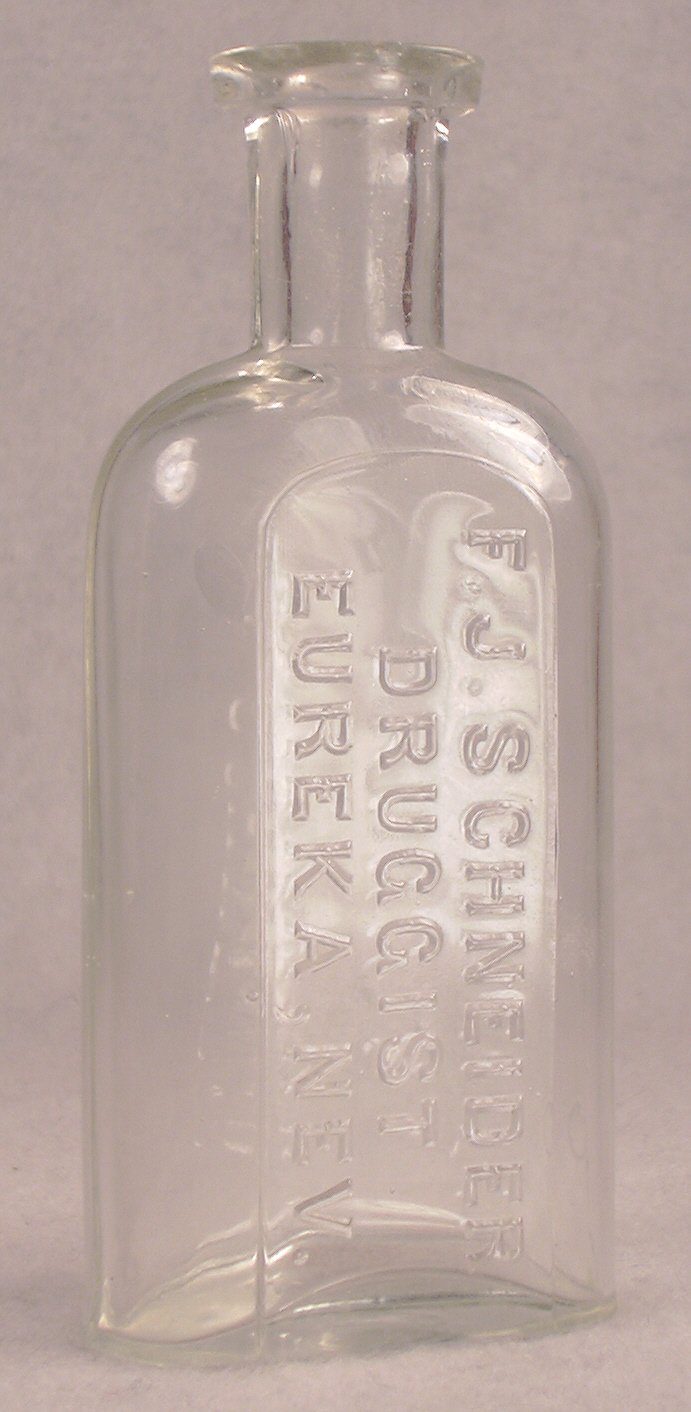
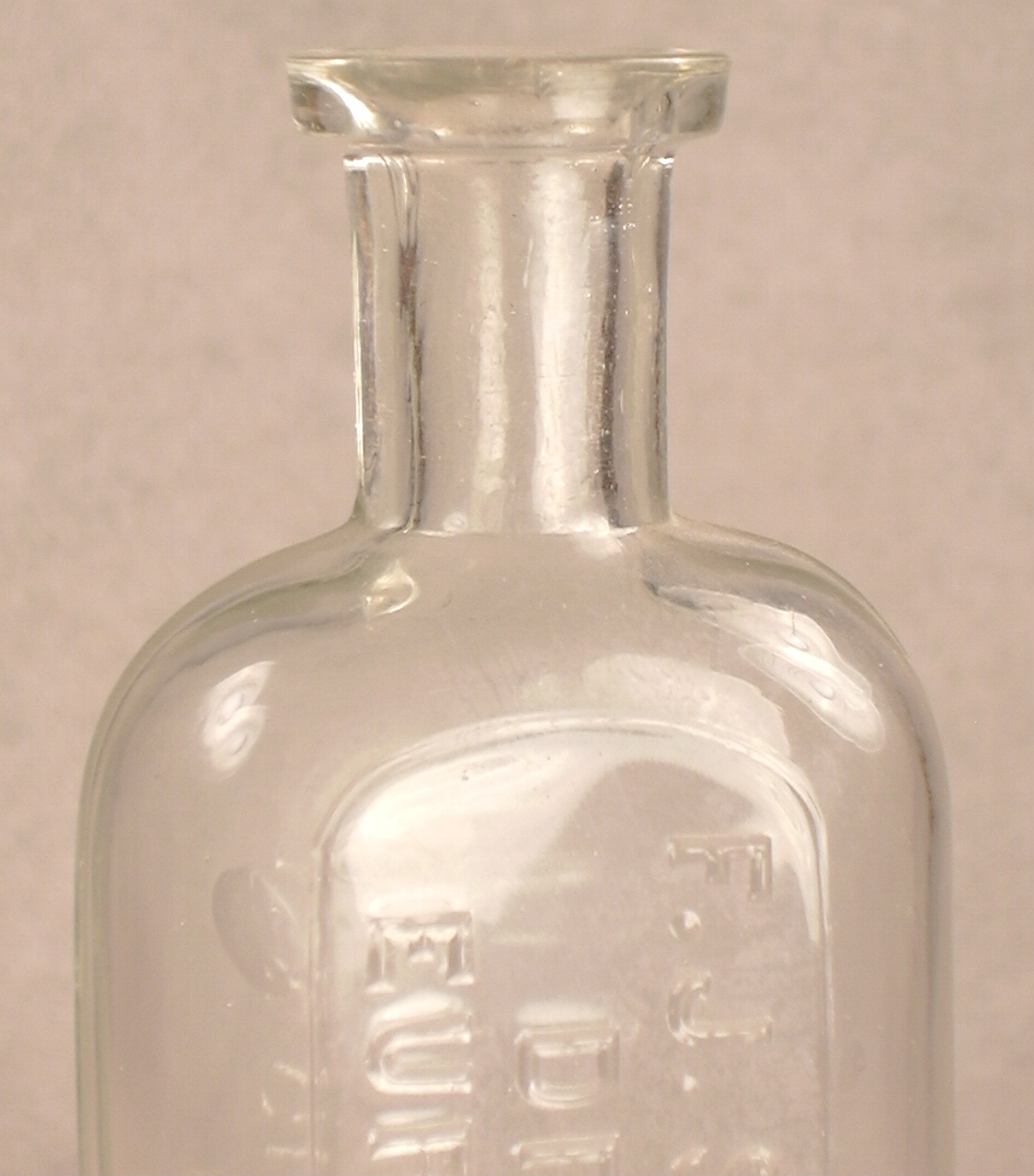 F. J.
SCHNEIDER / DRUGGIST / EUREKA, NEV. - 19th to early 20th century
hand/mouth blown bottles from Nevada are in
relatively high demand; a function of that states connection with the early days of mining in the
19th century West. One of the many hundreds of gold and/or silver
rushes that occurred in Nevada was to the area around Eureka, Nevada.
Eureka! Just the name conjures up images of miners and their burros searching
the scores of north/south ("basin & range") running mountains in search of treasure.
The first half of my career as a rangeland & wild horse management type with the
Bureau of Land Management was in east central Nevada. My
particular management responsibility was the million or so acres north and west
of Ely, Nevada (BLM District totaled 12 million acres) with the western boundary
extending to just east of Eureka.
F. J.
SCHNEIDER / DRUGGIST / EUREKA, NEV. - 19th to early 20th century
hand/mouth blown bottles from Nevada are in
relatively high demand; a function of that states connection with the early days of mining in the
19th century West. One of the many hundreds of gold and/or silver
rushes that occurred in Nevada was to the area around Eureka, Nevada.
Eureka! Just the name conjures up images of miners and their burros searching
the scores of north/south ("basin & range") running mountains in search of treasure.
The first half of my career as a rangeland & wild horse management type with the
Bureau of Land Management was in east central Nevada. My
particular management responsibility was the million or so acres north and west
of Ely, Nevada (BLM District totaled 12 million acres) with the western boundary
extending to just east of Eureka.
There aren't a lot of bottles from 19th century Eureka - a couple soda bottles, a couple extremely rare coffin flasks and some druggists bottles primarily. This bottle I acquired long after being transferred to Klamath Falls, OR. to finish out the other half of my career. (Note: I also have examples of the two Eureka blob soda bottles which will be listed someday.) I don't know how many sizes these druggist bottles came in (such not listed in Fred Holabird's great book on Nevada drug store bottles) I've only seen this size (4 5/8th" tall), a 3.25" example (on eBay) and a 6.5" example (also on eBay). These bottles tend to a bit beat up (dug bottles) but this example is in about perfect condition. According to Holabird, there were plain based ones (no makers marking embossing) and ones with McC embossed in the center of the base. This example is the later with the makers marking. (Click base view to see such which didn't photograph well bit bolder than it appears.)
More specifically, Holabird notes that the plain base ones are the earliest - made c. 1874-1878 - and the McC embossed ones used from 1878-1890. This example is from the earlier end of that the range as it has no evidence of air venting placing it in the 1878 to maybe 1885 range. The McC is the makers marking for the William McCully & Co. (Pittsburgh, PA.) who used that marking from the mid-1870s to 1896. Since this bottle was blown in a mold that was not air vented the likely date of it is the late 1870s to 1885. (If interested in the history of that company see the in-depth history of that company and its products on my Historic Bottle Website at the following link: https://secure-sha.org/bottle/pdffiles/WilliamMcCully.pdf
As noted, the bottle stands 4 5/8th" inch tall and is 2" wide. It has the standard tooled "prescription" finish (aka "lip") and the vertical side mold seams end a bit below the bottom of the lip where the lipping tool reached. It is clear or colorless glass which I can't tell if it would turn purple or not in the sunlight over time. The bottle is pretty much stain free with just a few very light wisps on the back that are hard to see. There are a few bubbles in the glass and is one of the better examples I've seen. The embossing is nice and bold - click close-up of the embossing to see such. As far as "issues" there is a bit of a bumpy but smooth spot on the back side where the bottom of the back mold half meets the base plate, i.e., the base of the mold. There was some seepage where the hot glass oozed a bit leaving the smooth but bumpy 3/8" long spot at that interface indicating a mold flaw at that point where some glass extruded...as best as I can tell. There are a couple images showing it: back base edge image 1; base image 2. There is also a pin prick nick on the edge of the lip which couldn't be photographed as it is essentially invisible and can barely be felt. All in all this is a very nice example of a relatively rare, famous Nevada "gold rush" mining camp druggists bottle from the date range noted above. $150

 (LCE
monogram) SUMPTER DRUG CO. (in banner) / L. C. EDWARDS, PROP. / SUMPTER, ORE.
- That is the embossing on this scarce
druggist bottle from a very small town in NE Oregon. It is also one of the only
(?) druggist bottles I know of from a true, 19th century Oregon mining camp.
(LCE
monogram) SUMPTER DRUG CO. (in banner) / L. C. EDWARDS, PROP. / SUMPTER, ORE.
- That is the embossing on this scarce
druggist bottle from a very small town in NE Oregon. It is also one of the only
(?) druggist bottles I know of from a true, 19th century Oregon mining camp.
I don't know anything about the history of Mr. Edwards drugstore, but the bottle is also embossed on the base with PARIS which indicates the bottle was made by Dean, Foster & Co. - a Boston, MA. glass maker. The "Paris Square Prescription" was a proprietary line that the company apparently produced only between 1901 and about 1904...pegging the date of these bottles down pretty narrowly. (Information on the history of that glass company, its predecessors, and the Paris style prescription bottle is available on my Historic Glass Bottle ID & Information Website at this link: https://secure-sha.org/bottle/pdffiles/DeanFoster.pdf )
This nice example is 4.75" tall as are all the examples I've seen through the years though they may have been made with different capacities? Like the vast majority of same era druggist bottles this is of a colorless/clear glass (which will turn a bit purple if exposed to enough sun) with a tooled "prescription" style finish or lip. Click view of the upper body, shoulder, neck and finish to see another view of the bottle. Click view of the reverse to see such.
It is in very near perfect condition except for some very light/faint and hard to see wisps of internal haze it essentially has no external staining. There are also no nicks, chips or cracks or other issues; it is the finest example I've had (I've sold a couple others). Nice example and fairly hard to come by these days...and a key bottle if one is putting together a collection of druggist bottles from different Oregon towns, which seems to be popular. This is the only druggist bottle from Sumpter that I know of. $100

 (Mortar & Pestle) / Wm. PFUNDER / APOTHECARY /
PORTLAND, OR. - That is all embossed on this pair of earlier
Portland, Oregon druggist bottles from the well known (in the NW) apothecary and
patent medicine purveyor - William Pfunder & Co. This is the same guy that
around 1879 began making and distributing his Oregon Blood Purifier
which had a variable - depending on the mold - face and shoulders of a baby
embossed bodly in the glass. One of the later examples of the bottle (1890
or so; there were least 5 other molds I've encountered) is embossed with
"REGISTERED MARCH 25TH 1879" though the earlier ones just have "COPYRIGHT
SECURED". Not sure what either means besides maybe to scare off imitators
or ??? (Note: I'll be offering several different variations of the
Oregon Blood Purifier bottles in the future.)
(Mortar & Pestle) / Wm. PFUNDER / APOTHECARY /
PORTLAND, OR. - That is all embossed on this pair of earlier
Portland, Oregon druggist bottles from the well known (in the NW) apothecary and
patent medicine purveyor - William Pfunder & Co. This is the same guy that
around 1879 began making and distributing his Oregon Blood Purifier
which had a variable - depending on the mold - face and shoulders of a baby
embossed bodly in the glass. One of the later examples of the bottle (1890
or so; there were least 5 other molds I've encountered) is embossed with
"REGISTERED MARCH 25TH 1879" though the earlier ones just have "COPYRIGHT
SECURED". Not sure what either means besides maybe to scare off imitators
or ??? (Note: I'll be offering several different variations of the
Oregon Blood Purifier bottles in the future.)
Back to these offered bottles...which are of the type typically used by druggists to bottle their wide variety of concoctions, remedies and (I guess) prescriptions, if such existed then when there was little to regulation of medicines. These two are identical in embossing both having the neat mortar & pestle embossed above the druggist's name, trade and location.
The large one is 6.5" tall, has a tooled prescription finish (lip) and the embossing verbiage running from top to bottom - the embossing pattern found on the vast majority of druggist bottles of this type. The base is embossed with W.T. & CO. / A (embossed on 2 lines) indicating manufacture by the Whitall, Tatum & Co. (New Jersey). Click base view to see the bases of both bottles. (If interested in this long lived company see the article on my other educational Historic Glass Bottle Identification & Information Website at the following link: https://secure-sha.org/bottle/pdffiles/WhitallTatum1.pdf ) The style of this specific bottle is probably what the company called the "Millville Round" in their 1880s catalogs as it had rounded body corners. It also has one small air venting mark on opposite the shoulders which don't have the vertical side mold seams. This type pattern of mold air venting was one of the earliest of such mold features dating this bottle to the mid 1880s and possibly a bit later.
The smaller bottle has the same embossing and is 3.5" tall with similar features - tooled prescription finish and base makers marking embossing which is a bit different. Specifically, it has W.T. & CO / B / U.S.A. embossed on three lines on the base as well as similar air venting as described for the larger bottle. This model of bottle is likely the glass company's version of the "Blake" style which has flat, narrow body corners. To view the back sides of the bottles click on back view of both bottles.
Condition of both bottles is excellent - there are no chips, cracks, dings or any other physical issues. They are essentially perfect with only the smaller one having a bit of very, very faint hard to even see haze; the larger bottles is simply perfect. These two bottles - and many more - were found in my youth in the old part of Portland (downtown on the west side of the Willamette River) at 50-55 years ago during the urban renewal days when the old was torn down and new stuff built. Time to pass them on as I'm not getting any younger. $45
...more to list in the future.
SODA/MINERAL WATER & BEERS

 IMPROVED
/ TRADE MARK / (crescent moon with three stars) / MINERAL WATER - C. A. REINERS
& CO / 723 / TURK
ST / S. F. -
These type of earlier, pre-Hutchinson, California soda bottles used to "be around" frequently, but that seems to have changed
over the past 5 or so years in that the prices/values have gone up
proportional to their less abundant availability. Supply and demand I guess. I've
accumulated a fair number of Gold Rush era California "blob" or (more
accurately) "pony" style soda bottles over the years and this one with the cool
moon and stars is a favorite although not really "Gold Rush" era...but
from shortly
thereafter. It is also a favorite with many Western collectors though not
as rare as the earlier, colored and often pontiled "true" Gold Rush sodas from
the 1850s in particular (many to be offered in the years to come).
IMPROVED
/ TRADE MARK / (crescent moon with three stars) / MINERAL WATER - C. A. REINERS
& CO / 723 / TURK
ST / S. F. -
These type of earlier, pre-Hutchinson, California soda bottles used to "be around" frequently, but that seems to have changed
over the past 5 or so years in that the prices/values have gone up
proportional to their less abundant availability. Supply and demand I guess. I've
accumulated a fair number of Gold Rush era California "blob" or (more
accurately) "pony" style soda bottles over the years and this one with the cool
moon and stars is a favorite although not really "Gold Rush" era...but
from shortly
thereafter. It is also a favorite with many Western collectors though not
as rare as the earlier, colored and often pontiled "true" Gold Rush sodas from
the 1850s in particular (many to be offered in the years to come).
Specifically THE book on the subject "Western Blob Top Soda and Mineral Water Bottles" by Peck and Audie Markota (1994 revised and final edition) notes that C. A. Reiners was a German immigrant who came to the US at age 18 in 1854. He migrated to California in 1863 after living in NYC for 8 years. He was apparently a butcher among other forms of employment during the years prior to getting in the soda/mineral water business. From 1873 to 1875 he was in partnership with a John Breig as the Eureka Soda Works which was located at 541 and 543 Bryant St. in S.F. He was the sole proprietor of the soda works at the embossed address from 1875 to 1882. After 1882 he moved to Sonoma County where he lived out the rest of his life...doing what isn't noted in the Markota's book...maybe in the wine business?
The earlier variant of this bottle was blown in the same mold as this example during the partnership days (1873-1875) but had no address embossed just SAN / FRANCISCO below Reiners. One wonders why the other partner's name wasn't on the original version of the mold? In any event, the 723 TURK ST / S.F. embossing was added by Reiners using the existing mold by "slugging out" the SAN FRANCISCO and adding the new address. This created two variations of this bottle with the first version being much less abundant. (Didn't do much business?) Upon close inspection, the new plate edges can just barely be seen on this TURK ST example.
Given that this bottle has the well known "curved R's" of a still (?) unknown mold engraver on both sides, the original 1873 mold was altered around 1875 with the new address which also contains the curved R (in TURK) and was almost certainly done by the same mold maker/engraver. Some of the most iconic Western bottles were done by this unknown mold maker/engraver from the late 1860s until sometime the first half of the 1880s when his mold artistry ended and the embossing only sported the straight leg "R". (Would certainly be an interesting story if anyone ever comes across a name for the guy.)
Anyway, this bottle is a nice SF&PGW "fire aqua" in color - a beautiful variation of aqua that is closely identified with that company and it's predecessors (San Francisco Glass Works and Pacific Glass Works) though certainly this intense aqua glass does show up in other bottles blown in the Midwest and Eastern Seaboard. It is 7.25" tall, has an applied "blob" finish or lip and was blown in a period appropriate "post-base" type mold. Click image of the base to see such. The bottle has stretch marks and other crudeness in the neck and finish where the bottle was detached from the blowpipe and glass applied to create the finish. Click upper neck and finish to see a close-up of such. There is also some whittle to the body and scattered bubbles here and there including some stretched out ones in the neck. The bottle is in near mint condition with very little staining or scuffing. There is a tiny bit of very faint sediment line inside at the shoulder on one side which may come out but is almost invisible as well as a small patch of wear just to the right of the address. There is also a tiny iridescent mark (a few millimeters wide) at the edge of the lip which is essentially invisible and hard to find. Since it isn't associated with a nick in the glass it may possibly be in-making? (I try to describe everything in regards to a bottles condition which makes it sound much worse than is.) Overall this is a superior example which I've had for decades having picked it up at some CA. bottle show long ago. $195

 FREDERICKSBURG
(arched) / (dashed line) / BOTTG Co / S. F. CAL. - That is all
etched on the body of this medium olive green, "Apollinaris"
style beer bottle. These etched San Francisco beer bottles seem to be
pretty rare in my experience. I remember seeing images of a few etched
"export" style beer bottles in Grace Kendrick's book from the early 1960s, but
had seen very few in real life. Until this example I had never seen this
style etched though I have had and sold several of the similar shaped but
embossed Fredericksburg Bottling Co. beer bottles in past years (see
SOLD BOTTLES below). I picked this one up years ago at a California bottle
show to illustrate the style on my other educational "Historic
Glass Bottle Identification & Information Website." The
Apollinaris style of bottle was used extensively for both beer and mineral water
- particularly in the West.
FREDERICKSBURG
(arched) / (dashed line) / BOTTG Co / S. F. CAL. - That is all
etched on the body of this medium olive green, "Apollinaris"
style beer bottle. These etched San Francisco beer bottles seem to be
pretty rare in my experience. I remember seeing images of a few etched
"export" style beer bottles in Grace Kendrick's book from the early 1960s, but
had seen very few in real life. Until this example I had never seen this
style etched though I have had and sold several of the similar shaped but
embossed Fredericksburg Bottling Co. beer bottles in past years (see
SOLD BOTTLES below). I picked this one up years ago at a California bottle
show to illustrate the style on my other educational "Historic
Glass Bottle Identification & Information Website." The
Apollinaris style of bottle was used extensively for both beer and mineral water
- particularly in the West.
These, like the embossed examples, were likely blown in Germany although American bottle makers listed these in their catalogs implying they made them. See the following linked page from the 1906 Illinois Glass Company catalog I have scanned and posted on the noted website: https://secure-sha.org/bottle/Typing/IGCo1906/IGCo1906page250.jpg The right page at that link shows these available in several sizes including this offering which is the "quart" size which really only held about 25 ozs.; what was called a "scant" size. The catalog also notes that the company did sell "Full Measure" 32 oz. quarts also. I believe that the offerings in those catalogs were actually imported from German and sold as though they were actually produced by the American company. But who knows...
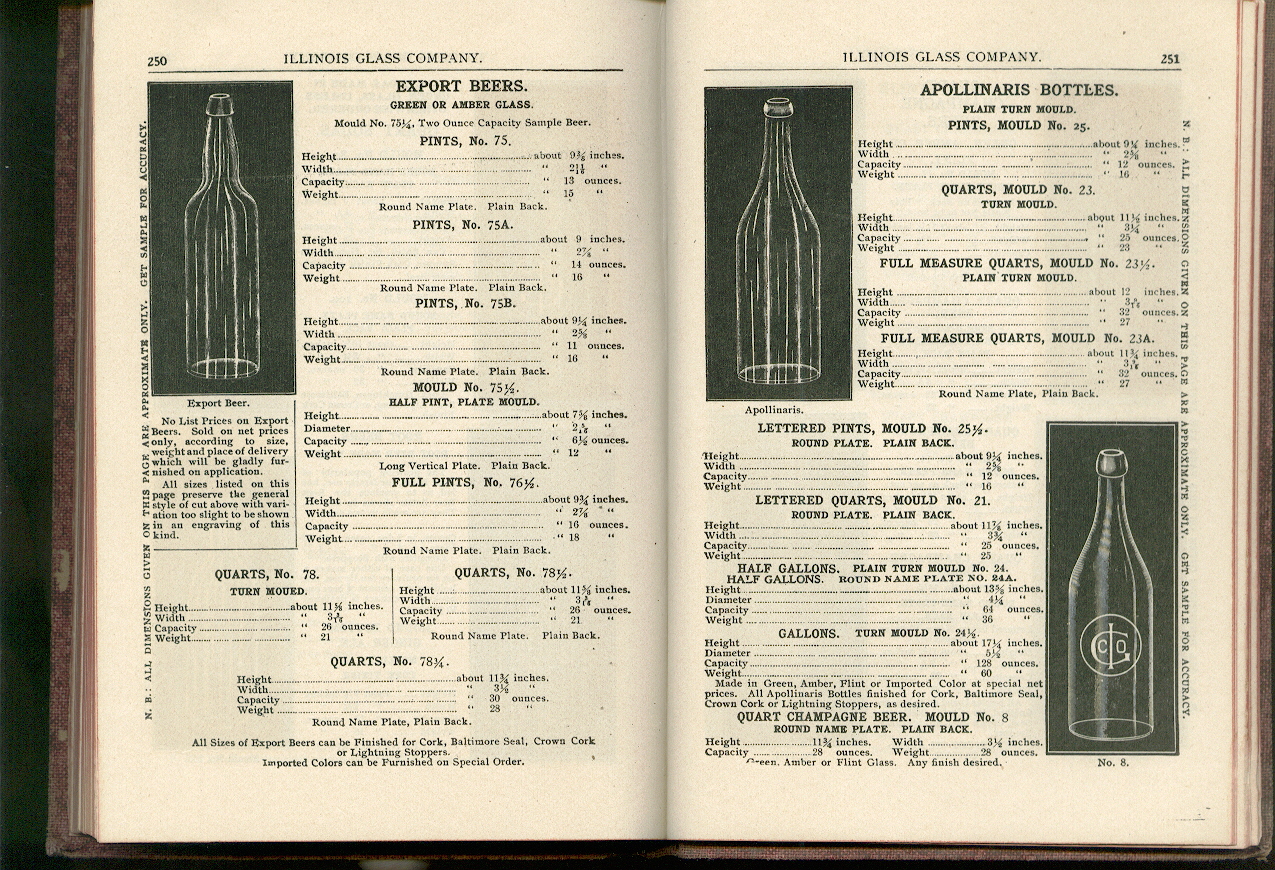
Anyway...this example, like those noted in the catalog, was produced in a turn mold which is very evident as the horizontal spinner rings are pretty noticeable - they can be seen on the enlarged examples of the images to the right. (The guys that produced these bottles were called "twister" blowers in the trade.) This example has an applied "blob" finish (lip) with the usual short conformation typical of these bottles and likely dates from the 1890s to maybe early 1900s. It has no chips, cracks or other post-production damage but does have some wear and scratching on the outside indicating that it was reused many times. This is also obvious on the base which has a lot of wear around the resting surface; click base view to see such. It also has a sediment stain ring inside (visible in the close-up shot above) which is a bit detracting but not too bad. In any event this is still a nice example of a rare and historic type beer bottle that as far as I can tell, was only used in the West. $45
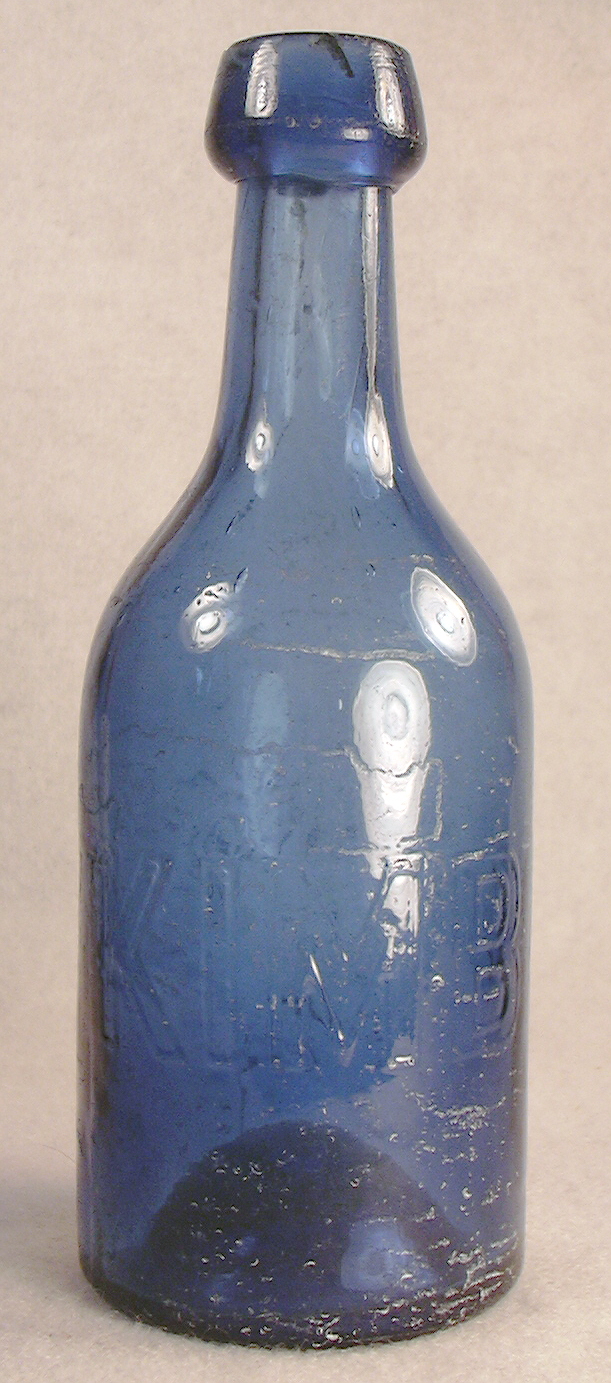
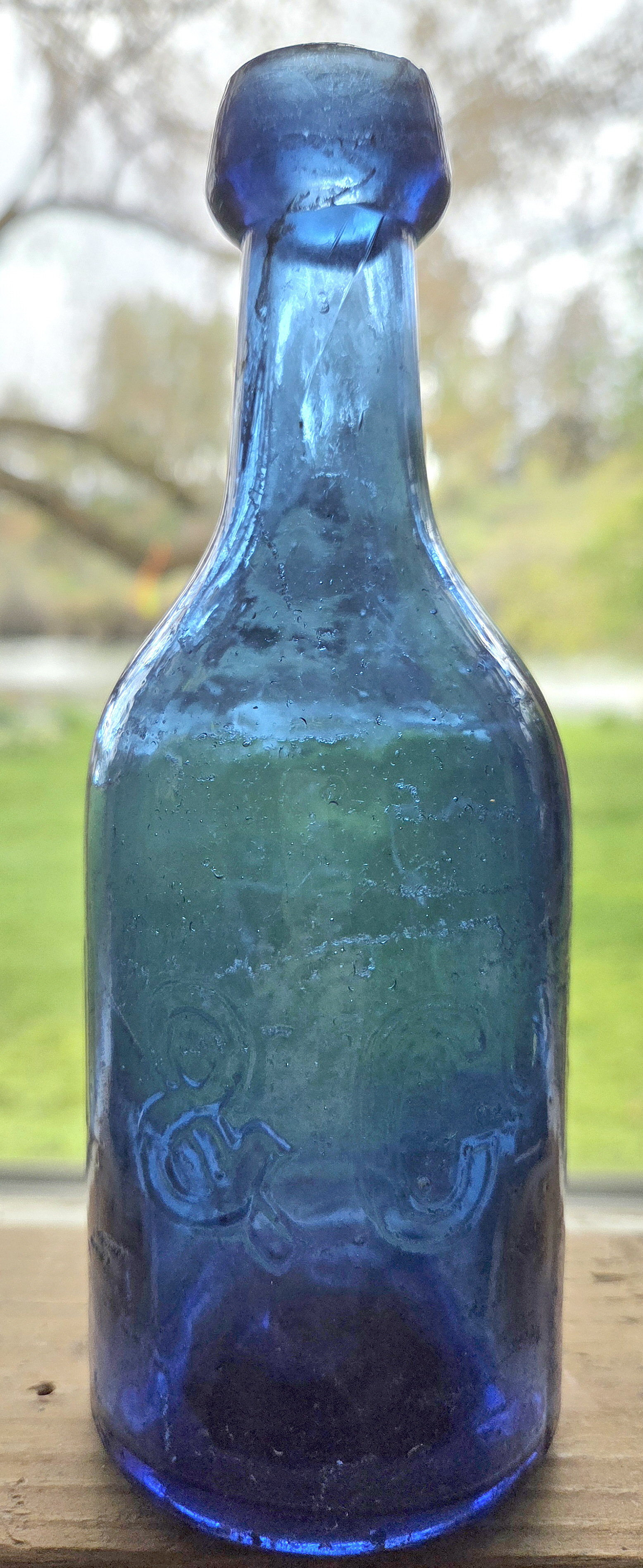
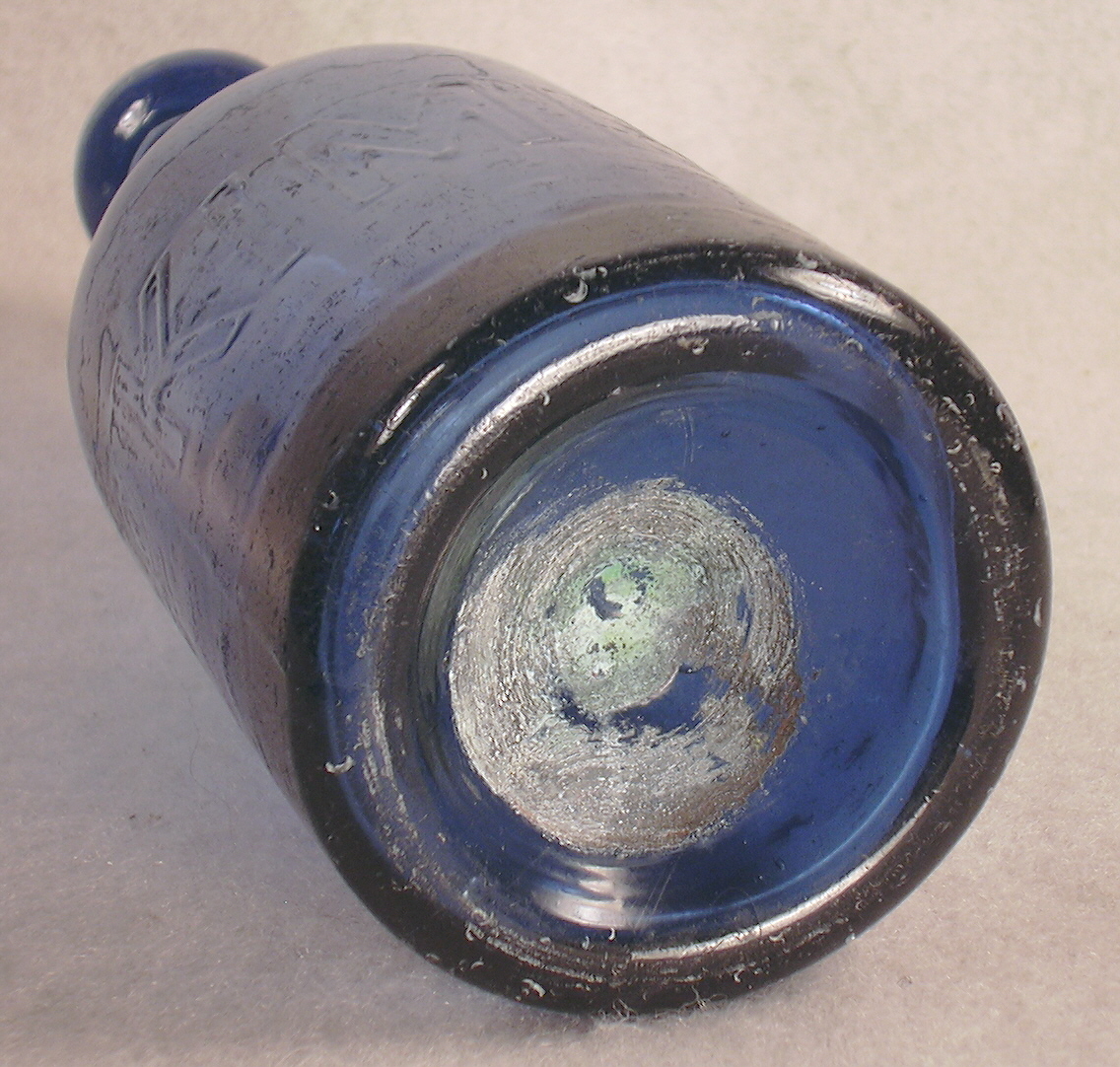 KIMBALL
& Co - This
is one of the more unusual colored Gold Rush era soda bottles which was used by
Charles H. Kimball in Marysville, CA. The shape of the bottle was typical
of the era (1850s to 1870s) but the embossing was different. Specifically,
the embossing on the bottle is in 1" tall block/outlined lettering which was not
typical of the era although there were a few other Western soda bottles (L & V,
L & B, DEAMER, C. & K., W & B) during that era (1850s - 1860s) that also had the
embossing engraved that way.
KIMBALL
& Co - This
is one of the more unusual colored Gold Rush era soda bottles which was used by
Charles H. Kimball in Marysville, CA. The shape of the bottle was typical
of the era (1850s to 1870s) but the embossing was different. Specifically,
the embossing on the bottle is in 1" tall block/outlined lettering which was not
typical of the era although there were a few other Western soda bottles (L & V,
L & B, DEAMER, C. & K., W & B) during that era (1850s - 1860s) that also had the
embossing engraved that way.
According to the Markota's great (and hard to find) "Western Blob Top Soda and Mineral Water Bottles" (1994 second edition) Mr. Kimball was in the soda water business in that city from 1853 to 1856. According to the Markota's "From 1853 to 1855 his place of business was located on the corner of B and Front Streets and in 1855 he was listed as being on B Street between Front and First Streets. In September of 1856, Kimball had his soda water manufacturing business up for sale which was then located on the corner of First and B Streets." Such moving around was pretty common in the volatile era of the 1850s Gold Rush in California where most of the "gold" was extracted from the minority of successful gold miners to fund life in what was an expensive place to live. The Markota's noted that these early bottles only come in cobalt blue and all are iron pontiled. Since there were no bottle makers in the West until the 1860s, these were blown back east and shipped around Cape Horn to California to be filled and refilled scores of times before being tossed. This example is one that was used extensively given its condition described below.
This bottle is just over 7" tall, has a era typical applied "blob" lip or finish which were typically sealed with a wired down cork. As the image to the left shows, it has a very distinct iron or improved pontil scar covering the indented base center. Click the base image to the left to see a larger version of that image. The bottle has been professionally cleaned and quite shiny but still retains a fair amount of ground wear from reuse. Click the following links to see some body images showing both the polishing and ground wear: body image 1, body image 2. There are no cracks or significant open bubbles within the body, neck or base. Click the body views to the left; an additional body view in natural light is available here. The lip has some roughness to the edges from corks being pried out and and short 5 mm flash or fissure. Click the following links to see portions of the finish: finish view image 1; finish view image 2; finish view image 3.
I've had this bottle for many years but don't remember where I acquired it...likely at one of the California bottle shows or Western Auction houses. Recently one of these in j bit better condition sold for $2493.99 on eBay by SIMONSAYS (aka Glass Works Auctions) and the first one I've seen for sale in recent years. The Markota's called these sodas "scarce" (less than two hundred known) but I believe these being from a small town (Marysville in the 1850s) that they are much scarcer than that and/or that most are locked up in collections somewhere. Even though this offered example is overall a bit rougher it has a far better iron pontil scar than the eBay example. The eBay listing notes the following about the condition of the offering: CONDITION: In "as found’ dug condition and never cleaned. It has areas of moderate internal milky stain. It has a number of tiny ‘ground imperfection’ from being in the ground, but no cracks, chips or noticeable damage. The content stain is of the type that could be tumbled out. As the listing notes, it has "ground imperfections" and content stain, the latter of which my offering doesn't have because it was also cleaned on the inside. It certainly does have a rougher lip edge and likely more ground wear on the outside but is a fairly sold example of the bottle. Not sure what to price it at given the recent eBay sale but will make it much more reasonable at this time. $450
p.s. In the next few years I have more California Gold Rush era pontiled soda bottles to likely part with, all of which are in much better condition that this one. Stay tuned...

 ROYAL
SODA WORKS / HILLSBORO / ORE. - That is embossed within a "plate"
on this scarce crown finish soda bottle from Hillsboro, Oregon. I've never
seen one of these before but I'm sure they are "around" in some quantity as Ron
Fowler called them "common" in his "Oregon Soda Pop Bottling" book
(1981, 1998 revised) on the subject. According to his listing, the company
was in business from 1911 until at least 1932. This bottle would certainly
date from the early end of that range as it is mouth-blown and has a tooled
crown cap accepting finish (aka lip). Apparently the owner of the company
was Mrs. Hazel A. Morgan and it was located at 1343 Main Street in Hillsboro.
Fowler also noted that in 1925 it had 3 employees and bottled 125 cases of their
soda a day. No mention of what type soda they produced but must have been
decent since the company was in business all through Prohibition and possibly
after for some time period though it could well have bit the dust due to the
Great Depression though Fowler noted in business until "1932+."
ROYAL
SODA WORKS / HILLSBORO / ORE. - That is embossed within a "plate"
on this scarce crown finish soda bottle from Hillsboro, Oregon. I've never
seen one of these before but I'm sure they are "around" in some quantity as Ron
Fowler called them "common" in his "Oregon Soda Pop Bottling" book
(1981, 1998 revised) on the subject. According to his listing, the company
was in business from 1911 until at least 1932. This bottle would certainly
date from the early end of that range as it is mouth-blown and has a tooled
crown cap accepting finish (aka lip). Apparently the owner of the company
was Mrs. Hazel A. Morgan and it was located at 1343 Main Street in Hillsboro.
Fowler also noted that in 1925 it had 3 employees and bottled 125 cases of their
soda a day. No mention of what type soda they produced but must have been
decent since the company was in business all through Prohibition and possibly
after for some time period though it could well have bit the dust due to the
Great Depression though Fowler noted in business until "1932+."
The bottle is a standard 10 oz. or so capacity soda bottle common to the period. These type soda bottles were machine made almost entirely by 1918 according to research I've seen. Fowler's book also has a line drawing of a machine-made example that has the same embossing and listed as very common (though I've not seen one of those either). The bottle also is embossed on the rear heel with 11-S A B Co indicating that the bottle was made by the American Bottle Company (Streator, IL.) who were in business from 1905 until 1929. (Note: There is an in depth article on the company on my educational Historic Glass Bottle Identification & Information Website at the following link: https://secure-sha.org/bottle/pdffiles/AmericanBottleCo.pdf ) That article has a table of codes used by the company noting that the 11-S marking indicates that the bottle was made at their Streator, IL. plant during the period from 1906 to 1912. Since the Royal Soda Works didn't start operation until sometime in 1911 we can deduce that this bottle was likely made for less than 2 years indicating that it may be much scarcer than previously thought.
Fun stuff, eh? The bottle is 8" tall and 2.5" in diameter. Click base view to see such. The vertical side mold seams disappear about 3/4" below the base of the crown finish which is the furthest point the "lipping tool" reached. Above that one can faintly see the horizontal striations caused by that tool. The embossing is in a plate (aka "slug plate" in collector jargon) and the shoulder has an assortment of air venting marks that helped speed up the blowing of the bottle by releasing the pressure as the hot glass expanded. The color is a greenish aqua and the glass is heavy to withstand the carbonation of the contents. Condition is essentially perfect with no staining, chips, cracks or other post manufacturing issues. There are a very few tiny (pin head size or less) peck marks on the surface of the glass where the bottles likely bumped a bit when either being filled or when being shipped by the case. It is just a fine example of one of the few mouth-blown bottles embossed with Hillsboro, Oregon. $35
MISCELLANEOUS WESTERN BOTTLES & RELATED ITEMS
 CRANE
& BRIGHAM / SAN FRANCISCO Florida Water bottles
- These two bottles are excellent examples of scarce/rare Florida Water bottles
produced (blown) and used in San Francisco in the 1870s. Both are pictured
to the left (click to enlarge). The following is from Bill & Betty
Wilson's 1971 book 19th Century Medicine in Glass - "This
firm started as Crowell, Crane and Brigham in about 1856. It was
originally established by Eugene Crowell several years earlier as a retail drug
store. In 1859 Crowell & Crane pulled out and started their own business,
which lasted for only two years and Crowell sold his interests to William H.
Brigham. The firm of Crane & Brigham became one of the largest in San
Francisco. Henry A. Crane retired in the early 1880s but lived on to the
grand old age of 82 when he died in 1922."
CRANE
& BRIGHAM / SAN FRANCISCO Florida Water bottles
- These two bottles are excellent examples of scarce/rare Florida Water bottles
produced (blown) and used in San Francisco in the 1870s. Both are pictured
to the left (click to enlarge). The following is from Bill & Betty
Wilson's 1971 book 19th Century Medicine in Glass - "This
firm started as Crowell, Crane and Brigham in about 1856. It was
originally established by Eugene Crowell several years earlier as a retail drug
store. In 1859 Crowell & Crane pulled out and started their own business,
which lasted for only two years and Crowell sold his interests to William H.
Brigham. The firm of Crane & Brigham became one of the largest in San
Francisco. Henry A. Crane retired in the early 1880s but lived on to the
grand old age of 82 when he died in 1922."
 The
earlier company (Crowell, Crane & Brigham) was responsible for two of the great
and extremely rare (I've never seen either in person) 1850s Gold Rush era
embossed bottles from San Francisco: the cobalt blue, mug based, iron pontiled
soda bottle embossed C C & B / SAN FRANCISCO and the
rectangular, blowpipe pontiled medicine bottle embossed on three sides with
CROWELL, CRANE & BRIGHAM - SARSAPARILLA & - YELLOW DOCK
- both of which date from the 1856 to 1858 period. As there were no glass
makers in the West (or even west of the Mississippi) at the time these bottles
were blown somewhere in the east and shipped around the horn to San Francisco.
Then they were filled, used and eventually tossed with few of them still extant.
In any event, these two Florida Water bottles date from the 1870s with the
smaller one possibly being from the very early 1880s. Both were found in
the downtown urban renewal areas in Portland, OR. back in the late 1960s.
The
earlier company (Crowell, Crane & Brigham) was responsible for two of the great
and extremely rare (I've never seen either in person) 1850s Gold Rush era
embossed bottles from San Francisco: the cobalt blue, mug based, iron pontiled
soda bottle embossed C C & B / SAN FRANCISCO and the
rectangular, blowpipe pontiled medicine bottle embossed on three sides with
CROWELL, CRANE & BRIGHAM - SARSAPARILLA & - YELLOW DOCK
- both of which date from the 1856 to 1858 period. As there were no glass
makers in the West (or even west of the Mississippi) at the time these bottles
were blown somewhere in the east and shipped around the horn to San Francisco.
Then they were filled, used and eventually tossed with few of them still extant.
In any event, these two Florida Water bottles date from the 1870s with the
smaller one possibly being from the very early 1880s. Both were found in
the downtown urban renewal areas in Portland, OR. back in the late 1960s.
Although neither are embossed as to contents, the shape of them is of a type that was used about 100% of the time for that particular product - a type of inexpensive perfume/cologne which some claimed to have medicinal properties. Typical of the style, the neck is about as tall as the body in both sizes.
The larger bottle has three of the distinctive curved "R's" in the spelling which are firmly attributed to an unnamed mold maker/engraver working in the Bay Area from the late 1860s into the early 1880s. This person created scores of - maybe several hundred - molds for embossed bottles that have this type "R". Click on the image to the immediate left to see a larger version showing the embossing. Most of the bottles attributed to this mystery mold maker/engraver (don't know if he did both or not) were clearly embossed as being from the West (typically California, Oregon, & Nevada) like both of these bottles or used by companies historically known to be operating in the West. The smaller example has no "R's" in the embossing to curve though the "look" of the embossing is identical to its larger brother so it is certainly a product of the same mold maker. Both were blown in the type of deeper blue aqua glass commonly seen with bottles blown at the San Francisco Glass Works or Pacific Glass Works or the combined company (San Francisco & Pacific GW) after merging in 1876. The larger example is very much the "fiery" deep aqua color with the smaller one being a bit more muted but still of the same look in general.
The larger example is very scarce but more abundant than the smaller size in my experience. It is embossed CRANE & BRIGHAM / SAN FRANCISCO vertically inside a deeply indented panel. It is 9" tall, has a crudely applied "oil" style finish or lip, and smooth somewhat indented or domed base. Click close-up of the applied lip to see such. This bottle is a beauty and one of the finest example I've ever seen. It has no post-production issues, i.e., no chips, cracks, pings, nibbles or even really any staining as the "fire aqua" glass from the Bay Area during that era was quite resistant to staining or patination. There are even a few specs of the original foil capsule showing on the upper neck! The glass is fairly crude with decent whittling, a few bubbles and neck stretch marks. Great example! $75
The smaller and rarer example is also embossed vertically inside a deeply indented panel in a much more abbreviated manner (not as much room as the big bottle) with C. & B. / S. F. although that says enough to make it certain to have been Crane & Brigham. It is 6.25" tall, has a tooled "oil" style finish or lip, and a more proportionally indented domed base than the larger example. The glass is a medium blue aqua and the neck is crude and a bit wavy on the inside from the use of the lipping or finishing tool. The bottle is in very good condition though does have a bit of staining inside the shoulder, a bit of outside light dullness and a small flake at the heel on the backside. Click close-up of the heel to see the latter issue. Overall a nice example of a very rare SF Florida water (a recent sale of a mint one on eBay was for $280+). $100 SOLD
SAN FRANCISCO / GLASS WORKS - This is an example (following the "An Interesting Western-made..." section below) of one of the classic and rare wax sealer jars made on the West Coast in the 1870s. Actually, probably the only embossed wax sealer of Western origin. This is what I believe to be the hardest to find - the half gallon size - though it and the quarts are all quite rare and desired. I've had a couple of the quarts over the years along with an example of the third use of the same mold. I explain this on my Historic Glass Bottle ID & Information Website which is cut 'n pasted below from that educational site:
An Interesting Western-made Applied Groove Ring Wax Seal Canning Jar Story
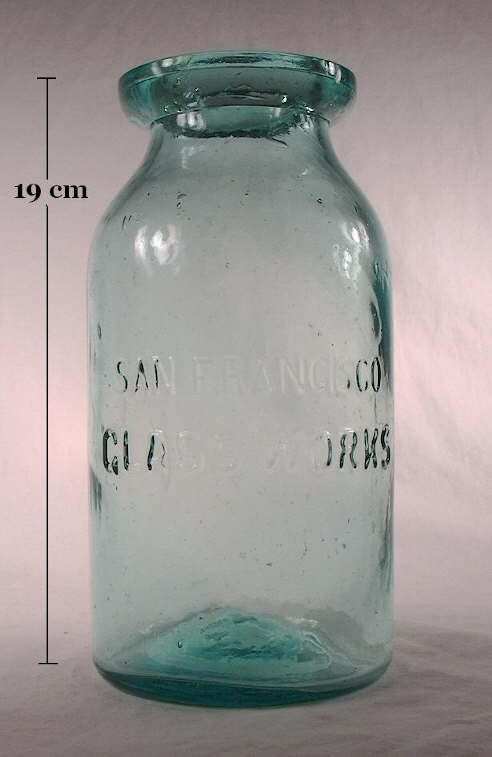 The
quart, applied groove ring wax seal canning jar pictured to the right (finish
close-up below left) is embossed with SAN FRANCISCO / GLASS
WORKS. This jar was also blown in a post-bottom mold, is fairly crude
("whittled" uneven bubbly glass), and lacks any evidence of mold air venting.
This glass company operated under this name from 1869 to 1876, although the jars
from this mold were also likely produced as late as the early 1880s by the
successor to that company - the San Francisco & Pacific Glass
Works (Toulouse 1971; Creswick 1987; Hinson 1995).
The
quart, applied groove ring wax seal canning jar pictured to the right (finish
close-up below left) is embossed with SAN FRANCISCO / GLASS
WORKS. This jar was also blown in a post-bottom mold, is fairly crude
("whittled" uneven bubbly glass), and lacks any evidence of mold air venting.
This glass company operated under this name from 1869 to 1876, although the jars
from this mold were also likely produced as late as the early 1880s by the
successor to that company - the San Francisco & Pacific Glass
Works (Toulouse 1971; Creswick 1987; Hinson 1995).
One interesting aspect about this particular quart jar is that the mold used to make it was also used for an earlier and a later jar - both with different embossing, although this mold was not designed for an interchangeable embossing plate. How did this happen? A close inspection of the pictured jar shows that there is the faint impression of a arched blank filler plate covered area just above the SAN FRANCISCO embossing. The first or original jar made with this mold was embossed in this now covered arch with CUTTING.AND.CO for the Baker & Cutting Packing Company (Zumwalt 1980). This jar was certainly blown - as the embossing shows - at the San Francisco Glass Works (CA.) in business from 1862 to 1875 and not by the short lived Baker & Cutting bottle factory (also in San Francisco and the same Francis Cutting as the noted packing concern and the first glass factory in the American West) in business 1858-1860 (Zumwalt 1980; Friedrich 2010). Click on the following links to see images of the earlier jar (courtesy of American Bottle Auctions): entire Cutting jar; close-up of the embossing.
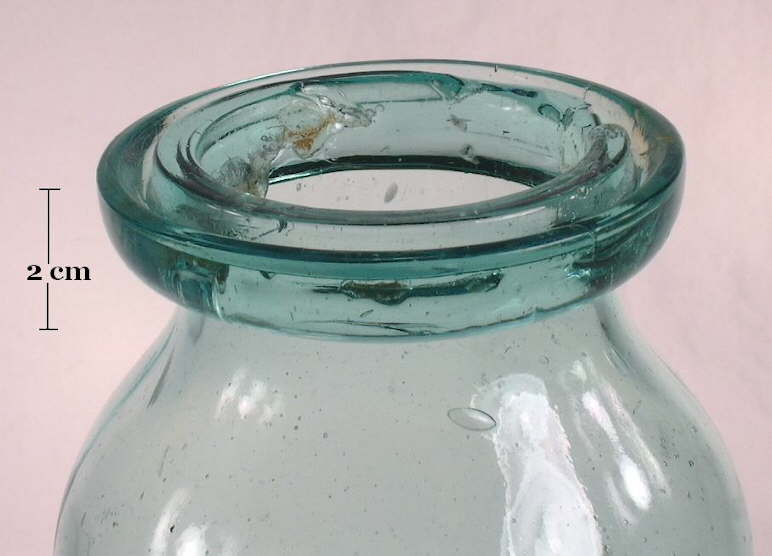 After
being used for a relatively lengthy period of production for the pictured jar
(with the words GLASS WORKS having been cut
into the mold below the previously existing SAN FRANCISCO)
the entire embossing pattern (i.e., SAN FRANCISCO / GLASS WORKS) was
covered by another plate and the reverse half
of the mold cut with M. SELLER & CO. / PORTLAND, O. Click M.
Seller quart jar to see the embossing side of
this jar; the plate covered embossing areas on the now reverse side of the jar
are too faint to photograph but are obvious upon actual examination. The M.
Seller quart jars were likely blown by the San
Francisco & Pacific Glass Works (1876-1902) in the late
1870s to maybe
mid-1880s and clearly shows the now three previous lines of embossing covered by
two plates on what was now the reverse side of the jar. This is a great
example of the type of duty a mouth-blown mold could be put to with some
adaptation. It is also an example of potential mold life in that this mold
saw duty for around a decade or so, i.e., from the early to mid 1870s to the mid
1880s (Toulouse 1971; Creswick 1987).
After
being used for a relatively lengthy period of production for the pictured jar
(with the words GLASS WORKS having been cut
into the mold below the previously existing SAN FRANCISCO)
the entire embossing pattern (i.e., SAN FRANCISCO / GLASS WORKS) was
covered by another plate and the reverse half
of the mold cut with M. SELLER & CO. / PORTLAND, O. Click M.
Seller quart jar to see the embossing side of
this jar; the plate covered embossing areas on the now reverse side of the jar
are too faint to photograph but are obvious upon actual examination. The M.
Seller quart jars were likely blown by the San
Francisco & Pacific Glass Works (1876-1902) in the late
1870s to maybe
mid-1880s and clearly shows the now three previous lines of embossing covered by
two plates on what was now the reverse side of the jar. This is a great
example of the type of duty a mouth-blown mold could be put to with some
adaptation. It is also an example of potential mold life in that this mold
saw duty for around a decade or so, i.e., from the early to mid 1870s to the mid
1880s (Toulouse 1971; Creswick 1987).
(Note: One further observation about these San Francisco made jars is that the original mold engraver or "mold cutter" for the Cutting jar and the mold cutter for the later two jars appear to be two different people as the style of the embossed lettering is distinctly different. In particular, the later mold cutter was the one who made a distinctive "R' with an outwardly curving angled leg. This "R" is a distinctive feature found on scores of different Western bottles that were almost certainly made at the San Francisco & Pacific Glass Works between about 1876 and the mid-1880s, and possibly the latter days [early to mid 1870s] of one or both of the precursor glass companies [Pacific Glass Works and/or San Francisco Glass Works]. Click curved "R" to view an image of a late 1870s liquor flask with this feature pointed out and almost certainly "cut" by the same mold engraver as these jars. )
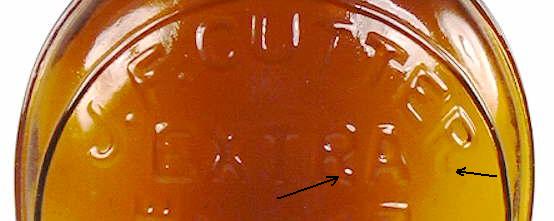

 Interesting
Western glassmaking history, eh?! All three jars come in two sizes - half
gallon and quart. This offering is for the half gallon size which was the
2nd use of the original Cutting mold. Click
this offered jar next to a quart
M. Seller's jar to see the difference in size between a quart and half
gallon. As noted, this example is embossed with SAN FRANCISCO /
GLASS WORKS (on two lines) with the embossing the same size/height as
the quart jars. Click close-up of the
embossing inside to see such; click
natural light view to see an
image with outside background lighting. Other images are also available as
follows: view of the
backside of the jar; view of
the base and side; view of the
grooved wax seal finish.
Interesting
Western glassmaking history, eh?! All three jars come in two sizes - half
gallon and quart. This offering is for the half gallon size which was the
2nd use of the original Cutting mold. Click
this offered jar next to a quart
M. Seller's jar to see the difference in size between a quart and half
gallon. As noted, this example is embossed with SAN FRANCISCO /
GLASS WORKS (on two lines) with the embossing the same size/height as
the quart jars. Click close-up of the
embossing inside to see such; click
natural light view to see an
image with outside background lighting. Other images are also available as
follows: view of the
backside of the jar; view of
the base and side; view of the
grooved wax seal finish.
The jar is 8.5" tall and 4.25" diameter at the base. It is a nice moderately deep blue aqua which is a common coloration for the aqua products of this company for many years. The jar was blown in a post-base type mold evidenced by the two side mold seams curling around the edge of the base ending at the "post" plate area centered on the base. The glass has scattered bubbles in the glass and an applied groove ring wax sealed lip or finish. The jar is in near mint condition with no staining or scratching - just a bit of wear on the bases resting edge which is common with fruit jars used for years and not buried.
The only issue that keeps this jar from being "mint" is that there are two very small nicks on the edge of the rim towards the backside of the jar on the left. They are very hard to see and photograph but I took several images which shows them barely. Click inside close-up view of the two tiny nicks and natural light view of the two tiny nicks to see such. One is about pin head size and the other even smaller. These jars often have issues, but this is one of the better half gallon examples I believe. These jars are in demand by Western collectors since they are one of the few early fruit jars made out West. The only recent comparables I've seen were of the ever-so-slightly more abundant quarts and they sold for $2800 (North American Glass - not including the commission) and $2899 (eBay)! This example came from one of the Western auction houses (forgot which but probably ABA) a long time ago. Time to pass it on. $1750
 Pair
of small San Francisco medicine bottles - Here are a couple of
small bottles that are unrelated except for both having their use origins in San
Francisco, CA. (Click on the natural light image to the left to see a
bigger version.) Both bottles were likely made in the Bay Area - certainly
the aqua, ca. 1870s to early 1880s "Jamaica Ginger" on the right in the
image was made there. That is evidenced by the "curved R" in GINGER which
was the trademark of a totally unknown mold maker/engraver at one of the
glassworks there in the 1870s to mid-1880s timeframe. The other bottle
is a bit later (early 1900s) but likely a product of a local or regionally
nearby glassworks.
Pair
of small San Francisco medicine bottles - Here are a couple of
small bottles that are unrelated except for both having their use origins in San
Francisco, CA. (Click on the natural light image to the left to see a
bigger version.) Both bottles were likely made in the Bay Area - certainly
the aqua, ca. 1870s to early 1880s "Jamaica Ginger" on the right in the
image was made there. That is evidenced by the "curved R" in GINGER which
was the trademark of a totally unknown mold maker/engraver at one of the
glassworks there in the 1870s to mid-1880s timeframe. The other bottle
is a bit later (early 1900s) but likely a product of a local or regionally
nearby glassworks.
The nice blue aqua bottle on the right in the image is embossed with - E. G. LYONS & CO.. /ESS. / JAMAICA GINGER /S.F. It is 6" tall, oval in cross-section like most Jake's (collector term for these type bottles), tooled "oil" finish (lip) and a slightly inset base. (Click base view of both bottles to see such.) There is no air venting visible on the body indicating the mold is pre-1885 or so. These can also have an applied finish and all of the few I've seen were made in the same "curved R" mold (although there was at least one later - mid to late 1880s - mold shown in the Wilson's book noted below). There is an interesting article by Dr. Cecil Munsey from the 2006 "Bottles & Extras" magazine on the notorious history of Jamaica Ginger. If interested it is available to read on my Historic Bottle Website at the following link: https://secure-sha.org/bottle/pdffiles/JakeWalkStoryMunsey.pdf
There is also a short blurb about the bottle in Bill & Betty Wilson's "19th Century Medicine in Glass" (1971) which noted "Ernest G. Lyons started with a small syrups manufactory in San Francisco in 1866 and the company was still operating at the turn of the century. He became one of the big wholesale liquor dealers there with a large line of cordials, bitters, wines, brandy and whiskey." This bottle dates from the earlier times of Mr. Lyons business ventures in SF. Condition of this bottle is about perfect with with no chips, cracks or other damage. It only has a bit of virtually invisible but even haze on the inside. The embossing is bit weak in the lower middle portion of the body but all is easily readable as the image to the left will show when enlarged.
The other colorless (actually very faintly having a bit of a straw colored tint) bottle is embossed with GOLDBERG, BOWEN & CO. / SAN FRANCISCO with the other sides lacking embossing. The base also is embossed with G. B. & Co. which I'm sure is for the company name though in a location that often was used by the bottle maker to emboss their initials. (See the base view image of both bottles linked earlier.) The bottle is a bit of an odd rectangular shape with widely beveled corners - an unusual conformation. It has a hand tooled "patent" or "flat" finish or lip and has a few air venting marks on the noted beveled sides as well as the edges of the base. It dates - given those characteristics - from the first two decades of the 20th century (1900 to maybe 1920). The noted faint straw color shows that is an early example of a glass batch being made largely colorless with the use of selenium. (Covered on my Historic Bottle Website at the following link: https://secure-sha.org/bottle/colors.htm#Colorless )
This bottle looks to be a possible druggist or prescription drug bottle but the Wilson's "Spirits Bottles of the Old West" (1968) notes the following about the company: "From 1896 until Prohibition Goldberg Bowen prospered in the wholesale liquor business. Although this was really only a sideline as their main business was wholesale groceries and gourmet foods. They were still in business today." (In 1968 that is.) I suppose that this bottle could have been used as a small, sample bottle for their liquor (?) but it most likely was something connected to their groceries and food business (for food flavoring extracts maybe?). Neat bottle in any event and one I've never seem before. Condition of the bottle is that it is physically perfect - no chips, cracks, etc. - but just a bit of white-ish haze inside the bottle on the back panel and some in the neck. Both bottles together for one price. $35
...MORE TO COME IN THE FUTURE!
Click on the following links to go to these other pages with more bottles for sale.
|
BITTERS |
Listed prices do not include shipping & insurance. Please read the Important Information for Buyers section on the main "Bottles For Sale" page for complete buyer information.
Please confirm item availability prior to sending any type payment and include your zip code in your message so that the shipping can be calculated.
Click here to return to the main Bottles For Sale Page menu

My email is -
© Copyright 2026
Page Last Updated: 10/7/2026