

BITTERS BOTTLES
Listed prices do not include shipping & insurance. Please read the Important Information for Buyers section on the main "Bottles For Sale" page for complete buyer information.
BITTERS BOTTLES
Listed prices do not include shipping & insurance. Please read the Important Information for Buyers section on the main "Bottles For Sale" page for complete buyer information.

 WORMSER BROS' / (indented "bung hole") / SAN FRANCISCO -
(Click close-up of the embossing
to see the bold embossing.) Here is example of one of the classic Western (made)
bottles - the famous Wormser Bros. barrel! This is the only true Western barrel bitters
(or maybe used for liquor also?) bottle (the Turner Brothers barrels are really
Eastern items). These date from the late 1860s and apparently only made
for a short time.
WORMSER BROS' / (indented "bung hole") / SAN FRANCISCO -
(Click close-up of the embossing
to see the bold embossing.) Here is example of one of the classic Western (made)
bottles - the famous Wormser Bros. barrel! This is the only true Western barrel bitters
(or maybe used for liquor also?) bottle (the Turner Brothers barrels are really
Eastern items). These date from the late 1860s and apparently only made
for a short time.
These used to be virtually unobtainable and rarely seen, though due to a couple small caches of them being found a couple decades ago (Nevada & Oregon reportedly) there are a few more around now...including this nice example. (If you are looking for one of these you likely know the stories better than I.) These bottles date from only 1869 according to Wichmann's great "Antique Western Bitters Bottles" book (and the Wilson's 1969 classic) who listed them as valued at "$3000 to $7000" in the various shades of amber. (The unique light citron green example was unknown at that time.)
Since there were a few more of them around economics dictated a falling of prices - which happened for a time. Examples are more rarely seen at auctions today having been dispersed to collectors quickly. A similar colored (a fairly similar medium amber ) example sold a few years back on eBay for over $2000! Another similar one (though a bit brighter) at American Bottle Auctions (ABA) went for $2500+ with commission though the supply is still dwarfed by the demand and prices have been ticking up again. I recently acquired one that came from a particular Nevada mining camp - the noted Nevada cache?) so I'm selling this example even though it is a bit superior in condition and color to my other one which has not been cleaned.
This offered example is 9.5" tall, has an applied, one-part "oil" type lip or finish with some nice "slop-over" just below (click view of the shoulder, neck and finish to view such), smooth shallow domed base, and is in a very shiny bright medium amber color. The images show the color accurately to my eye. This example is near mint with no chips, cracks, pings, dings or flea-bites...just a few light scratches near WORMSER on the front and some very vague haze spots mid-body. It has been professionally cleaned (like most of them) but without any diminishment of the glass surface, embossing or beauty. The image of the base (base view link) shows some light haze where the cleaning didn't reach. It has some bubbles in the glass - particularly at the neck/shoulder interface and a few in the body. Click the following links to see more views of this bottle: left side view; right side view; back side view. Overall it is a very nice example in essentially perfect condition - a classic Western made (likely) and used bottle that every serious Western bottle collector should have an example of. $1650

 DR.
HENLEY'S / WILD GRAPE ROOT / IXL (in an oval) / BITTERS
- These large (at least a quart
in capacity) Western bitters bottles are quite popular with collectors since
they are...large...have great embossing and found in a myriad of colors, though
any color besides shades of aqua are very expensive. A
very popular product, these bottles are found all over the West from the mining
camps of Utah, Nevada, and Montana to the big cities of the day - San Francisco,
Portland, Sacramento. In my experience visiting scores of the mining camps
and ghost towns of the West, it is the rare location where one does NOT find
fragments of an IXL - it was that popular.
DR.
HENLEY'S / WILD GRAPE ROOT / IXL (in an oval) / BITTERS
- These large (at least a quart
in capacity) Western bitters bottles are quite popular with collectors since
they are...large...have great embossing and found in a myriad of colors, though
any color besides shades of aqua are very expensive. A
very popular product, these bottles are found all over the West from the mining
camps of Utah, Nevada, and Montana to the big cities of the day - San Francisco,
Portland, Sacramento. In my experience visiting scores of the mining camps
and ghost towns of the West, it is the rare location where one does NOT find
fragments of an IXL - it was that popular.
This example is just over 12" tall, a relatively rich "San Francisco & Pacific Glass Works" blue-aqua color (where it was made), the usual domed base, and an appropriately crude applied "champagne" style banded finish (click neck and lip image to see such). This example probably dates from the late 1870s to early 1880s since it fairly crude (stretch marks, bubbles), not air vented, and from a mold that lacks the distinctive curved "R" of the earlier mold(s). The embossing is also bold for this particular mold. FYI...here is a copy of the original labeling that these bottles had: Henley's IXL Bitters label
This offering is in very good condition with no chips, cracks, dings or repairs - only some light scattered haze inside and some minor scratching, scuffing/wear mostly on the back of the bottle. It has lots of small seed bubble throughout as well as some decent whittle. An example from the same mold as this example recently sold at Golden Gate Bottle Auctions for $400 + the 15% commission. This one has some light inside haze and a bit of back side scuffing as noted but a nice example with a moderately deep aqua coloration. $225

 PIPIFAX
- This is embossed large and bold on one side of this hard to find Western
"bitters" bottle; the other 3 panels are unembossed. These are somewhat of
a mystery bottle but are reportedly only found in the West. There were a
series of distributors in San Francisco according to the two Western bitters
bottles books by Bill & Betty Wilson (Wilson & Wilson 1969) and Jeff Wichmann
(1999). According to their research, the product was actually made in
Germany and franchised to dealers in the US, being shipped in barrels with the
labels supplied by the manufacturer for placing on the bottles.
PIPIFAX
- This is embossed large and bold on one side of this hard to find Western
"bitters" bottle; the other 3 panels are unembossed. These are somewhat of
a mystery bottle but are reportedly only found in the West. There were a
series of distributors in San Francisco according to the two Western bitters
bottles books by Bill & Betty Wilson (Wilson & Wilson 1969) and Jeff Wichmann
(1999). According to their research, the product was actually made in
Germany and franchised to dealers in the US, being shipped in barrels with the
labels supplied by the manufacturer for placing on the bottles.
It was first distributed in SF by Walter & Schaeffer in 187o with the franchise sold to the James M. Gowey Wholesale Liquor Company in 1873. In 1876, John Sroufe and Hugh McCrum bought out Gowey and (to quote the Wilson's), "...the first embossed bottles were ordered for the Pipifax brand. By 1885 the mold wore out and they selected a smaller bottle (like Hostetter's) and it was paper labeled thereafter." The product was advertized as "The Famous Rosicrucian Elixir" according to the label used by Goewey. (Note: The label image in the Wilson's book shows the name spelled as Goewey, not the Gowey noted in the text of both books). It was a "Magenbitter" according to the several labels pictured in the two books which was apparently German for bitters?
In any event, these bottles are fairly rare according to Wichmann and I've seen one now and then through the years indicating some level of scarceness. This example is about 9.4" tall, about 2.7" wide on each side, and has a somewhat crudely applied "brandy" finish or lip. The color is pretty well shown in the images - a light to medium yellowish amber. As the full bottle image shows, it has quite a bit of wavy body crudeness (mold was not air vented) along with dimples in the glass, twist marks on the neck and some scattered bubbles. The condition is good with no chips, cracks or dings of any kind. It does have a nice glossy outside surface (as images show) with just a few minor scuffs and very small spots of staining. The inside has an overall though fairly uniform moderate content haze which could easily be cleaned but isn't too distracting. Nice example at a decent price. $150

 S. T. / DRAKES
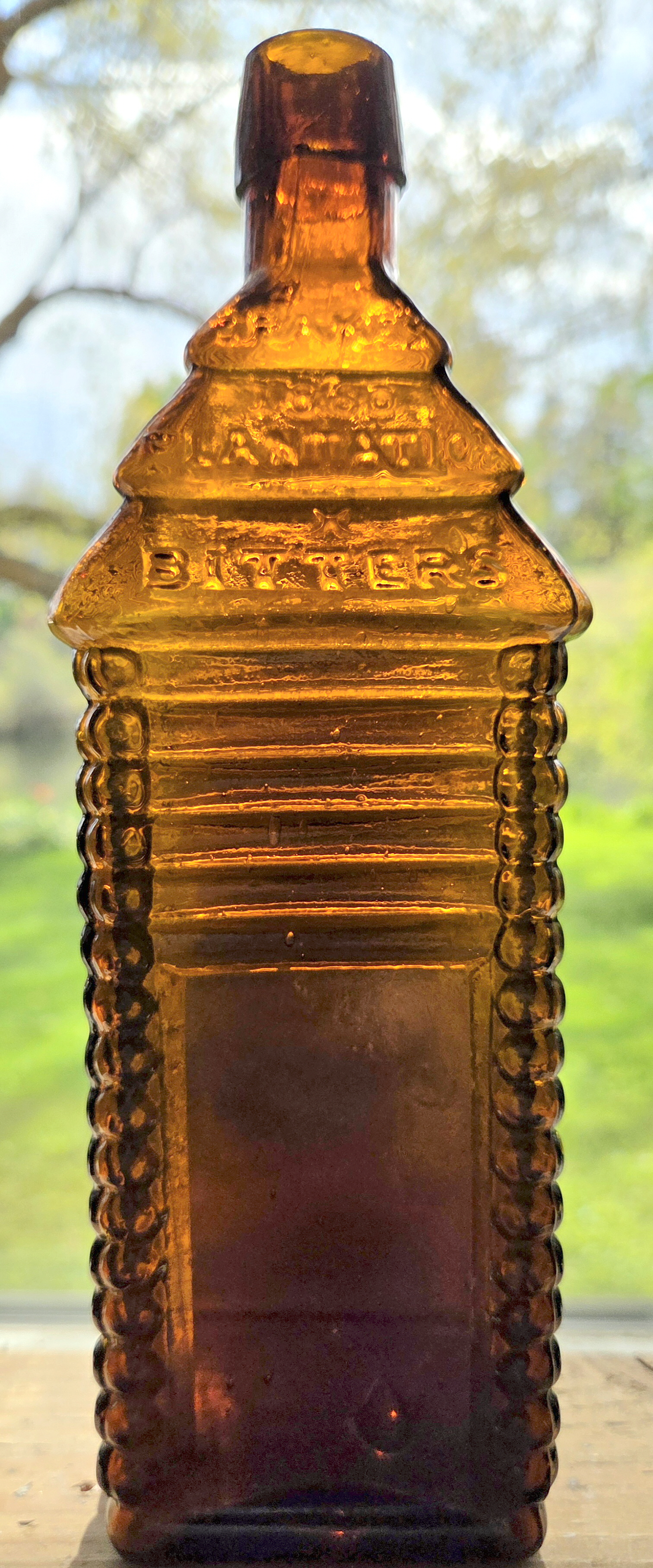
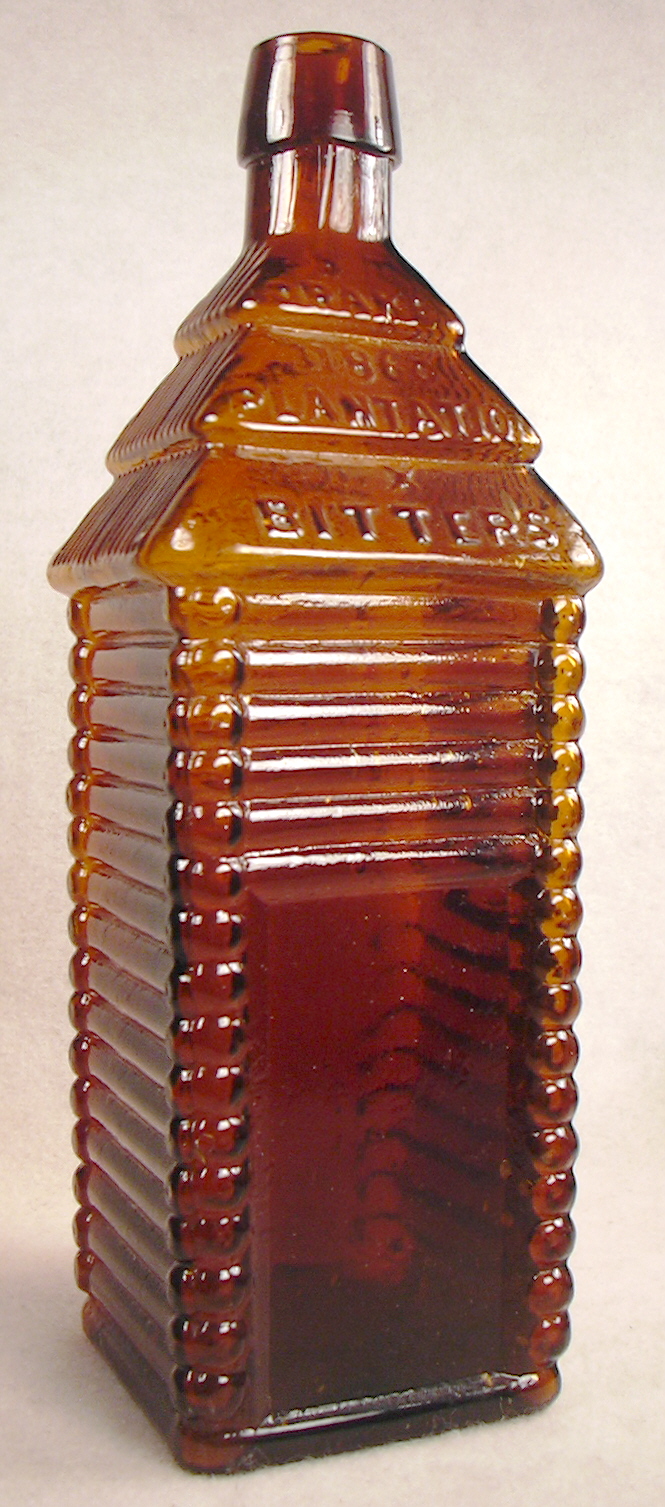
/ 1860 / PLANTATION / X / BITTERS - This mold variation of the
ubiquitous Drake's Bitters has the usual
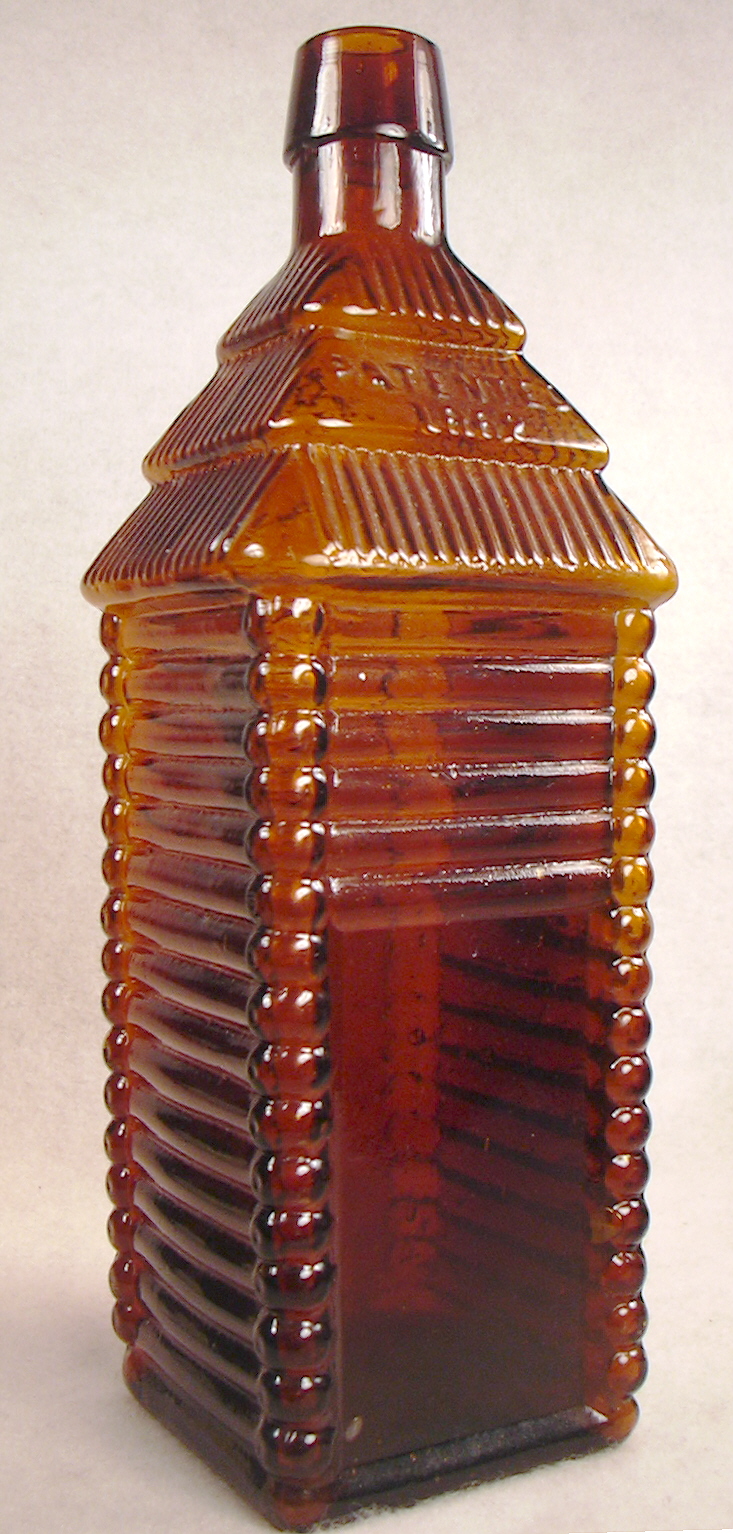
PATENTED / 1862 embossed totally on one (the center) roof panel on the
reverse. Click reverse
view to see such. (That reverse image shows the glass color to be
lighter than it really is; the other images are more accurate.) This example is just over 9.75" tall,
true applied "oil" type finish
or lip (aka "long tapered collar"), smooth slightly domed base (no embossing),
and dates from the heyday of the 6-log Plantations - 1865 to the late 1870s.
The glass is a very pleasing medium but bright amber color; would really make
a nice window bottle.
S. T. / DRAKES
/ 1860 / PLANTATION / X / BITTERS - This mold variation of the
ubiquitous Drake's Bitters has the usual
PATENTED / 1862 embossed totally on one (the center) roof panel on the
reverse. Click reverse
view to see such. (That reverse image shows the glass color to be
lighter than it really is; the other images are more accurate.) This example is just over 9.75" tall,
true applied "oil" type finish
or lip (aka "long tapered collar"), smooth slightly domed base (no embossing),
and dates from the heyday of the 6-log Plantations - 1865 to the late 1870s.
The glass is a very pleasing medium but bright amber color; would really make
a nice window bottle.
Condition is essentially perfectly mint with no chips, cracks, scratches or other post-production damage...looks to have never been buried given the base wear. It has no staining except a very small virtually invisible splotch on the front label panel which may have been induced by the original labeling? There is some original contents dried up in the base so I don't think it is a dug bottle. These bottle were often kept because of the shape; this one no exception judging by the wear on the corners of the base from sitting somewhere for 150 years. This is a comparatively "neatly" made Drake's though has some period body crudeness and bubbles. The embossing is about average with some minor weakness at the top (S.T.) and more distinct as one moves down to the X and BITTERS. (See the close-up image enlargement by clicking on the first image to the right.)
The Ring & Ham book on Bitters classifies similar Drake's between D-103 and D-108 but not sure which one this is as there had to have been dozens of molds used for this very popular product; most of the variations/ differences being very subtle. All in all this is a solid, beautiful, and essentially mint condition example. $140
 S.T.
/ DRAKES / 1860 / PLANTATION / X / BITTERS - PATENTED / 1862 -
Offered here is another mold version of the extremely popular Drakes
Plantation Bitters...or at least popular from the Civil War period to the
later end of the 19th century. The one offered above has a few differences
in the fine details of the embossing to indicate it is one of the scores of molds that the company used
and is also a 6 log version like this
offering.
S.T.
/ DRAKES / 1860 / PLANTATION / X / BITTERS - PATENTED / 1862 -
Offered here is another mold version of the extremely popular Drakes
Plantation Bitters...or at least popular from the Civil War period to the
later end of the 19th century. The one offered above has a few differences
in the fine details of the embossing to indicate it is one of the scores of molds that the company used
and is also a 6 log version like this
offering.
This example (images to the left)is slightly taller at 10" than the one listed above (9.75") due to the slightly taller neck. It also has the typical true applied "oil" finish (aka "lip"), a smooth slight domed base (no embossing - click base view to see such which also shows the wear from sitting somewhere for 150+ years) and also dates from the heyday of the 6-log Plantations, i.e., early 1860s to the late 1870s. The product inside was quite popular most likely due to the 38.2% (76.4 proof) alcohol level and various roots and herbs that the labels proclaimed would cure various diseases (Fike 1987). The Steamship Bertrand which sank in the Missouri River on April Fools Day, April 1st, 1865 had 109 examples salvaged from the hold indicating its popularity with miners in Montana.
The bottle is essentially perfect with no chips, cracks, staining or other post-production issues. The only "issue" is an in-making, pin head sized open bubble with no depth on the mold seam to the lower left side of the bottle 6 "log ends" up from the base. Click on the middle image to the left to sort of see it. Additional views of the bottles are available at the following links of the bottle: upper half view of the front; upper half view of the back; view showing the right log side; and view showing the left log side. The glass color is variable depending on the light striking it. I would generally call it a medium golden amber (second & third images to the left) though in bright sunlight (first image to the left) it displays a bright light-ish yellow amber. The embossing is quite sharp with the usual lightness right at the top. (Click on the "upper half view of the front" just above to see such.) Overall this is an excellent window bottle which is where I've had it for years. $175
...and if interested in both the Drakes above for your window, you can have the pair for $300!


 DR
GEO. PIERCE'S - INDIAN / RESTORATIVE / BITTERS - LOWELL, MASS. -
That is embossed on three sides of this rectangular bitters bottle with a great
heritage - it was in the Charles Gardner collection! (Click on the images
to the right to see larger versions with more detail.)
DR
GEO. PIERCE'S - INDIAN / RESTORATIVE / BITTERS - LOWELL, MASS. -
That is embossed on three sides of this rectangular bitters bottle with a great
heritage - it was in the Charles Gardner collection! (Click on the images
to the right to see larger versions with more detail.)
The collection was auctioned off in 1975 by Norman Heckler when he was working for Robert W. Skinner Jr. I believe. I acquired a copy of the auction catalog back then and just marveled at the great bottles he had. When I was in the Coast Guard back in the early 1970s and going through their New York school the spring of 1972 (when I was 19 years old) I got an opportunity - a pilgrimage really - to visit Charley (he was 83 at that point) and his wife Nina at their home in Connecticut. He had most of the figured/historical flasks in multi-tiered rows of window shelves in what appeared to be a three walled addition to his house. Absolutely spectacular with probably a thousand flasks with many color runs of the same mold! The massive bitters collection - think cobalt blue Sazarac ladies leg ($7,000 at auction in 1975) and cobalt Homestead Bitters ($16,500) - were tucked away in a fairly dark basement room underneath the flasks.
Over the years I've acquired a half dozen Gardner collection bottles just because they were in his collection. This included his Canton Star Bitters (ladies leg), a pint Keene Masonic flask, a half pint Union/clasped hands flask, golden amber quart Corn For The World flask and likely another I can't remember at the moment...as well as this offering more recently. It is a relatively abundant bitters bottle but in impeccable condition...and sporting the 1975 auction number sticker on the front (#136) and a bit remaining on the neck of Charley's numbering tags. So there is no doubt that this bottle is from his collection. No, it doesn't rival the many one of a kind (or almost) bitters he had but it still a better than average example of this particular bottle.
According to Richard Fike's "The Bottle Book" the product was being made at least as early as 1857 and possibly as early as 1849. There are pontiled examples according to "Bitters Bottles" (Ring & Ham). This product was copyrighted in 1877 which is likely around the date of this example. It was blown in a post-base mold (click base view to see such) and is boldly embossed. The other specs are as follows: almost 9" tall, 3.5" wide and 2" deep. It has an applied (with a bit of slop) double ring finish (aka lip) and no evidence of mold air venting. (Click view of the shoulder, neck and finish to see such.) Those attributes would place this example in the 1870s to early 1880s time frame. It is a nice blue aqua glass color and is in sparkling mint condition - looks to have never been buried and certainly wasn't professionally cleaned. There is some whittle to the glass as well as scattered seed bubbles and stretch marks on the shoulder and neck. All in all this is about as fine of an example as one can find of this particular bottle along with a little piece of Gardner Collection heritage. $110
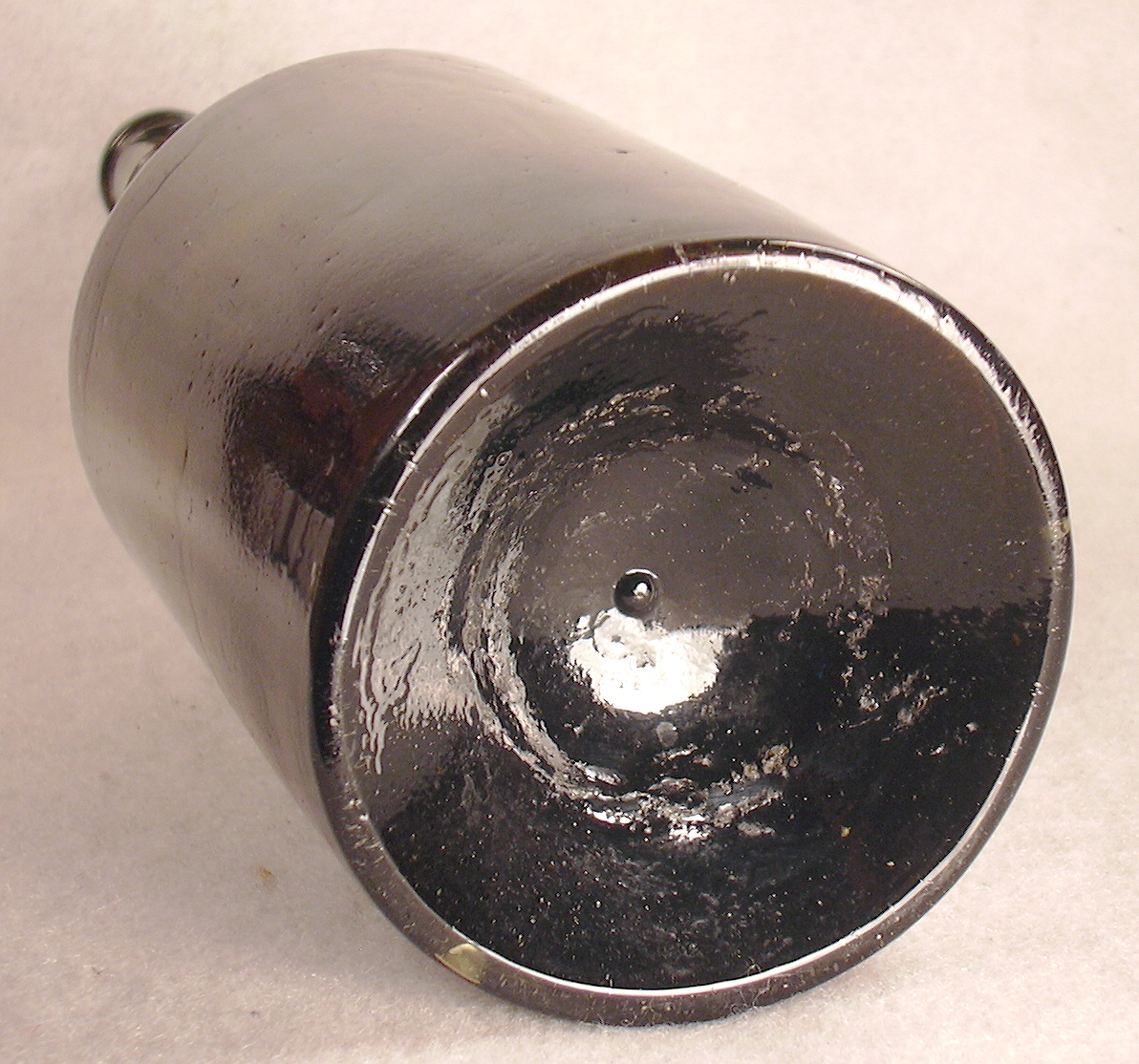 Sand
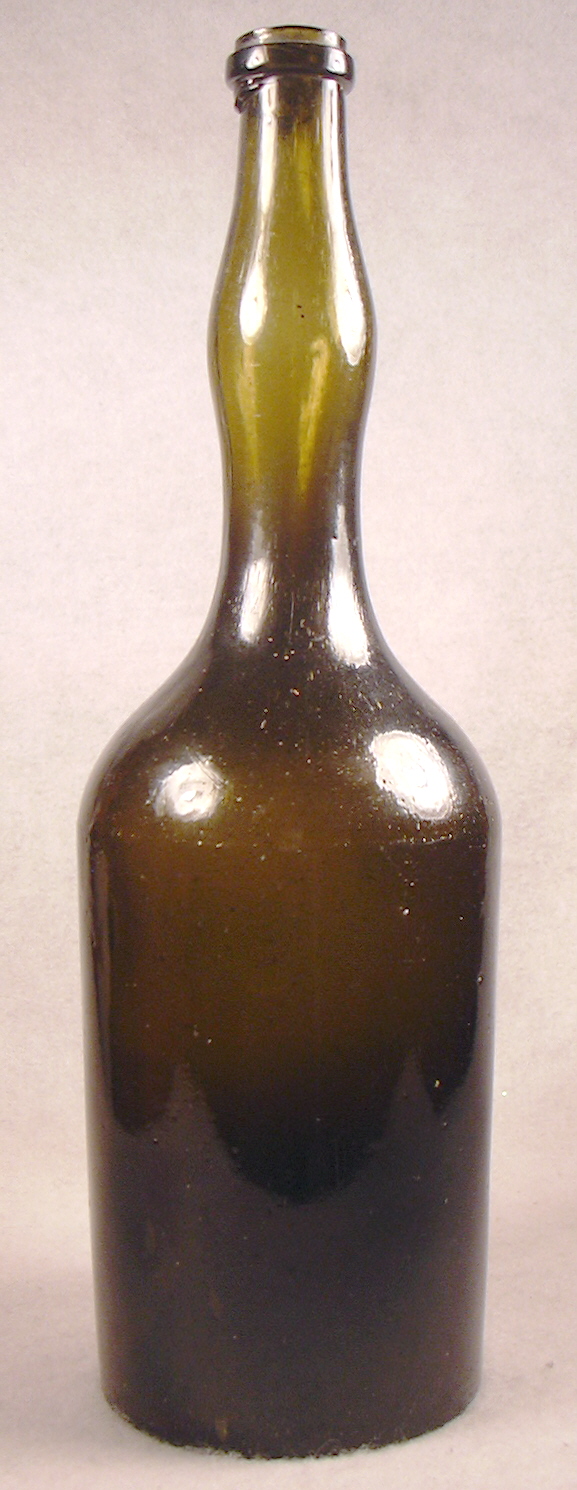
Pontiled "Ladies Leg" bitters bottle - This is a nice example of an
early (1850s) "ladies leg" style bottle typically used for bitters but certainly
used for other spirits products also. As far as I can tell, this style was
a popular American invention for bottling bitters with no foreign equivalents. Yes, European
bottles can have a bulging neck but these tall - 12" - bottles with the pictured
proportions were pretty much exclusively made and used in the US. The
style goes back to around 1850 though I don't know when the style was first
made. There are numerous examples of the style listed in Ring & Ham's
classic "Bitters Bottles" books which have some type of pontil scar.
Sand
Pontiled "Ladies Leg" bitters bottle - This is a nice example of an
early (1850s) "ladies leg" style bottle typically used for bitters but certainly
used for other spirits products also. As far as I can tell, this style was
a popular American invention for bottling bitters with no foreign equivalents. Yes, European
bottles can have a bulging neck but these tall - 12" - bottles with the pictured
proportions were pretty much exclusively made and used in the US. The
style goes back to around 1850 though I don't know when the style was first
made. There are numerous examples of the style listed in Ring & Ham's
classic "Bitters Bottles" books which have some type of pontil scar.
The pontil scar on this bottle - which is the round rough circle distinctly encircling the embossed, centered bump in the image to the left - is known as a "sand pontil" or "disc pontil" scar and dates back to antiquity (think Roman era). Click on the base view to the left to see a larger version of that image. If unfamiliar with that feature, click on the following link for an in depth discussion of it on my educational Historic Glass Bottle ID & Information Website (HBW for short): https://secure-sha.org/bottle/pontil_scars.htm#Sand%20Pontil This bottle is one of my earliest purchases back when our family was getting into bottle digging/collection. It came from Dr. Rittenhouse when he was selling bottles at Western bottle shows in the late 1960s into the 1970s. He noted that it was dug in the California Mother Lode country, though that doesn't narrow down the location much. I think it was the first pontiled bottle we acquired and quite a beauty.
It has an applied "champagne" style finish with some nice slop over on the upper neck. I cover that period popular style on my HBW at the following link: https://secure-sha.org/bottle/finishstyles2.htm#Champagne This was a frequently used lip (finish) style for alcoholic beverage bottles from the late 18th century to the last quarter of the 19th century. Click close-up of the shoulder, neck and finish to see such closer up. This bottle was blown in a three-piece mold - a mold conformation which was originally invented in England in 1820. Such molds usually show an horizontal mold line right at the interface of the upper vertical body and the lower shoulder. It is hard to see on this bottle but the horizontal mold line does show at the shoulder at the following link: shoulder area image. The upper shoulder and neck mold seams are there with close inspection with the bottle in hand.
(Note: I have a few more "ladies leg" bitters bottles to list in the future: an ex-Gardner collection, shoulder embossed Canton (star) Bitters; a milk glass, base embossed Sazerac Bitters; and a certainly Western made, beautiful medium grass green unembossed example found in Oregon.)
Getting back to this offering...the color of the glass is a somewhat dark olive green with maybe a touch of amber. The glass is beautifully full of various sized bubbles and has nice stretch marks in the neck. Click shoulder area image hot link also shown above to see some of the glass texture and bubbles. There are no chips, dings, cracks or other post-production issues and the glass surface is shiny and just about totally scuff free. The insides of the bottle have some faint content staining but it is close to invisible. In short, the condition of the bottle is near mint and I'm sad to part with it but can't keep everything. $135
...MORE TO COME IN THE FUTURE!
Click on the following links to go to these other pages with more bottles for sale.
Listed prices do not include shipping & insurance. Please read the Important Information for Buyers section on the main "Bottles For Sale" page for complete buyer information.
Please confirm item availability prior to sending any type payment and include your zip code in your message so that the shipping can be calculated.
Click here to return to the main Bottles For Sale Page menu

My email is -
© Copyright 2026
Page Last Updated: 9/25/2026