

FOODS & CANNING JARS
Listed prices do not include shipping & insurance. Please read the Important Information for Buyers section on the main "Bottles For Sale" page for complete buyer information.

 Large
size "Gothic" pepper sauce bottle - This is a seldom encountered
example of the largest size (that I've ever seen) fancy Gothic style pepper
sauce bottle. This cool bottle is a towering (for a pepper sauce) 10.75"
tall and is square with each side equally 2.5" in width. Its body looks
like a smaller size pickle bottle from the top of the bulging ring at the base
of the neck down (7.75" from the lower side panel/base edge) but with a
small sauce type neck and finish from the neck ring up. It is not the
result of some weird retooling of a pickle bottle, but was designed to be a kind
of design cross between a pickle and sauce bottle, but was certainly used for
sauce (no pickles could fit down that neck). The first time I saw one of
these I had to have one...this is the one which is an ex-Greg Spurgeon auction
item I believe.
Large
size "Gothic" pepper sauce bottle - This is a seldom encountered
example of the largest size (that I've ever seen) fancy Gothic style pepper
sauce bottle. This cool bottle is a towering (for a pepper sauce) 10.75"
tall and is square with each side equally 2.5" in width. Its body looks
like a smaller size pickle bottle from the top of the bulging ring at the base
of the neck down (7.75" from the lower side panel/base edge) but with a
small sauce type neck and finish from the neck ring up. It is not the
result of some weird retooling of a pickle bottle, but was designed to be a kind
of design cross between a pickle and sauce bottle, but was certainly used for
sauce (no pickles could fit down that neck). The first time I saw one of
these I had to have one...this is the one which is an ex-Greg Spurgeon auction
item I believe.
Like with the typical Gothic style pickle bottles (one offered below) three sides are ornately embossed on the shoulder as well as the upper end of the indented panels; the fourth back panel has the shoulder embossing but the indented panel is left open for accepting a label. Click the 3rd and 4th panel view to see the reverse view of this bottle compared to the image to the left. The glass is a nice blue aqua and about identical in depth and blue-ness to the pickle below. As with the pickle the glass is wavy and pleasing on most panels; some nice stretch marks on the neck also. The overall Gothic embossing is also very similar to the pickle but upon close inspection the shoulder and upper panels are subtly different in execution. Compare the images of the two bottles.
The lip/finish of the bottle is of the "mineral" variety and much more commonly seen on mineral water bottles. (I cover the style on my Historic Bottle Website at the following link: https://secure-sha.org/bottle/finishstyles.htm#Mineral%20or%20Double%20Oil ) It is applied with some nice "globiness" underneath the lower part just about all the way around. The base of this bottle has a round and fairly deeply indented center with about as big of an "open" (blowpipe) pontil scar as one can encounter essentially filling the indented base. Click base view to see such. The small felt pads on the corners are not to help it stand straight as the base is about perfectly flat. Apparently just what the previous owner wanted to limit wear on the base? The bottle is in essentially perfectly mint condition as it came from the (unknown) glass works (1850s) with no staining, chips, cracks, etc. and very little wear. There is very tiny bubble at the base of one corner which has a bit of a "disturbance" to it which I think is either a very, very small sand grain or some bit of reflection from the inside surface of the bubble; in making certainly (like all the bubbles) and extremely hard to see. One of the finer examples of a quite rare but quite large pepper sauce bottle from the pre-Civil War period. $295 SOLD


 Larger
"Gothic" pickle bottle - Here is a very nice larger (quart+) sized
gothic pickle bottle I've had for years. I purchased this example back in
the early 1990s from the New York City auction firm of Harmer Rooke
Galleries. I don't know the full story of their problems except their
bottle expert (Chuck Moore) had some money related issues and the company quit
handling bottles at some point after 1995 or so. (Note: A quick search of the internet
indicates that the company is still operating! I do believe that when Mr.
Moore left the company - fired I think - that they quit handling bottles and
flasks but still do a myriad of other auctions, e.g., coins, stamps, and other
antiquities.) Click base view
to see the original Harmer Rooke Galleries sticker...and the rest of
the base also of course.
Larger
"Gothic" pickle bottle - Here is a very nice larger (quart+) sized
gothic pickle bottle I've had for years. I purchased this example back in
the early 1990s from the New York City auction firm of Harmer Rooke
Galleries. I don't know the full story of their problems except their
bottle expert (Chuck Moore) had some money related issues and the company quit
handling bottles at some point after 1995 or so. (Note: A quick search of the internet
indicates that the company is still operating! I do believe that when Mr.
Moore left the company - fired I think - that they quit handling bottles and
flasks but still do a myriad of other auctions, e.g., coins, stamps, and other
antiquities.) Click base view
to see the original Harmer Rooke Galleries sticker...and the rest of
the base also of course.
Anyway...this pickle was part of a lot of three Gothic or "cathedral" food bottles I acquired from them (the others to be listed in the future). Period glass makers referred to these style of design as "Gothic"; I think that "Cathedral" is a later collector term. For example, the earliest bottle makers catalogs I have copies of were put out by the Whitall, Tatum & Co. in 1879 and 1880. Both use the term "Gothic" or "square Gothic" for this style of both square pepper sauce bottles and pickle jars. (If you have a copy, the 1880 catalog actually has an illustration of a Gothic pepper sauce bottle on page 49 and that it was available in pint and quart sizes.) The Gothic style got its name because it apparently resembled or was inspired by the tall, narrow often fancy leaded glass window of churches, universities and the like. The style originated at least as early as about 1850 for both pepper sauces (smaller square and sometimes hexagonal) and pickle bottles which certainly included other pickled or preserved foods. Gothic pickle and pepper sauce bottles were salvaged from several of the shipwrecks of the era that I've studied the bottles in person - S.S. Arabia (1856), S.S. Bertrand (1865) and the S.S. Republic (1865). I think this example dates to around the end of the Civil War to early 1870s.
I don't know the exact origin of this particular, moderately large pickle bottle but it is a beauty. It stands 11" tall, is square with sides that are 3" wide and has a smooth (non-pontil scarred) domed base. Three of the sides are as shown in the images to the right; the 4th side has the decorative shoulder embossing but doesn't have the inset upper "window" embossing. That was done on purpose on such bottles to facilitate the application of a paper label. Click on reverse view to see the two sides of the jar not shown in the images to the right including the noted label panel. The rounded bead type lip was certainly tooled to shape without the application of additional glass, i.e, that it is a typical rolled lip (aka "finish" in glassmakers terminology) but is pretty crude anyway with a bit of unevenness and stretch marks in the neck below it. The glass has lots of small bubbles and a few larger ones here and there; the blue aqua glass surface is wavy and crude - a great window bottle. The condition is near mint with only a few small minor and hard to see patches of faint interior stain and a non-distracting scratch here and there on the outside. I don't believe it was professionally cleaned but I can't say for sure; it certainly wasn't over cleaned if done at all. A great example of an early food bottle that is popular with collectors for obvious reasons. $225

 TRADE
MARK / LIGHTNING - That is embossed on the body of
this impressively large (over 10" tall and 4.25" in diameter) half gallon jar.
Colored Lightning jars are a popular with collectors item since they come in a
run of very interesting colors including many shades of amber like this offered
example. This jar was acquired to illustrate the food bottles section of
the
Historic Bottle Website; the history of these innovative jars is
available on my other website at this link:
Lightning canning jar. The amber jars are somewhat abundant though
quite popular with the pint being the rarest with these half gallons being much
rarer than the quarts. The base is embossed with PUTNAM and the
mold number 156; click base
view to see such. The base also has - as the image shows - some
flat, blotchy glass markings which was the result of the glass blower slopping
glass fragments into the mold bottom and not cleaning them out... an interesting
crudeness seen with hand-made production item.
TRADE
MARK / LIGHTNING - That is embossed on the body of
this impressively large (over 10" tall and 4.25" in diameter) half gallon jar.
Colored Lightning jars are a popular with collectors item since they come in a
run of very interesting colors including many shades of amber like this offered
example. This jar was acquired to illustrate the food bottles section of
the
Historic Bottle Website; the history of these innovative jars is
available on my other website at this link:
Lightning canning jar. The amber jars are somewhat abundant though
quite popular with the pint being the rarest with these half gallons being much
rarer than the quarts. The base is embossed with PUTNAM and the
mold number 156; click base
view to see such. The base also has - as the image shows - some
flat, blotchy glass markings which was the result of the glass blower slopping
glass fragments into the mold bottom and not cleaning them out... an interesting
crudeness seen with hand-made production item.
This jar is a light-ish medium golden amber color with a bit of orange to it; the full view image shows the color accurately to my eye. Condition is near mint as with most of these jars (which were rarely tossed and buried unless broken). The minor condition exceptions follow: some minor scratching/scuffing to the body, ample base wear (where it should be), some rusting/pitting to the wire bail (but quite solid and totally intact); and a small flake to the underside of the color matching glass lid which is visible in the enlarged image showing the lid (lid has the usual patent dates embossed on it). The ground rim is essentially perfect and better than average as it has very little evidence of grinding flaking. Nice jar with some body crudeness and bubbles. $100


 Labeled
Pepper Sauce bottle - This is a very nice blue aqua, fluted body
pepper sauce which has the original label on it. The label is of a
"gothic" panel-like shape which was a common indented panel on mid to late 19th
century pepper sauce bottles, including the earlier gothic or "cathedral" pepper
sauces. The label reads "PEPPER / SAUCE / INDIA MILLS / NEW YORK. It
is 100% complete but does have a narrow separating in the upper middle which
must have happened when it was wetted and stuck on.
Labeled
Pepper Sauce bottle - This is a very nice blue aqua, fluted body
pepper sauce which has the original label on it. The label is of a
"gothic" panel-like shape which was a common indented panel on mid to late 19th
century pepper sauce bottles, including the earlier gothic or "cathedral" pepper
sauces. The label reads "PEPPER / SAUCE / INDIA MILLS / NEW YORK. It
is 100% complete but does have a narrow separating in the upper middle which
must have happened when it was wetted and stuck on.
The bottle has six equal vertical sides all of which are indented and 5 of the 6 with two embossed lines running vertically within the panels; the sixth label panel does not have these lines (which would have likely made it harder to glue the label on if present). It is a bit over 8" tall, has a tooled double ring finish (aka lip) typical of that era's sauce bottles, a smooth (non-pontiled) indented "post-molded" base, and likely dates from the 1880s or early 1890s I suspect.
Betty Zumwalt's excellent 1980 book "19th Century Food in Glass" lists this bottle - also with a label (but slightly different in wording) - on page 255 and notes it is "extremely rare." That rarity is certainly true for examples with the original label - and this offered bottle is of a nice blue aqua color whereas the book example is of "clear" glass. (Betty didn't note any history about the company, alas.) I acquired it many years ago, later using it to illustrate one of a variety of pepper sauce bottles on my Historic Bottle Website at this link: https://secure-sha.org/bottle/food.htm#Ribbed%20sauce The bottle is in essentially mint condition with no chips, cracks, dings or really any scratching. There is some very faint content "haze" which may wash out, but not worth the chance of damaging the label. Nice bottle! $35

 A.
STONE & Co
/ PHILADA - Offered here is classic,
crude and early, about quart sized wax sealer fruit jar with the "groove ring
wax seal" finish - all in essentially pristine condition. The wax sealer
fruit jars are some of the earliest jars made for the home canning of fruit and
vegetables. Thus, they are some of the most sought after jars by
collectors of 19th century fruit jars. Even after Mason's patenting of the
shoulder seal screw cap closure fruit jars, wax seal (with the addition of the
insert metal disk) fruit jars were still made and used into the early 20th
century. There were even Ball jars with this type "groove ring wax sealer"
finish made by machine as late as about 1912 according the Creswick (1987) book
"The Fruit Jar Works - Volume 1." I guess some home canners were
still more comfortable with the old ways of canning back then, even though the
Mason jars had been around half a century since it was patented as noted on many
for the jars - November 20th, 1858! (Note: The close-up of the shoulder,
neck and groove ring finish to the right shows some very faint discoloring in
the groove. Specifically, it is inside the glass of the thick outer ring
and in making. I suspect it is a streak of some inclusion in the applied
finishing glass that shows up much more in the the photo than in real life.)
A.
STONE & Co
/ PHILADA - Offered here is classic,
crude and early, about quart sized wax sealer fruit jar with the "groove ring
wax seal" finish - all in essentially pristine condition. The wax sealer
fruit jars are some of the earliest jars made for the home canning of fruit and
vegetables. Thus, they are some of the most sought after jars by
collectors of 19th century fruit jars. Even after Mason's patenting of the
shoulder seal screw cap closure fruit jars, wax seal (with the addition of the
insert metal disk) fruit jars were still made and used into the early 20th
century. There were even Ball jars with this type "groove ring wax sealer"
finish made by machine as late as about 1912 according the Creswick (1987) book
"The Fruit Jar Works - Volume 1." I guess some home canners were
still more comfortable with the old ways of canning back then, even though the
Mason jars had been around half a century since it was patented as noted on many
for the jars - November 20th, 1858! (Note: The close-up of the shoulder,
neck and groove ring finish to the right shows some very faint discoloring in
the groove. Specifically, it is inside the glass of the thick outer ring
and in making. I suspect it is a streak of some inclusion in the applied
finishing glass that shows up much more in the the photo than in real life.)
Quite a few different fruit jars in different variations and sizes were made for the Amasa Stone & Co. by various glass companies in that region which had lots of glass makers. The the only variations of that included makers markings on the A. Stone & Co. jars were Cunninghams & Co. and Cunninghams & Ihmsen - both in Pittsburgh. Many of the Stone jars were simple wax sealers like this offering though others utilized glass lids with internal threads inside the bore to seal along with (I think) a rubber gasket. Some jar variations were pontiled, some were smooth base like this example and other variations can be found both ways. (A view of the base of the jar is available at the following link: base view.)
According to Creswick, all the jars date from 1857 to 1863 based on Philadelphia city directories. Dick Roller's "The Standard Fruit Jar Reference" (2011) notes the same source but from 1857 to 1864. Call them Civil War era jars. Given the relatively short period of time that Stone jars were made the company certainly used a wide assortment of different embossing and sized jars. For those keeping score, this example seems to be Roller #1238a or #1239a (pages 493-494)- the "a" examples being smooth base; no pontil scar. With Creswick, this jar is likely #2743-1 or possibly #2744 (pages 203-204).
This jar is 7" tall, 4.25" wide at the base, was blown in a post-base mold and has no pontil scar, i.e. a smooth base. The jar is a very nice deeper than usual blue aquamarine color glass and has some nice bubbles in the glass - none open that I can see or feel. The following two links are of the jar in a window with natural light showing better the embossing (front) and the heavy "whittle" effect (back) to the glass: front view; back view. It has the standard wax seal finish of the times - the groove ring wax seal finish. (I cover this finish type on my other educational Historic Bottle Website at the following link: https://secure-sha.org/bottle/finishstyles3.htm#Wax%20Seal ) A looking down view at the groove ring finish/lip is at the following link: close-up of the finish. (The previous linked image of the lip/finish for some reason indicates the glass color to be of a green shade. It is not and all the other blue aqua images are accurate under both artificial and natural light.) A view of the back of the jar is at the following link: reverse view.
Condition of this spectacular jar is essentially perfect. I can find no manufacturing issues or significant post production issues with it besides a couple small and faint scuff marks on the back shoulder and age appropriate wear around the resting edge of the base. It appears to never have been buried and has no evidence of a professional cleaning. It is hammered whittle as they say; see the two window views linked above to see it best. It is likely in the competition for the most "whittled" bottle that I have owned. The embossing is exceptionally bold. It is an Ex-Spurgeon auction item from years back when I acquired it. He has more recently sold a couple essentially identical quart examples. One was described as having "tiny flakes on the lip" and sold for $800 + 13.5% commission -$900+. The other was in December 2025 and essentially identical - perfect - for $1330 (including the commission)! I'm not really a jar collector but have picked up a few here and there because they were cool and/or useful to illustrate something on my other previously noted website. This one is priced well considering those sales and it's perfection. $795
SAN FRANCISCO / GLASS WORKS - This is an example (following the "An Interesting Western-made..." section below) of one of the classic and rare wax sealer jars made on the West Coast in the 1870s. Actually, probably the only embossed wax sealer of Western origin. This is what I believe to be the hardest to find - the half gallon size - though it and the quarts are all quite rare and desired. I've had a couple of the quarts over the years along with an example of the third use of the same mold. I explain this on my Historic Glass Bottle ID & Information Website which is cut 'n pasted below from that educational site:
An Interesting Western-made Applied Groove Ring Wax Seal Canning Jar Story
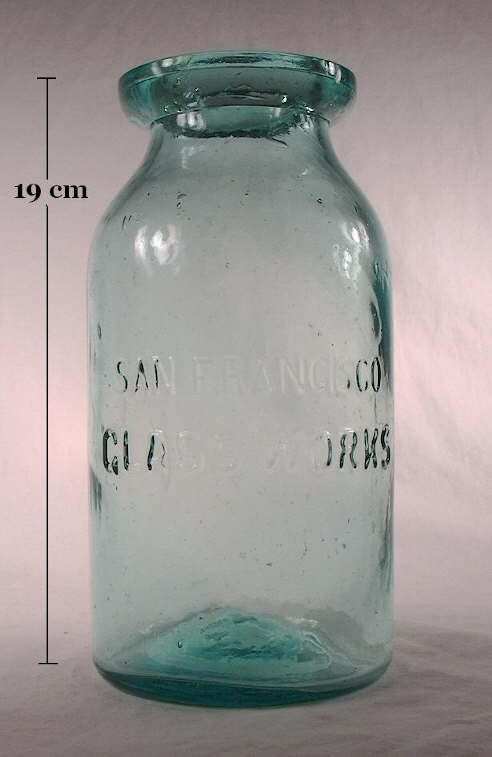 The
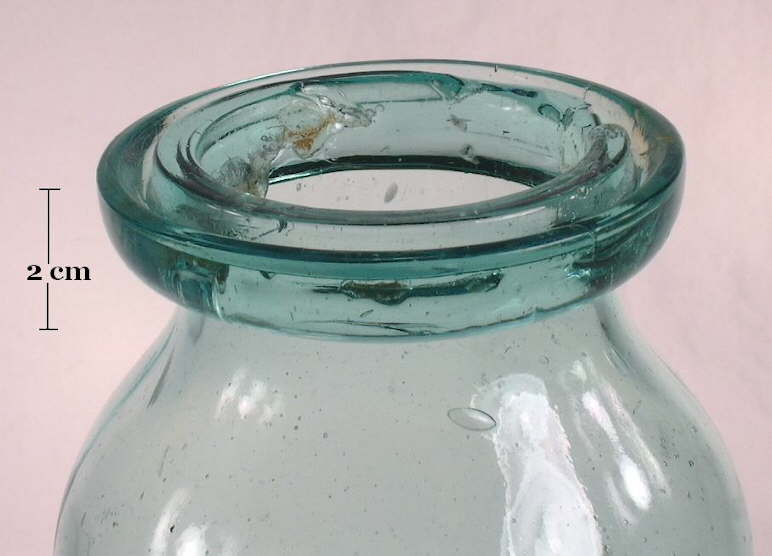
quart, applied groove ring wax seal canning jar pictured to the right (finish
close-up below left) is embossed with SAN FRANCISCO / GLASS
WORKS. This jar was also blown in a post-bottom mold, is fairly crude
("whittled" uneven bubbly glass), and lacks any evidence of mold air venting.
This glass company operated under this name from 1869 to 1876, although the jars
from this mold were also likely produced as late as the early 1880s by the
successor to that company - the San Francisco & Pacific Glass
Works (Toulouse 1971; Creswick 1987; Hinson 1995).
The
quart, applied groove ring wax seal canning jar pictured to the right (finish
close-up below left) is embossed with SAN FRANCISCO / GLASS
WORKS. This jar was also blown in a post-bottom mold, is fairly crude
("whittled" uneven bubbly glass), and lacks any evidence of mold air venting.
This glass company operated under this name from 1869 to 1876, although the jars
from this mold were also likely produced as late as the early 1880s by the
successor to that company - the San Francisco & Pacific Glass
Works (Toulouse 1971; Creswick 1987; Hinson 1995).
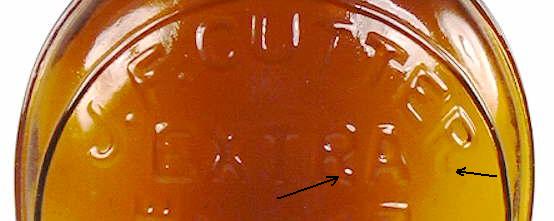
One interesting aspect about this particular quart jar is that the mold used to make it was also used for an earlier and a later jar - both with different embossing, although this mold was not designed for an interchangeable embossing plate. How did this happen? A close inspection of the pictured jar shows that there is the faint impression of a arched blank filler plate covered area just above the SAN FRANCISCO embossing. The first or original jar made with this mold was embossed in this now covered arch with CUTTING.AND.CO for the Cutting Packing Company (Zumwalt 1980). This jar was certainly blown at the Pacific Glass Works (San Francisco, CA.) who were in business from 1862 to 1876, and not by the short lived Baker & Cutting bottle factory (also in San Francisco and the same Francis Cutting as the noted packing concern and the first glass factory in the American West) in business 1858-1859 (Zumwalt 1980). Click on the following links to see images of the earlier jar (courtesy of American Bottle Auctions): entire Cutting jar; close-up of the embossing.
 After
being used for a relatively lengthy period of production for the pictured jar
(with the words GLASS WORKS having been cut
into the mold below the previously existing SAN FRANCISCO)
the entire embossing pattern (i.e., SAN FRANCISCO / GLASS WORKS) was
covered by another plate and the reverse half
of the mold cut with M. SELLER & CO. / PORTLAND, O. Click M.
Seller quart jar to see the embossing side of
this jar; the plate covered embossing areas on the now reverse side of the jar
are too faint to photograph but are obvious upon actual examination. The M.
Seller quart jars were blown by the San
Francisco & Pacific Glass Works (1876-1902) in the early to
mid-1880s and clearly shows the now three previous lines of embossing covered by
two plates on what was now the reverse side of the jar. This is a great
example of the type of duty a mouth-blown mold could be put to with some
adaptation. It is also an example of potential mold life in that this mold
saw duty for around a decade or so, i.e., from the early to mid 1870s to the mid
1880s (Toulouse 1971; Creswick 1987).
After
being used for a relatively lengthy period of production for the pictured jar
(with the words GLASS WORKS having been cut
into the mold below the previously existing SAN FRANCISCO)
the entire embossing pattern (i.e., SAN FRANCISCO / GLASS WORKS) was
covered by another plate and the reverse half
of the mold cut with M. SELLER & CO. / PORTLAND, O. Click M.
Seller quart jar to see the embossing side of
this jar; the plate covered embossing areas on the now reverse side of the jar
are too faint to photograph but are obvious upon actual examination. The M.
Seller quart jars were blown by the San
Francisco & Pacific Glass Works (1876-1902) in the early to
mid-1880s and clearly shows the now three previous lines of embossing covered by
two plates on what was now the reverse side of the jar. This is a great
example of the type of duty a mouth-blown mold could be put to with some
adaptation. It is also an example of potential mold life in that this mold
saw duty for around a decade or so, i.e., from the early to mid 1870s to the mid
1880s (Toulouse 1971; Creswick 1987).
(Note: One further observation about these San Francisco made jars is that the original mold engraver or "mold cutter" for the Cutting jar and the mold cutter for the later two jars appear to be two different people as the style of the embossed lettering is distinctly different. In particular, the later mold cutter was the one who made a distinctive "R' with an outwardly curving angled leg. This "R" is a distinctive feature found on scores of different Western bottles that were almost certainly made at the San Francisco & Pacific Glass Works between about 1876 and the mid-1880s, and possibly the latter days [early to mid 1870s] of one or both of the precursor glass companies [Pacific Glass Works and/or San Francisco Glass Works]. Click curved "R" to view an image of a late 1870s liquor flask with this feature pointed out and almost certainly "cut" by the same mold engraver as these jars. )

 Interesting
Western glassmaking history, eh?! All three jars come in two sizes - half
gallon and quart. This offering is for the half gallon size which was the
2nd use of the original Cutting mold. Click
this offered jar next to a quart
M. Seller's jar to see the difference in size between a quart and half
gallon. As noted, this example is embossed with SAN FRANCISCO /
GLASS WORKS (on two lines) with the embossing the same size/height as
the quart jars. Click close-up of the
embossing inside to see such; click
natural light view to see an
image with outside background lighting. Other images are also available as
follows: view of the
backside of the jar; view of
the base and side; view of the
grooved wax seal finish.
Interesting
Western glassmaking history, eh?! All three jars come in two sizes - half
gallon and quart. This offering is for the half gallon size which was the
2nd use of the original Cutting mold. Click
this offered jar next to a quart
M. Seller's jar to see the difference in size between a quart and half
gallon. As noted, this example is embossed with SAN FRANCISCO /
GLASS WORKS (on two lines) with the embossing the same size/height as
the quart jars. Click close-up of the
embossing inside to see such; click
natural light view to see an
image with outside background lighting. Other images are also available as
follows: view of the
backside of the jar; view of
the base and side; view of the
grooved wax seal finish.
The jar is 8.5" tall and 4.25" diameter at the base. It is a nice moderately deep blue aqua which is a common coloration for the aqua products of this company for many years. The jar was blown in a post-base type mold evidenced by the two side mold seams curling around the edge of the base ending at the "post" plate area centered on the base. The glass has scattered bubbles in the glass and an applied groove ring wax sealed lip or finish. The jar is in near mint condition with no staining or scratching - just a bit of wear on the bases resting edge which is common with fruit jars used for years and not buried.
The only issue that keeps this jar from being "mint" is that there are two very small nicks on the edge of the rim towards the backside of the jar on the left. They are very hard to see and photograph but I took several images which shows them barely. Click inside close-up view of the two tiny nicks and natural light view of the two tiny nicks to see such. One is about pin head size and the other even smaller. These jars often have issues, but this is one of the better half gallon examples I believe. These jars are in demand by Western collectors since they are one of the few early fruit jars made out West. The only recent comparables I've seen were of ever-so-slightly more abundant quarts and they sold for $2800 (North American Glass - not including the commission) and $2899 (eBay)! This example came from one of the Western auction houses (forgot which but probably ABA) a long time ago. Time to pass it on. $1750

 PRIMROSE
/ REGISTERED (in a banner) / BRAND / WESTERN MEAT COMPANY - This is one
of those odd bottles that looks like one thing - an early 20th century liquor
bottle - but was actually something quite different - salad oil!
Actually, this shape was commonly used for both oil and liquor during the first
couple decades of the 20th century - at least in the West which is where this
bottle comes from. It is 11" tall, aqua in color, with a tooled
finish...it is essentially mint with now staining, chips, cracks or other
post-production damage only a few light scuffs here and there. This bottle
was also acquired to illustrate the food bottles section of the
Historic Bottle Website. Here is the write-up from that website
which more fully describes this interesting bottle:
PRIMROSE
/ REGISTERED (in a banner) / BRAND / WESTERN MEAT COMPANY - This is one
of those odd bottles that looks like one thing - an early 20th century liquor
bottle - but was actually something quite different - salad oil!
Actually, this shape was commonly used for both oil and liquor during the first
couple decades of the 20th century - at least in the West which is where this
bottle comes from. It is 11" tall, aqua in color, with a tooled
finish...it is essentially mint with now staining, chips, cracks or other
post-production damage only a few light scuffs here and there. This bottle
was also acquired to illustrate the food bottles section of the
Historic Bottle Website. Here is the write-up from that website
which more fully describes this interesting bottle:
The pictured bottle above is embossed vertically with PRIMROSE / REGISTERED / BRAND / WESTERN MEAT COMPANY. This is known to be a salad dressing bottle as other variants are embossed with PRIMROSE SALAD OIL (Zumwalt 1980). Like its liquor bottle relatives, this salad oil bottle was blown in a cup base mold, has a tooled brandy finish, and plentiful air venting marks on the shoulders, body edges, and integrated within the embossing; it almost certainly dates from between 1905 and 1920. Click on the following links for more images of this bottle: base view showing the cup base mold conformation (base is 2.9" square); close-up of the shoulder, neck and finish. The Western Meat Company began business around 1895 and was located in Chicago but had several packing houses in California (Zumwalt 1980). It's president was Gustavus Swift and the company was (or became) part of Swift & Company - still one of the largest meat processing and food companies in the world (source: www.swiftbrands.com). Swift & Co. also used a similar aqua glass bottle that is embossed with MONOGRAM SALAD OIL / SWIFT & CO. / U.S.A. (Zumwalt 1980).
That about tells the story. Bottle also has some crudeness in the form of bubbles in the glass and a small but interesting ripple mark at the back corner - a byproduct of the hand manufacturing. $25
 Queen
Olives XXX Francis H. Leggett & Co. - This tall olive bottle is product
labeled indicating it contained "Queen Olives" and was used by the Francis H.
Leggett & Co. (New York). The label is about 95%+ intact, the base is
embossed as described below, 11.25" tall, clear glass, tooled one-part finish,
and from the late 19th century. This bottle was also acquired to
illustrate the food bottles section of the
Historic Bottle Website and like the bottle above, came from a large
collection of labeled food bottles. Here is the write-up from that website
which more fully describes this interesting bottle:
Queen
Olives XXX Francis H. Leggett & Co. - This tall olive bottle is product
labeled indicating it contained "Queen Olives" and was used by the Francis H.
Leggett & Co. (New York). The label is about 95%+ intact, the base is
embossed as described below, 11.25" tall, clear glass, tooled one-part finish,
and from the late 19th century. This bottle was also acquired to
illustrate the food bottles section of the
Historic Bottle Website and like the bottle above, came from a large
collection of labeled food bottles. Here is the write-up from that website
which more fully describes this interesting bottle:
The company began business in 1870 and also continued until at least 1980 (Zumwalt 1980). The base has the embossing F. H. L. & CO. / N. Y. for the F. H. Leggett Co. and is an example of base embossing that without the label would be hard to determine otherwise; it could also possibly be construed as a bottle makers marking. This bottle has a tooled one-part finish, was blown in a post base mold with no obvious evidence of mold air venting, and is somewhat crudely made (e.g., bubbles in the glass, stretch marks on the shoulder/neck, wavy glass). These diagnostic features would indicate a probable manufacturing date between the mid to late-1880s to mid to late-1890s. However, this bottle design with the ribbed lower body was patented by Leggett on February 26th, 1889 giving a good begin date for this particular style. Other examples of these tall bottles have the actual patent date embossed on the base (Caniff 1997). Click Leggett patent 1889 to see that patent. Click on the following links to view more images of this bottle: base view (embossing is minimally visible); close-up of the neck and tooled finish showing the tooled one-part finish.
Yet another perfect condition food bottle with a great label. $25
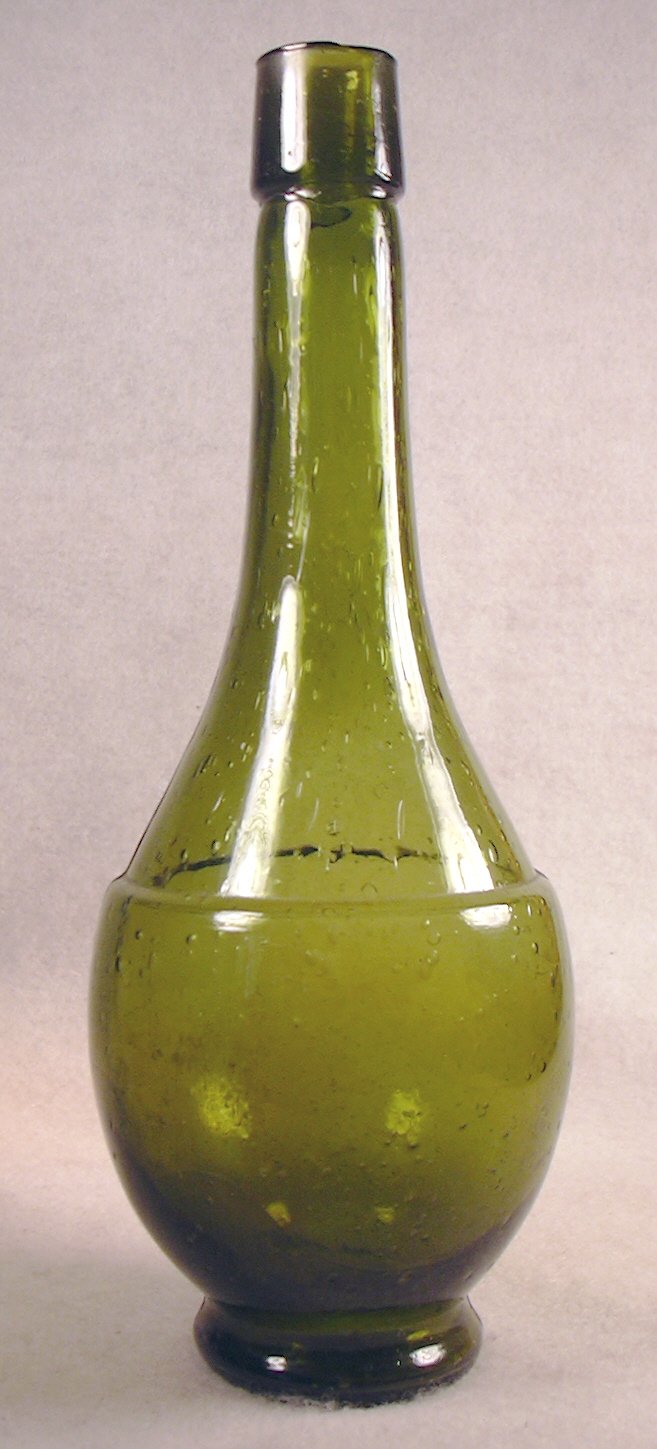
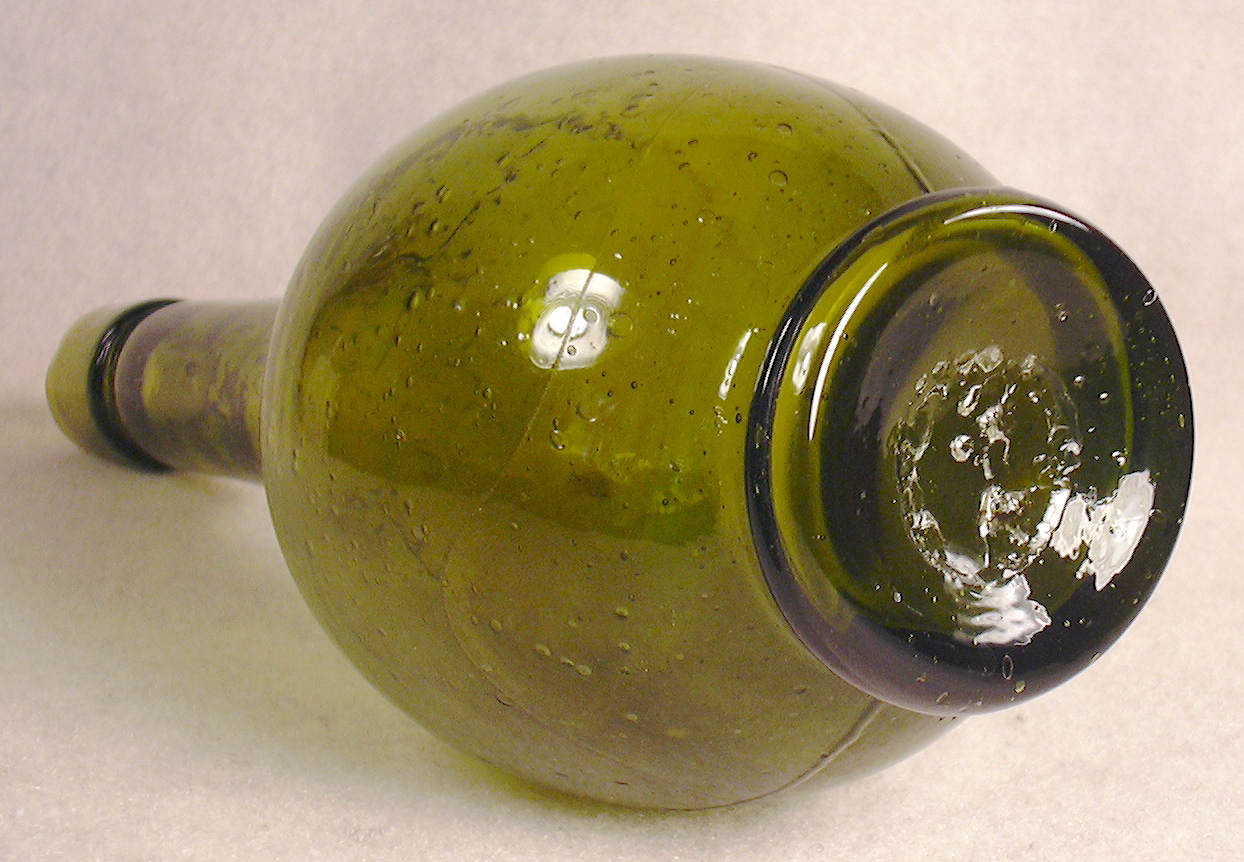 Bulbous
Body pontiled sauce bottle - Offered
here is an enigmatic bottle that has the appearance of a sauce bottle...think
Tabasco or some type of pepper sauce. Maybe it was used for spirits or
olive oil? I picked it up at a garage sale decades ago because it was
obviously an old and interesting bottle with an applied "oil" finish. It
also has a very distinct glass tipped pontil scar on the base. (Click the
base view to the left to see a larger version of the base image.)
Bulbous
Body pontiled sauce bottle - Offered
here is an enigmatic bottle that has the appearance of a sauce bottle...think
Tabasco or some type of pepper sauce. Maybe it was used for spirits or
olive oil? I picked it up at a garage sale decades ago because it was
obviously an old and interesting bottle with an applied "oil" finish. It
also has a very distinct glass tipped pontil scar on the base. (Click the
base view to the left to see a larger version of the base image.)
I've never seen another one like it nor seen one listed in the main "food bottle" books from years back. Unfortunately there is no embossing to help identify what it may of held - just that ridge on the body that you can see in some of the images. Click body view and another body view to see such close up.
The has a crudely applied finish - click close-up of the shoulder, neck and finish to see such. There appears to be a small indentation on the edge of the one part finish in that image but it is just a tooled crudeness and not post-production damage. The bottle is perfect with with no chips, cracks, staining or other issues...and no evidence of having been buried. The glass is amazingly full of various sized bubbles which show in any of the images if enlarged. It is a touch over 9" tall and about 3.5" to 3.75" in width at the widest point of the lower body. A great bottle in even greater shape! $95
...MORE TO COME IN THE FUTURE!
Click on the following links to go to these other pages with more bottles for sale.
|
WESTERN AMERICAN BOTTLES |
Listed prices do not include shipping & insurance. Please read the Important Information for Buyers section on the main "Bottles For Sale" page for complete buyer information.
Please confirm item availability prior to sending any type payment and include your zip code in your message so that the shipping can be calculated.
Click here to return to the main Bottles For Sale Page menu

My email is -
© Copyright 2026
Page Last Updated: 9/25/2026