According to Odell's book, the
earliest examples date to about 1848 and were introduced by Dr. William H. Hall.
Apparently the product was successful enough that it changed hands many times
starting in about 1850 (John F. Henry & Co.), then Hall & Ruckel
(1850-1860) and so on with the location of manufacturing consistently being New
York City. The product was made there until at least the 1920s though that
is much later than this bottle was made which would be Civil War era.
The earliest ones were about
identical to this example except for the use of a snap tool which was necessary
to "finish" the bottle by creating a cork accepted lip. Odell's noted 2000
publication has an image of an early pontil example (page 103). It appears
to be just about identical to my example except maybe a bit wider in the body
side-to-side and with a shorter, one part applied finish than this example
(which is also applied). That includes also the shape of the panels with
the indented corners visible in most of the images which this bottle has on all four sides and appears so
In Odell's book with the one
image. (Note: Betty Blasi's book "A Bit About Balsam's"
(1974) notes this particular variation of the Hall's Balsam and that it
has "Scovill Style" panels referring to the corners. Apparently such was
also used on other products of the Scovill company during that period.) It also has no other embossing
(like Odell's example) outside
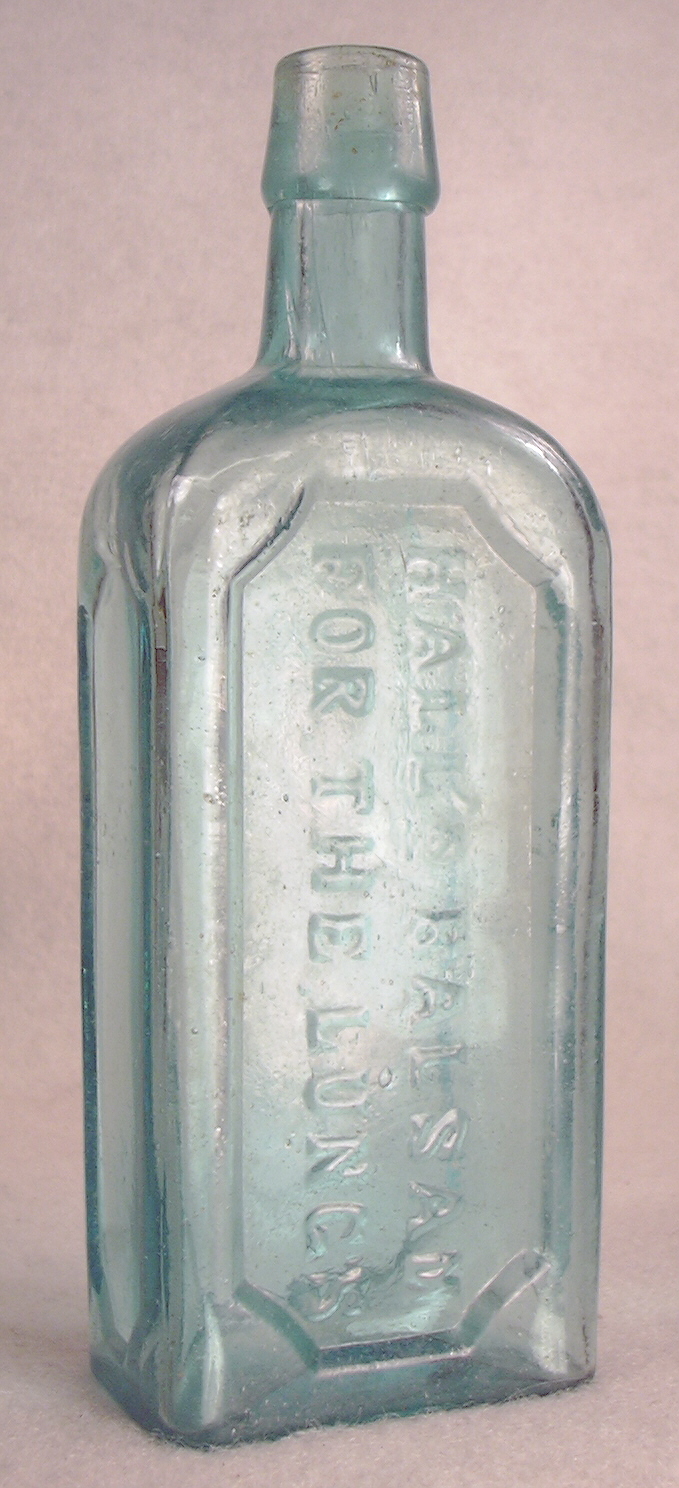
of the vertical HALL'S BALSAM / FOR THE LUNGS on the
front panel. Click the following links for more images:
image of the full back panel;
one narrow side panel;
the other narrow side panel; and
bottle laying on its side with
embossing side showing.
This particular bottle was found in
the Urban Renewal section of downtown SW Portland, Oregon back during the late
1960s along with some other similarly dated items, i.e., Civil War era. This
example is just about perfect with no chips, cracks, dings or other
post-production flaws. It does have some very light haze here and there on
the outside but it is non-distracting. See the images. The glass
color is also shown well in the images - a nice deep blue aqua color. The
bottle is 7.25" tall, 2.5" wide and 1.5" deep. It is over half an inch
taller than the example in Odell's book so likely a different mold since Odell's
seems to be wider in the body. Nice example of a relative scarce early
Hall's Balsam. $70
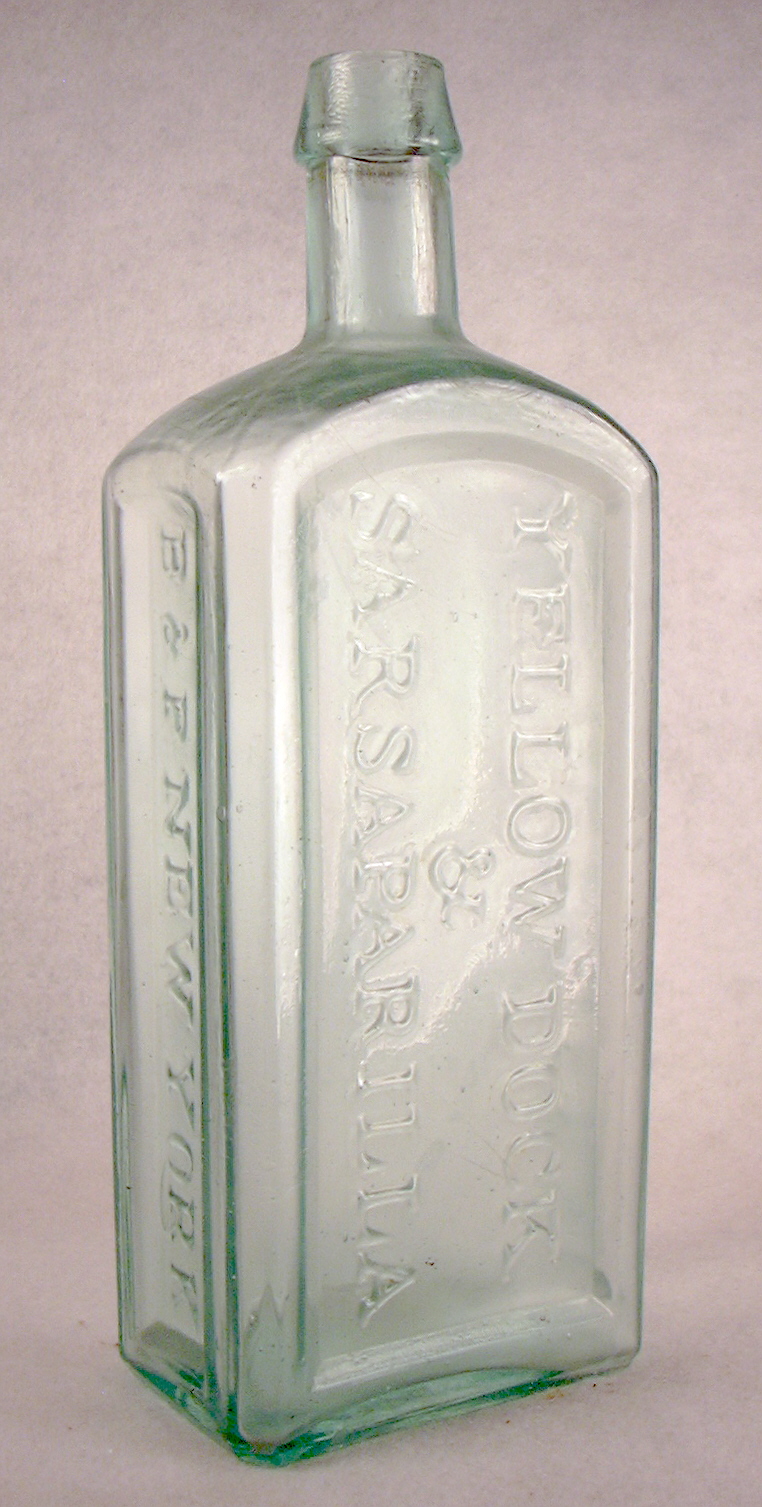
An in depth dive into the various
patent medicine oriented bottle books I have that list Guysott's Yellow Dock
& Sarsaparilla was quite interesting. There was a lot of different
variations of this product starting in 1849 and running up into the 1930s!
(Must have been high alcohol?!) The earliest of the books -
Sarsaparilla Bottle Encyclopedia (Shimko 1969) lists a couple examples with
the same embossing pattern as this example - one with an "open pontil" and 9"
tall, 2 and 7/8" wide & and 2" thick and another which had a "plain"
(non-pontiled) base and was 8.75" tall, 3" wide and 2" deep and a light green
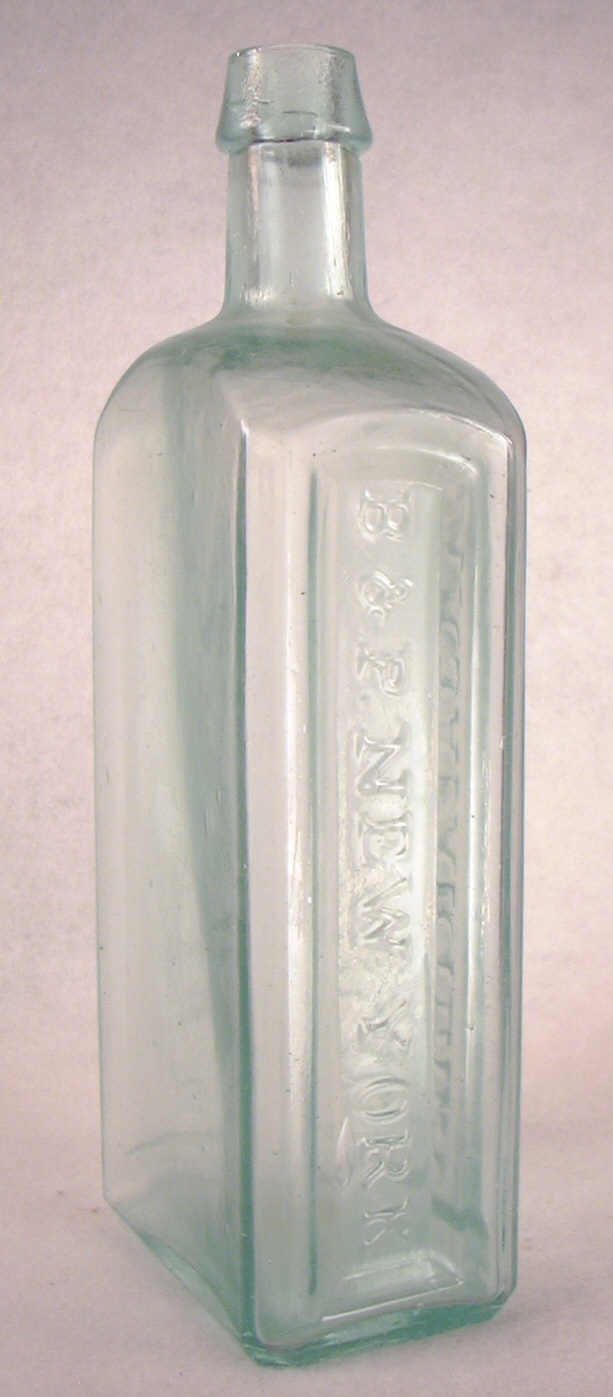
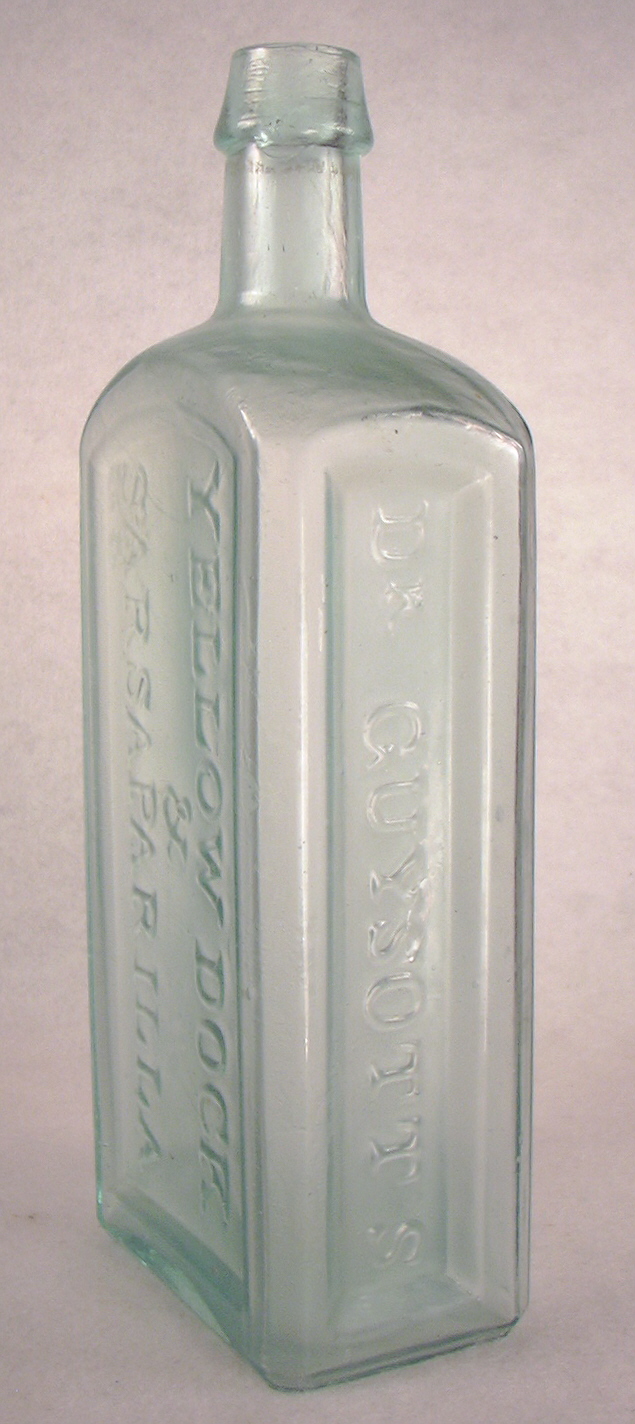
color. Neither quite fits this offered bottle which is 9 5/8" tall, 3.5"
wide and 2 1/8" deep and of a light blue-green aqua coloration. Click on
the images to the right for larger versions of each. She also listed 5
other variations of bottles with that product embossing; most of which are also
e3arly and quite rare).
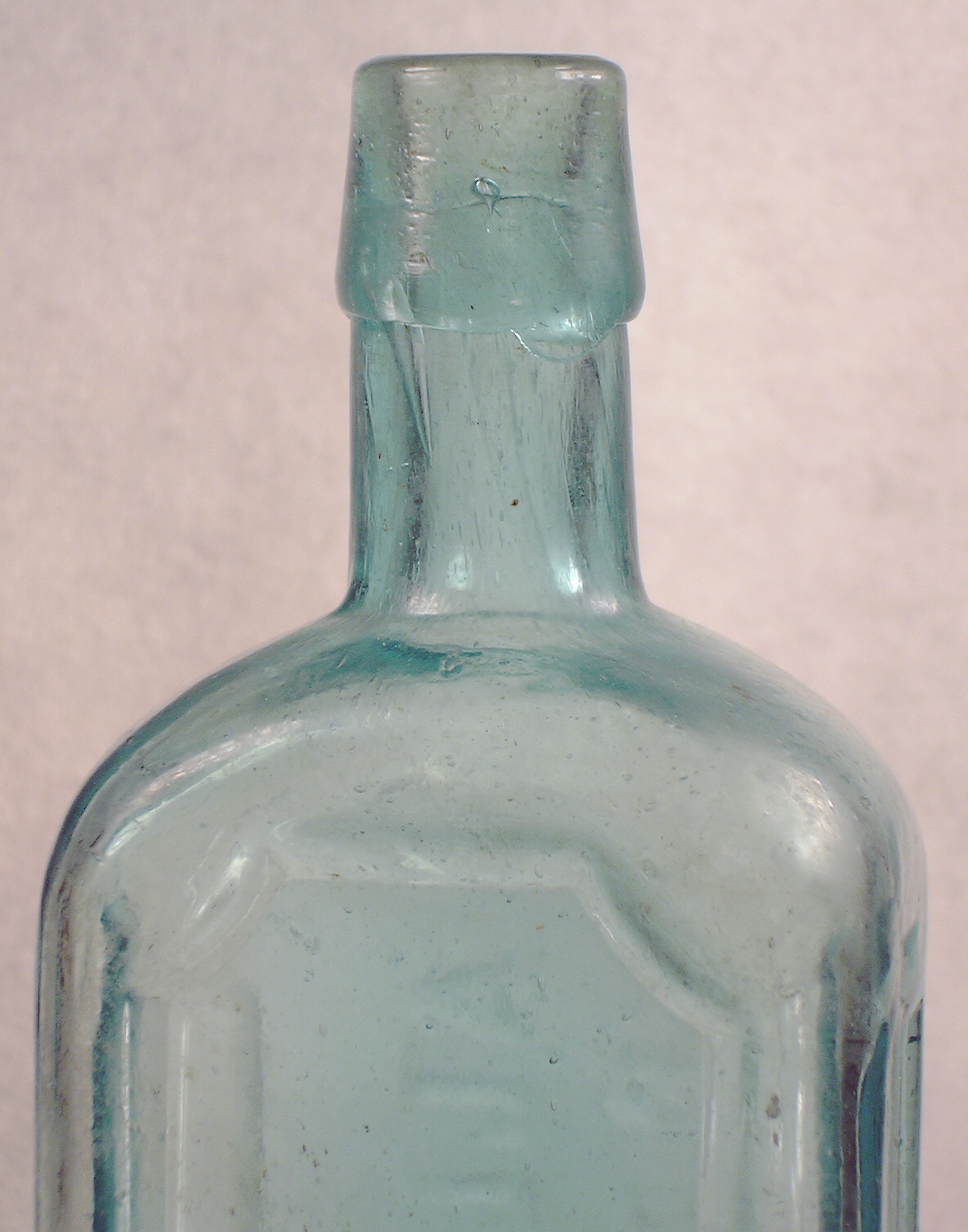
This offered bottle has the
dimensions listed above - 9 5/8" tall x 3.5" wide x 2 1/8". It has a
crudely applied and tooled lip/finish with some light visible physical evidence
just below the sloppy applied lip of the turning of the lipping tool. Kind
of cool and not usually seen on bottles. Click
view of the upper body, shoulder, neck
and finish to see such. The base has a fairly deep, oval indentation
with the side mold seams bending around the base edge to merge with that
indentation. Click base view
to see such. Interestingly, there is a couple peening marks visible on the
lower portion of the base indentation showing some type of maintenance (or ?)
work was done on the mold. The overall even haze is largely on the inside
with just a bit here and there on the outside. The bottle otherwise has no
post-manufacturing damage - no chips, cracks, dings, pot stones, etc. A
nice example of a bottle that is quite scarce but found on the West Coast prior
to the Transcontinental Railroad being completed. $195

 GLADSTONE'S
CELERY / AND PEPSIN COMPOUND -
MASTICO MEDICINE CO / DAMILLE, ILLS. -That is embossed on the
two narrower opposing sides in script-ish type lettering. The two long sides are not embossed
at all (label space); click
HERE to see the entire bottle from one of the plain sides.
GLADSTONE'S
CELERY / AND PEPSIN COMPOUND -
MASTICO MEDICINE CO / DAMILLE, ILLS. -That is embossed on the
two narrower opposing sides in script-ish type lettering. The two long sides are not embossed
at all (label space); click
HERE to see the entire bottle from one of the plain sides.
Looking at Google maps I find that Damille, IL....well, that it doesn't exist!
A check of Matt Knapp's massive book "Antique American Medicine Bottles" (2012)
lists 2 variants of the Gladstone's Compound bottle but both versions have
Danville, IL. not the apparently mythical "Damille" which is clearly what is
embossed on this bottle as there is a distinct "M" (not "N") and there is
distinctly no "V" present. The variant listed that is most like this offering also
has the company spelled "Maslico Medicine Co." not what is relatively clearly shown on this
bottle which is "Mastico Medicine Co." as the "t" in Gladstone on the
other side is identical to the "t" in Mastico. (The other variant of the
Gladstone's is identical to the other in the book but being sold by - and
embossed with - "The Raimer Heinly Co." also of Danville, IL.)
All things considered, the way many of the letters were rendered by the mold
engraver are just weird. So what gives?!
I've had this bottle for upwards of 50 years having found it
on a post-military jaunt around the West back in the 1974 right near the
Transcontinental Railroad grade in Cheyenne, WY. It was from a shallow
privy or trash pit that had no buildings near it, but must have had such back in
the day. I've not tried to search out any history on the bottle until now
nor even look to see if there ever was a Damille, IL. later changing the
name to something else. I could not find such so it
appears that this example is an engraving error mold which may have been "fixed"
in other molds. I've not seen any other examples of this bottle though
obviously they exists with the two variants noted in Knapp's book.
A quick check of Baldwin's "Patent and Proprietary Medicine
Bottles" book (1973) has it listed but just the "Gladstone's..." embossing side
noted, not the other company & city side. He did note finding an ad for the product in the
Mobile, AL. Daily Register in 1896 noting it was "For sale in all
bars." Hummm...apparently the product had some alcohol, eh? And finally, Richard Fike's
(1987) book on medicines has it listed correctly with the "Mastico Medicine Co."
embossing but with Danville and not Damille.
In any event, the bottle is essentially mint condition with
just a bit of sediment or light staining in one corner of the shoulder on the
inside. The outside is bright and shiny. The bottle stands 7.25"
tall, has a hand tooled "brandy" lip/finish (click
close-up of the shoulder, neck
and lip to see such) and nothing embossed on the base which has a
rectangular indentation in the middle. The bottle looks to date from the
1890s (consistent with the noted ad) into the early 1900's.
Possibly a very rare variant with the misspelled town of origin for your celery
or general collection. $65


 ESS OF JAMAICA / GINGER -
This is a nice "ball neck panel" bottle typically used for flavoring extracts
though also commonly used for patent medicines. In this case, a "medicine"
with a typical alcohol level of 90% (or more)! It is embossed on the large
front panel (all sides are indented panels) from top to bottom (like 95%+ of all
vertically embossed bottles) with ESS OF JAMAICA / GINGER, on
the right side panel with PHILADA PA
and JOHN C. HURST on the left. (The back label panel is
unembossed.)
ESS OF JAMAICA / GINGER -
This is a nice "ball neck panel" bottle typically used for flavoring extracts
though also commonly used for patent medicines. In this case, a "medicine"
with a typical alcohol level of 90% (or more)! It is embossed on the large
front panel (all sides are indented panels) from top to bottom (like 95%+ of all
vertically embossed bottles) with ESS OF JAMAICA / GINGER, on
the right side panel with PHILADA PA
and JOHN C. HURST on the left. (The back label panel is
unembossed.)
I have been paying more attention to Jamaica
Ginger (called "Jake's" by collectors) bottles of recent as they are a
fascinated group which utilized a wide array of small bottles across the U.S.
The classic shape for the product is like the Western example at the following
link on my educational website:
https://secure-sha.org/bottle/Typing/medicine/folgerjake.jpg
As an example offered below shows (shoo-fly flask) the product was bottled in
all kinds of different, though virtually always small, bottles.
Incidentally, John C. Hurst was also the producer of the Rising Sun Bitters
- a scarce square amber bitters from Philadelphia also. (Listed as
R-66 in Ring & Ham's bitters book.) I quick look at the internet indicated
that Mr. Hurst was a long time wholesale druggist in that city who died in 1891.
NOTE: For more information on Jamaica Ginger see
the following article by the late Dr. Munsey posted on my other website:
Munsey, Cecil.
2006. Paralysis in a Bottle (The “Jake Walk” Story).
Bottles and Extras 17(1):7-12 (Winter 2006). Very interesting article on
Jamaica Ginger and the bottles that held it. This
article is also available on this website at this link: https://secure-sha.org/bottle/pdffiles/JakeWalkStoryMunsey.pdf
This bottle is ~5.75" tall, a very nice blue aqua
as the images show, has an early tooled "patent" lip/finish and has a lot of
crudeness for its size - wavy uneven glass and bubbles. It has no evidence
of mold air venting and appears to have been blown in a post-base mold (hard to
say due to crudeness there) which all points to it being an 1870s production -
an early tooled lip bottle. Condition of this example is essentially
pristine mint with no staining, chips, cracks, potstone radiations (one small
potstone in the lower front panel) or other issues. There is the tiniest
bit of roughness at the heel on the back side which is associated with a bit of
a loose fit to the mold at that point; all in making. Nice and likely rare
"Jake"! $35

 JOYNER
/ UNITED DRUG CO. (in a shield) / TRADE MARK / SPOKANE / U.S.A. - This
is a scarce druggist bottle from Spokane, WA. that is quite rare with the
original label and string around the neck that probably had some tag attached at
some point. Click close-up of
the embossing to see such. This 7 3/8" tall (12 oz.) bottle from the
early 20th century has a tooled, unusual two-part lip or finish - what is called
the "reinforced extract" or "collared ring" depending on what reference is used.
It also has a large majority of the original label (see image) which notes that
it contained "Ideal Blood Mixture and Tonic" with an alcohol level of 20%; it
also notes all the maladies it would treat - from acne to "malarial poison."
The bottle is also embossed just above the label with "12 OZ.", has a smooth
base, clear or colorless glass and is in mint condition with no chips, cracks,
staining or other issues...reflecting it having never been buried. It does
have a bit of dirt inside which would certainly wash out easily, though I did
not since I didn't want to possibly disturb the label integrity. This
bottle was acquired for use in helping illustrate some concepts on the
Historic Bottle Website. Nice item with bold embossing and a
pretty nice original label. $25
JOYNER
/ UNITED DRUG CO. (in a shield) / TRADE MARK / SPOKANE / U.S.A. - This
is a scarce druggist bottle from Spokane, WA. that is quite rare with the
original label and string around the neck that probably had some tag attached at
some point. Click close-up of
the embossing to see such. This 7 3/8" tall (12 oz.) bottle from the
early 20th century has a tooled, unusual two-part lip or finish - what is called
the "reinforced extract" or "collared ring" depending on what reference is used.
It also has a large majority of the original label (see image) which notes that
it contained "Ideal Blood Mixture and Tonic" with an alcohol level of 20%; it
also notes all the maladies it would treat - from acne to "malarial poison."
The bottle is also embossed just above the label with "12 OZ.", has a smooth
base, clear or colorless glass and is in mint condition with no chips, cracks,
staining or other issues...reflecting it having never been buried. It does
have a bit of dirt inside which would certainly wash out easily, though I did
not since I didn't want to possibly disturb the label integrity. This
bottle was acquired for use in helping illustrate some concepts on the
Historic Bottle Website. Nice item with bold embossing and a
pretty nice original label. $25
 Sample
Dr. Morse's Indian Root Pills, and Comstock's Dead Shot Worm Pellets -
This is very neat sample "envelope" of the famous patent medicine product which
was first produced in the 1830s. This items appears to date from the late
19th century or early 20th and is sealed with the original "pills" and "pellets"
still included within! This item is like a small first class mail envelope
except that it is only 3.2" by 2" in size. Still fully sealed - never
opened - and in great condition as it still has a crisp and solid feeling with
only some mild soiling and a tiny (2 mm) tear on the top (above the "P" in
SAMPLE). Dr. Morse's Pills was bottled in a small pill bottle; the company
history and bottle is outlined in one of Dr. Cannon's great articles from
AB&GC Magazine (on the Glass Works Auctions site) at this link:
http://www.glswrk-auction.com/073.htm Great go-with for the medicine
bottle collector...or just bottle collectors in general. $15
Sample
Dr. Morse's Indian Root Pills, and Comstock's Dead Shot Worm Pellets -
This is very neat sample "envelope" of the famous patent medicine product which
was first produced in the 1830s. This items appears to date from the late
19th century or early 20th and is sealed with the original "pills" and "pellets"
still included within! This item is like a small first class mail envelope
except that it is only 3.2" by 2" in size. Still fully sealed - never
opened - and in great condition as it still has a crisp and solid feeling with
only some mild soiling and a tiny (2 mm) tear on the top (above the "P" in
SAMPLE). Dr. Morse's Pills was bottled in a small pill bottle; the company
history and bottle is outlined in one of Dr. Cannon's great articles from
AB&GC Magazine (on the Glass Works Auctions site) at this link:
http://www.glswrk-auction.com/073.htm Great go-with for the medicine
bottle collector...or just bottle collectors in general. $15

 DR.
MORSE'S INDIAN ROOT PILLS advertising Confederate Currency - Here is
another medicine go-with and again for Dr. Morse's Indian Root Pills.
This is a "FAC-SIMILE" (sez so on the front!) of a Confederate $20 bill
that was given out as an advertising flier for the famous patent medicine in the
late 1800s or very early 1900s. (Not sure why the company felt compelled
to say "Fac-simile" since CSA currency was of no value for many decades
already?) The advertising part on the reverse notes
it was a "...specific cure for most of the Blood, Stomach and Liver Diseases."
The pills were also for "...Giddiness, Headache and are most useful for
female disorders." No comment on the latter claims; click on the
images above to see much larger, better quality scans of this fake Confederate
bank note that measures 7" by 3". This IS the real thing and not a modern
reproduction (which I've never seen anyway). I picked this up - actually
two examples - in a lot of weird bank or bank-like notes at a numismatic auction
decades ago when I had a bout of coin and paper money collecting. This
item is essentially pristine with no stains, rips, or other issues...just a
couple very faint creases which can't even be seen in the scans. A
fantastic and certainly rare go-with quack medicine item that is in fantastic
shape. $20
DR.
MORSE'S INDIAN ROOT PILLS advertising Confederate Currency - Here is
another medicine go-with and again for Dr. Morse's Indian Root Pills.
This is a "FAC-SIMILE" (sez so on the front!) of a Confederate $20 bill
that was given out as an advertising flier for the famous patent medicine in the
late 1800s or very early 1900s. (Not sure why the company felt compelled
to say "Fac-simile" since CSA currency was of no value for many decades
already?) The advertising part on the reverse notes
it was a "...specific cure for most of the Blood, Stomach and Liver Diseases."
The pills were also for "...Giddiness, Headache and are most useful for
female disorders." No comment on the latter claims; click on the
images above to see much larger, better quality scans of this fake Confederate
bank note that measures 7" by 3". This IS the real thing and not a modern
reproduction (which I've never seen anyway). I picked this up - actually
two examples - in a lot of weird bank or bank-like notes at a numismatic auction
decades ago when I had a bout of coin and paper money collecting. This
item is essentially pristine with no stains, rips, or other issues...just a
couple very faint creases which can't even be seen in the scans. A
fantastic and certainly rare go-with quack medicine item that is in fantastic
shape. $20
 JOYS
- SARSAPARILLA - THE / EDWIN W. JOY CO. / SAN
FRANCISCO - I sold one of these some time back, but found another in a box
I didn't know I had. The embossing is scattered on three sides of this
rectangular medicine bottle from California; the remaining (back) side is a
typical plain, indented label panel. Actually, all of the sides are indented
and the embossing is bold and distinct - sometimes these are not that boldly
embossed in my experience. This is also a very nice example in a "Western" bluish aqua,
tooled single collar ("patent" finish), smooth slightly indented base, almost 9"
tall, ca. 1880s to 1890s. A scarce sarsaparilla from the West which didn't
produce very many embossed sarsaparilla bottles it seems...and most of those are
quite rare.
JOYS
- SARSAPARILLA - THE / EDWIN W. JOY CO. / SAN
FRANCISCO - I sold one of these some time back, but found another in a box
I didn't know I had. The embossing is scattered on three sides of this
rectangular medicine bottle from California; the remaining (back) side is a
typical plain, indented label panel. Actually, all of the sides are indented
and the embossing is bold and distinct - sometimes these are not that boldly
embossed in my experience. This is also a very nice example in a "Western" bluish aqua,
tooled single collar ("patent" finish), smooth slightly indented base, almost 9"
tall, ca. 1880s to 1890s. A scarce sarsaparilla from the West which didn't
produce very many embossed sarsaparilla bottles it seems...and most of those are
quite rare.
Condition is near
mint with no chips, cracks, overt staining or other post-production damage besides a
tiny "flea bite" on the middle of the outside edge of the back, unembossed
panel and a little bit of very faint haze inside primarily in the lower back and
one side panel; the outside is virtually spotless. This example also has some body crudeness and bubbles in the glass adding to its
visual appeal. It is what I would call "about mint" and is also a very
nice example - at least as good as the sold one. $50
NOTE: I also have another example that is
identical - a nice blue aqua (just a tiny bit less blue than the example to the
right) - but is full of hundreds of seed bottles and has nice rude, wavy glass,
stretch marks in the glass, and is a very nice example. It is also in
essentially mint condition but does have a couple small almost invisible
"flashes" at the edge of the base; pictures on request if desired. A
beautiful example and priced accordingly given the small flashes. $30
 NASH'S / RHEUMATIC AND / KIDNEY REMEDY
- This is a cute little (3 3/8") amber medicine bottle which is from the
S. Nash & Co., Detroit, MI. according to Matt Knapp's massive 2012 book
"Antique American Medicine Bottles." One of the easiest ways to get your
own embossed "proprietary" bottle was to order a plate (aka "slug plate") from a
glass company engraved with what you wanted embossed on the bottle. It was
then inserted into an existing mold and viola! You've got your own custom
made bottle. (Ordering custom, non-plate molds was many times the price of
just having a plate made up.)
NASH'S / RHEUMATIC AND / KIDNEY REMEDY
- This is a cute little (3 3/8") amber medicine bottle which is from the
S. Nash & Co., Detroit, MI. according to Matt Knapp's massive 2012 book
"Antique American Medicine Bottles." One of the easiest ways to get your
own embossed "proprietary" bottle was to order a plate (aka "slug plate") from a
glass company engraved with what you wanted embossed on the bottle. It was
then inserted into an existing mold and viola! You've got your own custom
made bottle. (Ordering custom, non-plate molds was many times the price of
just having a plate made up.)
An example of the above is this bottle which is
embossed on the base (W. T. CO. / S / U. S. A.) with the makers
marking for the Whitall, Tatum & Co. This NJ company had to be the top
producer of various druggist/apothecary bottles in the U.S. from the late 1870s
until the early the 1920s. According to their 1880 catalog, the plates
cost "One dollar and fifty cents to six dollars each for engraving"
along with a list of all the druggist style bottles they had plate "moulds" for
including the "Philadelphia Oval" which is what the offered bottle style is.
According to our article on the company (on my other educational website at the
following link:
https://secure-sha.org/bottle/pdffiles/WhitallTatum1.pdf ) the noted base marking
was used from about 1890 to 1901 dating this bottle pretty tightly.
The bottle itself is the previously noted height
and nice bright medium golden amber color, has a typical tooled "prescription"
style finish or lip, and the noted embossing on the indented oval base.
Condition is essentially mint with a light scratch on the back, just the faintest dullness on the body in a
few places (essentially invisible) and an equally invisible small (1-2mm)
roughness to the edge of the lip...not chipped but just a miniscule bit of
roughness that can be felt. Nice example of what is likely a scarce
medicine bottle. Knapp's book also notes that the likely preceding bottle
(same height and color) was embossed with "CURE" instead of "REMEDY." Different
plate for different times I guess. $20

 MOXIE / NERVE FOOD / LOWELL / MASS / PATENTED
- This is a large (about a quart), thick glass, early version of the product that
injected the word "moxie" into the American vernacular meaning "force of
character, determination or nerve." Perfectly fits with it's origin being
touted as a "nerve tonic." On the online Merriam-Webster dictionary - in
the "Did You Know" section - one finds the following:
MOXIE / NERVE FOOD / LOWELL / MASS / PATENTED
- This is a large (about a quart), thick glass, early version of the product that
injected the word "moxie" into the American vernacular meaning "force of
character, determination or nerve." Perfectly fits with it's origin being
touted as a "nerve tonic." On the online Merriam-Webster dictionary - in
the "Did You Know" section - one finds the following:
Hot roasted peanuts! Fresh popcorn! Ice-cold Moxie!" You might have
heard such a snack vendor's cry at a baseball game—if you attended it in the
early 1900s. In its heyday, some claim that the soft drink named Moxie outsold
Coca-Cola. The beverage was a favorite of American writer E. B. White, who
wrote, "Moxie contains gentian root,
which is the path to the good life. This was known in the second century before
Christ and is a boon to me today." In quick time, moxie had
become a slang term for nerve and verve, perhaps because some people thought the
drink was a tonic that could cure virtually any ill and bring vim back to even
the most lethargic individual. (Verbiage courtesy of the
following website:
https://www.merriam-webster.com/dictionary/moxie )
As noted, this is one of the earliest examples of the bottle
used for the product which began life as a carbonated patent medicine! In
later years (1910s and later) it morphed into purely a carbonated soda (without medicinal claims)
that is reportedly still sold in New England, where it first began. A
history of the company was recently made available on my
Historic Glass
Bottle Identification & Information Website thanks to an
article written late last year by Bill Lockhart and Bob Brown (members of our
Bottle Research Group). It is directly available by clicking on the following
link which is the title of the article -
Moxie
Nerve Food - Bottles and History. This particular example is
actually illustrated in the article (Fig. 13, right bottle) which is believed to
be the second type bottle used by the company during the 1880s or early 1890s. The
product was first prepared and sold in 1884 in heavy glass champagne style
bottles (label only) which could also withstand highly carbonated products.
Champagne bottles were also
used for beer during that era. See the article for the full and
entertaining story of the product and its bottles.
This example is just under 10" tall, a bit over 3" in
diameter, made of very heavy bluish aqua glass (the bottle weighs 1.5 lbs.), and
has a sloppy applied bead or ring type lip/finish. Click
view of the shoulder, neck and
finish to see such. The base is indented somewhat with three embossed
dots forming a triangle or sorts; meaning unknown. Click
base view to see such.
The bottle is whittled throughout the body with some stretch marks in the
neck. It has no chips, cracks, potstone bruises or other dings but does
have some dullness (see images) and moderate
scratching and scuffing to the outside here and there which is variably noticeable.
It seems like the bottle may have been reused for either more "Moxie" or other
use? It is not pristine having been dug in Portland, OR.
about 50 years ago but it display pretty well. I scarce early Moxie bottle with some great history.
$45

 THREE
MILK GLASS LOTION/SKIN "CURE" BOTTLES
- Here are three pretty nice milk glass "skin
medicine" bottles that likely came in lotion form. Two are different mold
varieties of the HAGEN'S / MAGNOLIA / BALM (individual images
of both HERE and
HERE). The other is embossed
with G. W. LAIRD / PERFUMERS / NEW YORK; click
HERE to see a close-up of this
bottle.
THREE
MILK GLASS LOTION/SKIN "CURE" BOTTLES
- Here are three pretty nice milk glass "skin
medicine" bottles that likely came in lotion form. Two are different mold
varieties of the HAGEN'S / MAGNOLIA / BALM (individual images
of both HERE and
HERE). The other is embossed
with G. W. LAIRD / PERFUMERS / NEW YORK; click
HERE to see a close-up of this
bottle.
Hagan's Magnolia Balm held a skin cream for "Beautifying
the Complexion, Eradicating Freckles, Eruptions, Sunburn and Tan" (Fike
1987). Early sunscreen? The Balm was first produced prior to the Civil War
and made until well into the 20th century by several different New York
companies during it's long tenure. Bottles are about 5" tall, rectangular with
beveled corners, what appear to be somewhat crude applied "patent" finishes/lips, and smooth (not
pontiled) bases with no embossing.
Laird's
was advertised as early as 1864 and as late as 1915 according to Richards Fike's book. What it contained is not noted but certainly some product similar to the
Hagan's since all of these bottles were found together decades ago in Oregon.
The Laird's bottle is a bit over 4.5" tall, has a tooled and fairly
flat "patent" finish, and a similar body conformation as the Hagan's except a
bit wider and not as deep (see base images above.) Click
HERE for another view of all
three bottles showing both the bases and the side embossing.
Condition of both Hagan's is very good
with some largely invisible iridescence to the outside surface (because of the
milk glass). Both have very tiny, less than a pin prick nick on the back
edge of the lip; no chips, cracks or other issues. Both likely date from
the late 1870s or 1880s as they exhibit no air venting markings. As the images
show one has very bold embossing (to the right in image to right); the other has
flattened embossing which is quite readable and a bit of grey-ish stain (?)
highlighting to some of the letters (possibly from contact with something in the
ground?). Click on the links to the individual bottles earlier in this
listing. Condition of the Laird's is also very good with no chips
or cracks - just some of that almost invisible iridescence from being buried for
a century or so. All of the bottles have a few of the commonly seen - on
most milk glass bottles - stress lines on the top surface of the lip.
Don't know why that occurs but it is ubiquitous to most all such bottles made of
milk glass. Nice set for beginning or rounding out a milk glass bottle
collection. $45

 PAINES - CELERY COMPOUND with complete labels!
- This is a great and rare example of a common bottle. This example
has both labels still present - the front one is 95+% complete and the rear one
essentially 100% complete. To top it off the bottle is a beautiful light
to medium golden amber, has various bubbles in the glass, and it has a true
applied "brandy" style finish (aka "lip") with a bit of slopover. Having
never been buried the bottle has no staining inside or out and is in perfect
mint condition. Click on the images to the right to view larger versions
of those pics.
PAINES - CELERY COMPOUND with complete labels!
- This is a great and rare example of a common bottle. This example
has both labels still present - the front one is 95+% complete and the rear one
essentially 100% complete. To top it off the bottle is a beautiful light
to medium golden amber, has various bubbles in the glass, and it has a true
applied "brandy" style finish (aka "lip") with a bit of slopover. Having
never been buried the bottle has no staining inside or out and is in perfect
mint condition. Click on the images to the right to view larger versions
of those pics.
Click the following links to see additional
images of the bottle: PAINES
embossing side; CELERY COMPOUND
embossing side; close-up of the
upper body, shoulder, neck and applied finish.
According to Richard Fike's great (1987) book on
medicine bottles, the product was first introduced in 1882 and made at least
into the 1920s. It was a popular patent medicine for a wide variety of
different ills. This early (mid to late 1880s) example has labeling (image
to the immediate right) which notes that the product "Restores Strength,
Renews Vitality, Purifies the Blood, Regulates the Kidneys, Liver and Bowels"
- all for a dollar a bottle! As fine an example as one can get of this bottle.
$25


 LYON'S
- KATHAIRON - FOR / THE / HAIR - NEW YORK - All sides of this hair
restorer bottle are embossed which makes one wonder where they put the
label...or if it even was labeled? I guess the product was more of a
medicine for the hair than just hair tonic. See
HERE to
see an image of the nice historical write-up from John Odell's great book "Digger
Odell's Pontil Medicine Encyclopedia" (2000:153). Lyons - full
name Emanuel Thomas Lyons - and the company's he either owned or worked for (see
the write-up above) also produced Lyons Magnetic Powders (insect
poison) which came in little bottles made in an array of colors from puce to
amethyst to amber and shades of green. He/they also produced Lyon's
Extract of Pure Jamaica Ginger, Lyons Indian Hair Dye (did Native
Americans dye their hair?) and likely other products. Click
KATHAIRON side panel view
to see such; click NEW YORK
side panel view to see that narrow side panel.
LYON'S
- KATHAIRON - FOR / THE / HAIR - NEW YORK - All sides of this hair
restorer bottle are embossed which makes one wonder where they put the
label...or if it even was labeled? I guess the product was more of a
medicine for the hair than just hair tonic. See
HERE to
see an image of the nice historical write-up from John Odell's great book "Digger
Odell's Pontil Medicine Encyclopedia" (2000:153). Lyons - full
name Emanuel Thomas Lyons - and the company's he either owned or worked for (see
the write-up above) also produced Lyons Magnetic Powders (insect
poison) which came in little bottles made in an array of colors from puce to
amethyst to amber and shades of green. He/they also produced Lyon's
Extract of Pure Jamaica Ginger, Lyons Indian Hair Dye (did Native
Americans dye their hair?) and likely other products. Click
KATHAIRON side panel view
to see such; click NEW YORK
side panel view to see that narrow side panel.
This bottle is 6" tall, has a crudely applied "double ring"
lip or finish (click view of upper
body/shoulder, neck and finish to see such), was blown in a true two-piece
mold and has an very sharp and distinct blowpipe type pontil scar...one of the
finest examples of such I've ever had. Click on the base view image to the
immediate right to see a larger version showing the thick and distinct mold seam
evenly dissecting the base (from upper left to lower right) as well as the great
tubular pontil scar. This conformation of a pontil scar indicates the use
of another similar sized blowpipe which was tipped on one end with a bit of
molten glass from the glory hole and fused onto the base to hold the bottle from
that end. Then the blowing blowpipe was cracked off, a small amount of
additional glass applied to the cracking off point on the neck and received tool
finishing to complete the lip/finish. The pontil marking does protrude a
bit from the base of the bottle so it tips slightly standing up but easily
stands on its own.
Condition of the bottle is essentially mint. I believe
the bottle may have been professionally cleaned ("tumbled") leaving only a bit
of very light staining in the middle of the neck and some even fainter haze in
some of the corners - all really only visible holding it to a bright light.
The rest of the bottle is sparkling clean with some nicely wavy blue aqua glass
and an overall crudeness that was typical of bottles made in the 1850s which
this bottle dates to. The bottle has no damage - no chips, cracks, dings,
etc. - although there are few sand grain sized unmelted "pot stones" in the
glass though none have any radiations. Great "hair" bottle for anyone's
collection! $75


 STEWART
D. HOWE'S - ARABIAN / TONIC / BLOOD PURIFIER - NEW YORK - These Arabian
Tonic bottles have always been a favorite of mine - have had several through the
years - in that they are big in size, nicely embossed, a bit earlier in age
(1870s), and have a great name! This bottle is 9.5" tall, 3.25" wide and
about 2" thick. It also has an applied "patent" finish, blown in a
post-mold (smooth base), lacks any mold air venting, and as noted likely dates
from the 1870s (possibly late 1860s or very early 1880s) era I would estimate
from the manufacturing characteristics.
STEWART
D. HOWE'S - ARABIAN / TONIC / BLOOD PURIFIER - NEW YORK - These Arabian
Tonic bottles have always been a favorite of mine - have had several through the
years - in that they are big in size, nicely embossed, a bit earlier in age
(1870s), and have a great name! This bottle is 9.5" tall, 3.25" wide and
about 2" thick. It also has an applied "patent" finish, blown in a
post-mold (smooth base), lacks any mold air venting, and as noted likely dates
from the 1870s (possibly late 1860s or very early 1880s) era I would estimate
from the manufacturing characteristics.
This example is boldly embossed and is
essentially mint with just a bit of content haze in the upper front shoulder
that takes a bright light to see. It also has some nice bubbles in the
glass, a pleasant blue aqua color, stretch marks on in the neck, and a bit of
slop over below the lip. I don't believe it has every been buried and
certainly not professionally cleaned. One of the bigger, better, and
fairly scarce "medicinal tonic" bottles! $45


 RATTLESNAKE BILL'S LINIMENT -
GENUINE
DIAMOND BACK RATTLESNAKE FAT - Here is a relatively late "quack" medicine...or
at least I don't think that rattlesnake fat would treat any ailment?!
It notes it was good for "RHEUMATIC PAINS, PAINS IN THE BACK, STRAINS,
SPRAINS, BRUISES, SORE ACHING FEET, STILL JOINTS, SORE MUSCLES." It
also notes it can also treat the following: "Throat Irritation, Nasal
Irritation, Headache, Earache, Toothache, Corns, Callouses (sic). It
then notes that it is FOR EXTERNAL USE ONLY. I guess one wouldn't
stick it up their nose, but instead rub it on and "viola"...cured of that
particular problem from the outside. There is a bit more crammed into the
verbiage on the label; see the larger versions of the images to the left by
clicking on them. It has no body embossing but some on the base noted
below.
RATTLESNAKE BILL'S LINIMENT -
GENUINE
DIAMOND BACK RATTLESNAKE FAT - Here is a relatively late "quack" medicine...or
at least I don't think that rattlesnake fat would treat any ailment?!
It notes it was good for "RHEUMATIC PAINS, PAINS IN THE BACK, STRAINS,
SPRAINS, BRUISES, SORE ACHING FEET, STILL JOINTS, SORE MUSCLES." It
also notes it can also treat the following: "Throat Irritation, Nasal
Irritation, Headache, Earache, Toothache, Corns, Callouses (sic). It
then notes that it is FOR EXTERNAL USE ONLY. I guess one wouldn't
stick it up their nose, but instead rub it on and "viola"...cured of that
particular problem from the outside. There is a bit more crammed into the
verbiage on the label; see the larger versions of the images to the left by
clicking on them. It has no body embossing but some on the base noted
below.
The product was made by the FRANK MEDICINE COMPANY -
Belleville, New Jersey. I know nothing about the company. Since
there are Western and Eastern diamond back's I assume that it was made with the
Eastern version which ranges from the the Carolina's to Florida and west to
about Louisiana. The Western subspecies is way out West - really the
Southwest - ranging from Texas across New Mexico and Arizona to southern
California.
The base of the bottle - which is machine-made - has the
"diamond O I" makers marking for the Owen's Illinois Glass Company.
See and enlarge the base image to the immediate left. It shows that the
bottle was made in 1936 (6 to the right of the makers mark) at their plant #12
(number to the left of the mark). That is the assigned number for the Gas
City, Indiana plant which used that number from 1929 (formation of O-I from a
couple of other companies) to 1982. This bottle, however, certainly dates
from the 1930's given the details of the marking. There is also a "4."
below the makers marking which is likely a mold or machine cavity designation.
(If interested in the history of that glass company see the two part article
available on my Historic Glass Bottle ID & Information Website
at the following links:
https://secure-sha.org/bottle/pdffiles/OwensIllinois2018Part1.pdf &
https://secure-sha.org/bottle/pdffiles/OwensIllinois2018Part2.pdf
This bottle was obviously never buried as the label is 99%+
intact and completely readable. It is almost 5.5" tall and a bit under 1"
in diameter. A bit of the original cork is stuck inside the bore (lip or
neck) of the bottle. It is also perfect and machine blown from a selenium
decolorized batch of glass (common at this period) that will not turn amethyst.
Interesting bottle that I picked up somewhere I don't remember though years ago.
Got it because it has my first name on the label. Time to pass it on.
$35

 S.S.S. - Swift Specific Company, Atlanta, Georgia
-
SSS "Blood Medicine"
- This is a body unembossed, label only, early machine-made proprietary medicine
from the 1920s. It contained the blood medicine produced by the Swift
Specific Company (Atlanta, GA.). This company earlier produced
Swift's Syphilitic Specific - which was bottled in a large cobalt
blue bottle (image courtesy of Glass Works Auctions) - in the 1870s and 1880s
to treat that malady noted in the name. It was the
origin of this later (more genteel) product name of simply S.S.S. with
the original meaning of the middle "S" being strangely not mentioned (ha!). Amazingly,
SSS is still being produced and marketed by Wal-Mart today...or at least
up to just a few years ago! That certainly indicates that the company
managed many "go-arounds" for at least 125 years in order to meet the ever
restrictive regulatory environment for such medicines...and that the product
continued to be popular with customers!?
S.S.S. - Swift Specific Company, Atlanta, Georgia
-
SSS "Blood Medicine"
- This is a body unembossed, label only, early machine-made proprietary medicine
from the 1920s. It contained the blood medicine produced by the Swift
Specific Company (Atlanta, GA.). This company earlier produced
Swift's Syphilitic Specific - which was bottled in a large cobalt
blue bottle (image courtesy of Glass Works Auctions) - in the 1870s and 1880s
to treat that malady noted in the name. It was the
origin of this later (more genteel) product name of simply S.S.S. with
the original meaning of the middle "S" being strangely not mentioned (ha!). Amazingly,
SSS is still being produced and marketed by Wal-Mart today...or at least
up to just a few years ago! That certainly indicates that the company
managed many "go-arounds" for at least 125 years in order to meet the ever
restrictive regulatory environment for such medicines...and that the product
continued to be popular with customers!?
The label notes that it "Contains 12% Alcohol"
as well as the notation about the contents - "A Vegetable Compound which we
recommend as a general Alterative Tonic and in the treatment of such forms of
Rheumatism and Skin Diseases as arise from an impoverished condition of the
Blood." (In a word - syphilis.) The base is embossed with "CHATT.
CO." - which indicates the bottle was made by the Chattanooga Glass
Co. (Tennessee) which used the marking from 1918 to 1934. See the
article at the following link for the full story:
https://secure-sha.org/bottle/pdffiles/ChattanoogaGlass.pdf (This
actual bottle is the one on page 237 of that article used to illustrate that
marking!)
This bottle with the cork closure lip (cork still present als0)
likely dates from the first half of that period, i.e., 1918 to mid-1920s.
It has about 99% of the label intact and easily readable as the image indicates;
click to view a larger version of the image. It is of a nice yellow amber
color, 7.3" tall, and what I would call a "strap side oval" style of bottle.
The bottle itself is mint as one would expect as it was never buried.
Great historical item from a company that originally advertised it product via
an cast iron "witches kettle" that was embossed with S. S. S. FOR THE
BLOOD (image of one of those pots
HERE). I remember seeing years ago the trade mark for the product
which included the witches around the pot mixing up a batch. Cool history!
$20
...MORE TO COME IN THE FUTURE!

Click on the following links to go to these other
pages with more bottles for sale.
Listed prices do not
include shipping & insurance. Please read the
Important Information for Buyers section on the main "Bottles For Sale" page for
complete buyer information.
Please confirm item
availability prior to sending any type payment and include your zip code in your
message so that the shipping can be calculated.
Click here to return to the
main Bottles For Sale Page menu

My email is -
© Copyright 2026
Page Last Updated: 9/5/2026
v
w v w v w v w v w v

 DR
GUYSOTT'S - YELLOW DOCK / & / SARSAPARILLA - B. & P. NEW YORK
DR
GUYSOTT'S - YELLOW DOCK / & / SARSAPARILLA - B. & P. NEW YORK


 ESS OF JAMAICA / GINGER

 Sample
Dr. Morse's Indian Root Pills, and Comstock's Dead Shot Worm Pellets
Sample
Dr. Morse's Indian Root Pills, and Comstock's Dead Shot Worm Pellets
 DR.
MORSE'S INDIAN ROOT PILLS advertising Confederate Currency
DR.
MORSE'S INDIAN ROOT PILLS advertising Confederate Currency


 STEWART
D. HOWE'S - ARABIAN / TONIC / BLOOD PURIFIER - NEW YORK
STEWART
D. HOWE'S - ARABIAN / TONIC / BLOOD PURIFIER - NEW YORK


